



Without a well-developed feedback culture, employees cannot develop either. Feedback helps them grow and improves their performance, with development taking place at both the individual and organizational levels. However, creating a feedback culture at work is not easy.
Building a corporate culture in which everyone feels comfortable both giving and receiving feedback can be quite challenging. This is especially true if you want these feedback cycles to support continuous performance management and continuous employee evaluation (and you really do want that, as we explain below).
Introducing this element into your company’s organizational culture can be difficult, particularly if you or your team members do not understand which feedback models to use. But if you invest the effort required to build a feedback culture, you will certainly reap the benefits. Feedback will support your team’s development and enable its members to achieve outstanding results.
The importance of a feedback culture in a company
You are not perfect. Neither are your colleagues. Nor, for that matter, is your manager. We all make mistakes from time to time, and that is normal. What matters is that we learn from our mistakes, giving us the opportunity to grow and improve. That is how effective feedback works. But there is more to it than that.
Here are the five most significant benefits of building a feedback culture in your company.
1. Cost savings
Let us begin with the most significant benefit. A feedback culture can save your company money. But how?
Let us look at the statistics:
- According to an Officevibe study, companies that provide regular feedback have 14.9% lower employee turnover than companies without an established feedback process.
- According to research by Robert Half Talent Solutions, 66% of employees are likely to leave if they do not feel appreciated. The figure is even higher among millennials, at 76%.
- In a survey conducted by Globoforce and SHRM, 89% of the HR leaders surveyed reported that continuous peer feedback and brief check-in meetings have a positive impact on the company.
Our analysis shows that employees place great value on feedback because it helps them feel appreciated. This increases their satisfaction and reduces employee turnover.
As a result, all of this can have a substantial effect on your organization’s financial position. High employee turnover places a significant financial burden on a business because you must invest in attracting and hiring new employees. Existing estimates suggest that each departure costs a company one-third of that employee’s annual salary.
2. Improved performance
When you give someone feedback, your goal is not to reprimand or belittle them. On the contrary, it is to praise them for good work or explain how something could have been done better. In either case, the objective is the same: to help employees perform at their best.
In a culture of active feedback, employees are continually encouraged to reflect on their work. This motivates them to learn, improve, and grow.
In this way, feedback helps foster a growth mindset. The idea is that people with a growth mindset see mistakes not as shameful failures, but as opportunities to develop.
When everything is organized properly (see below for details), employees will view feedback not as something negative, but as an opportunity for growth. This will improve their performance and help your business develop.
3. More open communication
A lack of open, trusting communication harms the working environment. Employees need to know that they can express their opinions freely or speak up when they disagree with something.
Otherwise, they have to suppress their feelings, creating a corporate culture characterized by dishonesty and secrecy. This demoralizes employees and reduces their performance. It also means fewer people will regard the company as a great place to work, negatively affecting its ability to attract highly qualified professionals. A toxic working environment can destroy your business.
A feedback culture promotes open, trusting communication: employees are not afraid to express their views and know that they will be heard. This increases transparency and helps establish healthy, mutually beneficial relationships within the team.
4. Better working relationships
Open communication, in turn, strengthens working relationships. If employees know that you encourage candor and honest feedback, they will feel comfortable expressing their opinions freely. This will have a positive effect on more than just their work.
A properly established feedback culture will help them feel more comfortable and at ease. They will not have to pretend to be someone else at work. When everyone feels comfortable enough to be themselves, working relationships become deeper, more genuine, and more trusting.
5. A wealth of data
Just imagine how much data you can collect if everyone continually thinks about how to improve their performance and openly shares those insights.
In more traditional companies, feedback is generally collected once or twice a year during performance reviews. However, such reviews can cover only a limited range of topics. You are also likely to overlook half of the events that occur between them.
But if your company has a culture of continuous feedback, your team can collect data throughout the year rather than only at specific times.

Free guide
How to implement a feedback culture: a step-by-step plan and templates
How to create a feedback culture
1. Introduce new employees to the feedback culture from the outset
It is much easier to develop a new habit than to change an old one. This is especially true for people who are just beginning their careers at your company.
A new employee joining your team enters a new working environment with its own practices, processes, and standards of behavior, all of which differ from what they encountered previously. Although a new hire will have certain preferences and an established working style, they will still need to adapt and make some changes to their behavior.
The earlier you explain your company’s practices during onboarding, the easier it will be for new employees to understand and absorb this information. That is why we try to introduce them to our guidelines as early as possible, including our Slack communication and meeting guidelines.
The same applies to the feedback culture. The earlier you explain that your company welcomes open and honest feedback, the easier it will be for them to become accustomed to giving feedback and speaking candidly.
That is why we discuss feedback from the very beginning when hiring an employee. During the two-week onboarding process, we explain that we would like their feedback when it ends and will therefore ask them to complete a survey.
This teaches openness and transparency from the first day. We ask them to respond in as much detail as possible, regardless of whether their feedback is negative or constructive. This helps us improve the onboarding process. It also gives new employees confidence because they understand that the company values their opinions and honest feedback.
2. Create a safe environment
Helping your team members understand the importance of feedback is one thing. Creating an environment in which they feel comfortable providing it is quite another.
People often become nervous when the subject of feedback arises. After all, it highlights something that someone did incorrectly, and that could lead to dismissal. Is that not the case?
Feedback should be viewed very differently. Nobody is perfect, and feedback exists to help people grow and develop. If someone gives you feedback, it is not because they think you should be dismissed. Your colleague wants to help you improve your performance.
To overcome these misconceptions, the company must create an environment in which feedback can be provided safely.
This requires continually informing employees about the company’s anti-retaliation policy. Explain that the purpose of feedback is development, not dismissal, and that constructive criticism and feedback will not result in any negative consequences.
Once employees understand that they can express their opinions freely, the feedback culture will begin to develop rapidly.
3. Start small
Even when employees know they can speak openly, they will probably need some time to become accustomed to doing so. Start small and do not rush the process.
You cannot create a feedback culture overnight. Everyone will need to invest time and effort to adopt the right mindset and develop the habits required to build a mature feedback culture.
So postpone public recognition for the time being and begin with small expressions of praise in one-on-one conversations. Before moving on to detailed constructive criticism, give the employee positive feedback several times.
When building a feedback culture, it is important to remember that this is a process that should improve over time.
4. Lead by example
Employees are unlikely to take the initiative if their manager neither provides good feedback nor asks to receive it. This applies to businesses of every size and structure.
Even companies with flat organizational structures have some levels of hierarchy. Ultimately, the CEO decides whom to hire and whom to dismiss.
That is why a safe environment alone (see item 3 above) is not enough. People in more senior positions must actively support the feedback culture and put its principles into practice.
By leading by example, they show employees that feedback is encouraged rather than punished.
5. Make feedback part of everyday practice
This is especially important during the initial stage of establishing a feedback culture in the company. Feedback must be incorporated into everyday working routines. It should become an integral part of communication between colleagues.
There are many ways to achieve this, including scheduling regular feedback meetings, such as monthly employee reviews (see also item 7). But you should not stop there.
Here is one good example: end the week with a team or company-wide meeting and set aside a few minutes at the beginning for employees to express their appreciation. Invite anyone who would like to praise a colleague for something they did well that week to speak. This is an excellent way to strengthen employee morale and team spirit.
Here is another example: use an automated weekly feedback form, perhaps in Slack. You can ask users to briefly describe how the team performed that week.
Be creative and try to determine which option works best for your team. Whatever you choose, make sure it does not become an isolated event: feedback must become part of everyday practice.
7. Use the appropriate feedback channel
Building on the principles described in the previous section, select appropriate channels and methods for providing feedback and use them properly. To understand what works best for you and your team, it is worth trying as many methods as possible.
Examples of feedback channels and methods:
• one-on-one meetings;
• company-wide meetings;
• team retrospectives;
• anonymous forms;
• automated tools (such as Slack feedback apps);
• employee surveys (such as monthly employee Net Promoter Score (NPS) assessments);
• 360-degree feedback;
• self-feedback (self-assessment and self-reflection).
8. Ensure the right balance
Earlier in this article, we recommended starting with positive feedback. However, you should ensure that this is not the only type of feedback provided in your company.
Initially, many employees only praise their colleagues. This is perfectly normal. But you must monitor the situation to ensure that the feedback culture is genuinely developing. Positive feedback is undoubtedly an excellent way to boost morale. However, the team also needs constructive feedback in order to grow.
You should therefore encourage both positive and corrective feedback. This will enable you to create the right balance between praise and the development your team needs.
9. Ensure that feedback leads to action
Another common trap employees fall into is failing to follow feedback through to its logical conclusion. This can happen for several reasons.
For example, an employee who has received feedback may not fully understand how to improve their work. For some reason, however, they do not ask for further clarification. They simply thank their colleague for the feedback.
An employee who receives feedback may also disagree with their colleague but be unwilling to argue. They respond that they will take the criticism into consideration, while having no real intention of changing anything.
In such cases, the feedback provides no benefit and may even cause frustration. Instead, the parties should agree on the actions that need to be taken and follow up to ensure they are completed.
10. Integrate feedback into the DNA of your corporate culture
The company as a whole and all its employees must embrace the feedback culture and begin acting in accordance with its principles. To benefit from feedback, you must make it an integral part of your corporate culture.
Building a feedback culture
Creating a feedback culture requires more than conducting quarterly performance reviews and occasional employee surveys. Feedback must become part of everyday practice, and you need to try different methods of giving and receiving it.
Building a mature feedback culture is not easy. It requires a considerable investment of time and effort. There will also be mistakes, and plenty of them. But with the right tools and a growth mindset, you can build a thriving feedback culture.
Appraise helps automate this process. The platform enables you to run regular surveys, collect feedback between employees and managers, and track changes in team engagement.
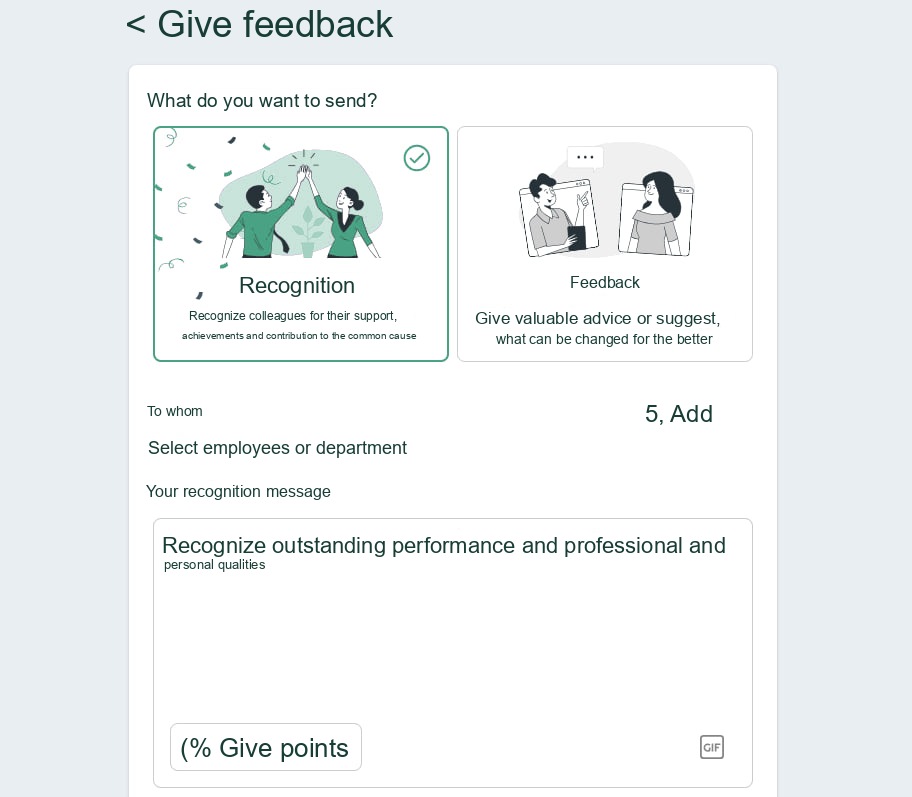
Feedback exchange window in Appraise