



The Appraise Editorial Team spoke with the product team to take a fresh look at familiar HR processes through CJM, A/B testing, and metrics previously used mostly in product development. Here are simple ideas that will save time and effort.
Contents
HR is increasingly expected to deliver quick results: filling vacancies, launching assessments or surveys, and processing employee feedback.
However, the tools traditionally used by HR do not always reveal exactly where a process breaks down or why it takes so long. We see the outcome – low engagement, a failed Performance Review, or a lengthy onboarding process – but do not understand at which stage things went wrong.
The Appraise Editorial Team spoke with the product team to learn how they solve these problems. This offered a fresh perspective on familiar HR processes through CJM, A/B testing, and metrics previously used mostly in product development. Here are simple ideas that will save time and effort.
Let's start with Customer Journey Mapping
CJM (Customer Journey Map) is a tool for visualizing an employee’s journey within a company: from recruitment to onboarding, and from the first 1-1 meeting to the latest Performance Review. In HR, this approach is often called an Employee Journey Map, but it is essentially the same CJM adapted to people management.
CJM helps HR view a process through employees’ eyes and understand where they encounter difficulties, lose motivation, or experience misunderstandings. Instead of evaluating HR tools separately, CJM considers the entire journey: applying for a vacancy, recruitment, onboarding, communication with a manager, Performance Review, development, and more.
Why use CJM in HR processes
In practice, CJM is most commonly used to:
- analyze and improve new employee onboarding;
- identify friction points in communication between employees and the company;
- reduce turnover during the first few months of employment;
- increase employee engagement and satisfaction;
- prioritize HR initiatives based on real data rather than assumptions.
Using CJM allows HR teams to move from “firefighting” to systematic management. Instead of asking “what went wrong?” they can identify and mitigate risks in advance, before those risks lead to resignation or burnout.
Try starting by building a CJM for one process, such as assessment. This will help you identify weak points faster and determine what needs to be redesigned and improved.
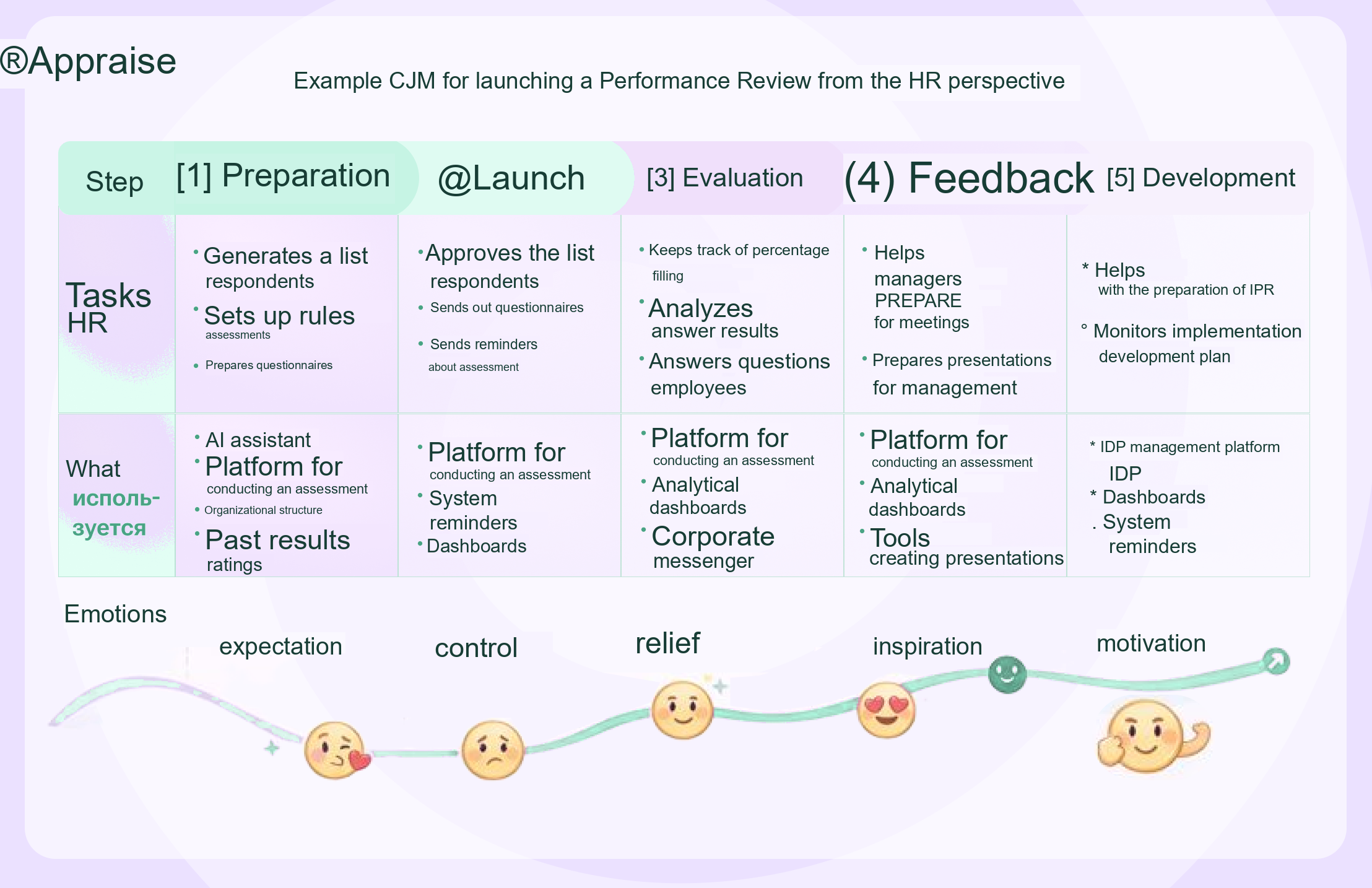
Example of a CJM for an HR-led PR launch
A/B testing
A/B testing is a method for comparing two or more versions of an HR solution to determine which works best. This approach is used to test hypotheses based on data.
💡 A study of organ donation uncovered an interesting fact: the decisive factor was not the procedure itself, but the wording of the questionnaire.
In countries with low donation rates, people had to check a box to opt in. In countries with high donation rates, they had to check a box to opt out.
The principle behind an A/B test is simple: one group of employees or candidates sees version A, another sees version B, and the results are then compared using a predefined metric. These metrics might include onboarding speed, engagement level, or survey completion rate.
Why HR should use A/B testing
A/B testing enables HR to:
- make decisions based on data rather than intuition;
- reduce risks when implementing new HR tools;
- identify effective wording, scenarios, and communication formats faster;
- and more.
Recommendations for successful testing
A/B tests can trip up inexperienced practitioners, so we have prepared several important rules to keep in mind:
One test, one metric
Do not test the questionnaire delivery time, header design, and question wording all at once.
➕ Good example: determine whether respondents are more likely to answer questions that address them informally or formally. The wording of the questions themselves remains unchanged. SuperJob, incidentally, conducted this type of study.
➖ Bad example: you want to understand how creating an onboarding plan affects completion of the probation period. You divide new hires into two groups: one has a plan and the other does not. However, you fail to account for the mentoring system, which also affects onboarding. The test conditions are compromised, and the results may not be representative.
One time period
Do not evaluate an A/B test if some questionnaires were sent in March and others in June. A great deal could have changed during that time. It is better to conduct such tests during the same period.
Randomly assign participants to test groups
Running one test with the marketing team and a separate test with the product development team is one thing. But if marketers see only questionnaire version A and developers see only version B, the study’s results will no longer be reliable.
When HR begins experimenting with wording, timing, and scenarios, the next question inevitably arises: which metrics should be tracked? This is where the product approach helps once again.

Free guide
A data-driven approach to HR: how to become a strategic partner to the business
25+ product development tools and metrics
At Appraise, we view HR as a system rather than a collection of disconnected processes.
Unless the entire employee journey is measured – from initial contact to regular 1-1 meetings and development – any improvements will be isolated. This is why product approaches are so well suited to HR tasks: they enable teams to test hypotheses instead of guessing and to identify real opportunities for growth.
This opens up new possibilities for analyzing indicators and helps teams view familiar issues from a new perspective.
We have compiled 25+ metrics and tools that you can incorporate into your work:
Metric or tool
How to apply it in HR
Retention – the percentage of users who return after 6/12/24 months
How many employees remain with the company after 6/12 months of employment. Helps evaluate onboarding and adaptation.
Engagement – engagement with a product: frequency and depth of use
Survey participation, feedback frequency, and activity in team practices.
Time-to-performance – time required to reach full productivity
How long it takes a new hire to perform at the level of an "average" employee. Useful for support, sales, and similar teams.
Conversion rate – the percentage of users who advance to the next stage of a funnel
How many employees progressed through their IDP: started training → completed a plan item → completed everything planned.
Drop-off rate – the percentage of users who drop off at a particular stage
How many employees did not complete a survey, return a questionnaire, or set their goals. Reveals points of resistance.
NPS / eNPS – willingness to recommend a product
Willingness to recommend the company (eNPS) is a direct indicator of its employer brand and culture.
CJM (Customer Journey Map) – a map of the user’s journey
In HR, for example, this is an employee’s journey from recruitment to leaving the company. It helps identify weaknesses in processes.
A/B testing – comparing two versions to select the best one
Testing questionnaire wording, surveys, headlines, assessment scenarios, and reminders.
Bug report – a report about an error in a product
The HR equivalent is collecting complaints and feedback about processes. A clear format and dedicated channels can be introduced.
Issue tracker – a task management system for tracking bugs
Record employee feedback (from surveys and PR) and track what has been fixed.
Kanban – a method for visualizing task status
Can be applied to development management, IDPs, and career paths.
Sprints – short 1-2 week iterations with specific tasks
Use in project planning: surveys, PR launches, questionnaire updates, and IDPs.
Retro / Retrospective – a team meeting held at the end of a sprint
In HR: hold a retro after launching an assessment, 1-1s, or an IDP pilot. Gather ideas and feedback.
MVP (Minimum Viable Product) – a minimum viable product
Do not try to create the “ideal process” immediately. For example, pilot an assessment in one department.
Roadmap – a product development plan
Build a roadmap for developing HR processes and link releases and initiatives to it.
Feature request – a request for a new feature
In HR, these are ideas from employees. Requests regarding benefits, surveys, and processes can be collected.
Changelog – a history of product changes
HR emails or an automated feed showing what is new at the company.
Heatmap – a map of “hot spots” where users click most often
In HR, this can be applied to surveys to show which sections are completed most often and which are skipped.
Onboarding flow – a sequence of steps for a new hire
Structure the onboarding process and create a CJM, checklists, and automated reminders.
User story – a scenario in which “a user wants to do X in order to Y”
Write user stories from the perspective of HR and employees. This clarifies why a feature or process is needed.
Dashboard – a panel displaying key metrics
Appraise already has one: instead of just assessment results, you can see deviations and compare cycles, results across teams, and more.
Alert / Notification – a signal about an event
Automated reminders in Appraise: about deadlines, insufficient feedback, or IDPs with no activity.
Auto-suggestions – automated suggestions based on data
In Appraise: AI-powered recommendations for development scenarios and questionnaire templates.
Load balancing – distributing workloads across servers
Can be used to identify who is overloaded with assessment questionnaires. Appraise, for example, can calculate this workload.
Churn prediction – predicting churn
Use metrics, engagement, and activity to predict employee attrition.
Conclusion
Product metrics do not make HR cold and impersonal; on the contrary, they help HR understand people better.
CJM shows where employees lose motivation. A/B tests help HR communicate with them in language they understand. Metrics make it possible to base decisions on data rather than impressions.
There is no need to start with the full set of tools. Simply choose one process, one hypothesis, and one metric. This is how product teams build systems that work.
HR can do the same – and do it deliberately.