




Olga Kotova
Appraise Methodology Expert
March 13, 2026
7 cases proving that surveys and feedback are not a formality, but a powerful HR tool. Learn how they can help reduce employee turnover by 20%, accelerate new hire onboarding, and make hiring and offboarding processes work for the business.
Contents
- Three cases where surveys helped solve real team problems
- 1. Conflicts after merging teams
- 2. New hires do not pass probation
- 3. Burnout in the design team
- Two cases where Performance Review is not a formality, but a tool for growth and development
- 4. A delayed Performance Review
- 5. How automation saved Performance Review
- Two cases where every HR professional has to wear many hats
- 6. How HR had to promote surveys within the company
- 7. How HR discovered unexpected design talent
- Which tools helped in each situation
- Conclusion
The Appraise editorial team has compiled seven cases from clients’ HR practices. Each one covers a specific problem, the steps taken by HR teams, and the results they achieved.
These stories show how HR analytics tools work in practice: employee surveys, Performance Review, regular feedback, and more.
Three cases where surveys helped solve real team problems
Employee surveys are not just box-ticking exercises. They are key to a healthy corporate culture, effective work, and a positive team environment. But as with any key, choosing the right one matters.
Below are three cases where surveys helped HR teams understand the situation and find a solution.
1. Conflicts after merging teams
After the company merged its sales and marketing departments, persistent conflicts soon emerged. The HR team scheduled a series of interviews with team leads and conducted a 360-degree assessment to gather more information.
The following questions were added to the survey:
- “Which issues do you think colleagues from the adjacent department should handle?”
- “How often do you encounter a lack of understanding of your role?”
- “What prevents effective collaboration between marketing and sales?”
The results showed that employees had different understandings of their duties, areas of responsibility, and success criteria.
Action taken: Tasks were redistributed and a RACI matrix* (responsibility assignment matrix) was created. A team-building session was held where mixed teams reviewed failed cases and devised alternative solutions. Monthly cross-functional meetings were introduced.
Result: According to the survey, team conflicts decreased by 67% over four months. Project approval times improved, as did revenue from joint campaigns.
*A RACI matrix is a project management tool that clearly shows how responsibilities are distributed among team members.
The matrix is a table with project tasks listed vertically and team members horizontally. Each intersection indicates a participant’s role in a specific task using the following designations:
- R (Responsible) – the person who performs the task
- A (Accountable) – the person ultimately accountable for the result
- C (Consulted) – the person who provides expert input
- I (Informed) – the person who must be kept up to date on the task
The main purpose of a RACI matrix is to eliminate uncertainty in the distribution of duties, prevent duplicated work, and ensure that every participant clearly understands their area of responsibility.
2. New hires do not pass probation
Forty percent of new hires left the company within their first three months. To identify the reasons, the HR team introduced exit surveys and automated onboarding surveys sent to new employees at the end of their first day, week, and month.
The following questions were used:
- At the end of the first day: “What caused you the most stress today?” and “Were your tasks explained clearly enough?”
- At the end of the first week: “Which processes are still unclear?” and “How often do you speak with your manager?”
- At the end of the first month: “Do you feel part of the team?” and “What would you recommend changing in the onboarding process?”
The results showed that almost half of new hires were afraid to ask their manager for help, fearing they would interrupt them or appear unable to work independently. Sixty percent said they had been overloaded with tasks and processes in their first few days without proper training or explanations.
Action taken: The onboarding process was redesigned with separate training modules and checklists, and the entire first week was dedicated to helping employees settle in. Each new hire was assigned a senior colleague whom they could approach with any questions.
Result: probationary turnover fell from 40% to 15%.

3. Burnout in the design team
Employees in the design department began taking sick leave and days off more often, while clients started complaining about a lack of creativity. The HR team decided to conduct an anonymous survey to measure employee burnout.
It had two sections:
- Quantitative questions rated from 1 to 5: “How often do you work overtime?” and “How emotionally exhausted do you feel?”
- Open-ended questions: “What demotivates you?” and “What changes would reduce your stress?”
The survey showed that 70% of employees had to work overtime because client revisions could arrive outside working hours or even after the deadline. The overall stress rating was 4.2 out of 5.
Action taken: Sending work messages and assigning tasks between 7:00 p.m. and 9:00 a.m. was prohibited, with emergencies requiring approval from the team lead. Employees could dedicate Friday afternoons to learning or personal projects.
Result: The stress level fell from 4.2 to 2.1 points.
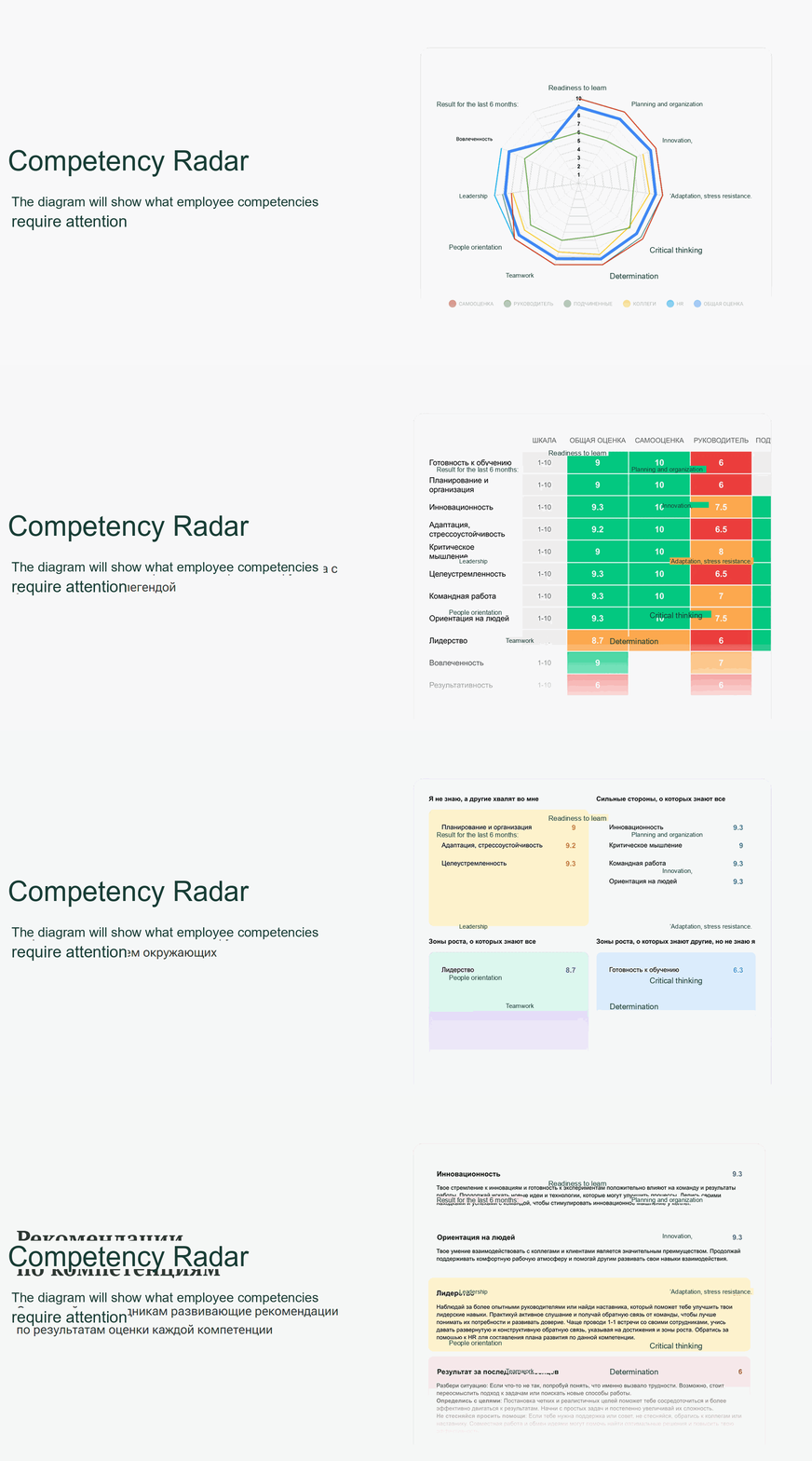
Preparing assessments, collecting data, and analyzing results can take HR professionals up to 40% of their working time. Appraise simplifies assessments, making them easy to run and the results easy to understand.
Set up automated reminder workflows and select participants based on the organizational structure and their workloads. Access results at any time: apply filters, compare assessment cycles and business units, and much more
Two cases where Performance Review is not a formality, but a tool for growth and development
Performance Review is often seen as a mandatory but formal annual procedure. As a result, employees stop taking Performance Review seriously, begin resisting the process, and lose faith in the tool.
This section presents two company cases where the assessment system had to be completely redesigned.
4. A delayed Performance Review
Engineering teams complained that Performance Review happened too late, was overly formal, and did not reflect their actual work. Because work was project-based and teams rotated constantly, feedback came from people with whom employees no longer worked or had barely interacted.
The HR team took a comprehensive approach to the problem:
- At the end of each project, they held short retrospective sessions to assess results, team collaboration, and development expectations.
- After Performance Review, they launched an anonymous survey to measure satisfaction with the quality and quantity of feedback and determine whether assessment criteria matched employees’ actual responsibilities.
- They analyzed exit interviews from employees in the department and adjacent teams, and added new questions for departing employees.
The results showed that more than 60% of employees saw no value in Performance Review, while for 40%, the assessment did not address their actual work results.
“I don’t understand why I need any of this. It’s a waste of time”, said one respondent.
Action taken: The company moved from abstract scores to assessing employees’ specific skills and competencies. Performance Review assessments were conducted at the end of every project rather than once a year, ensuring that feedback remained relevant.
Result: One month after Performance Review, an anonymous survey was conducted about the new process. Eighty-two percent of employees said the assessment now matched their actual responsibilities and expectations.

5. How automation saved Performance Review
The HR team conducted an annual Performance Review for all employees. The problem was that the forms were on paper and had to be completed by more than ten thousand employees. Digitizing and assessing the results took six months or more, leaving employees waiting far too long for decisions about their roles. Loyalty and engagement declined, while turnover increased.
The team decided to measure employee loyalty: eNPS was -24!
The final blow was the finding that 35% of employees’ individual goals were not aligned with the company’s strategic priorities.
The team began by digitizing and automating the assessment process. They also took the following steps:
- Introduced a system of “support slots”: The HR team reserved open hours in their calendars that any employee could book for an individual conversation or attend with their team or a colleague.
- Created a modular template for managers to use in 1-1 meetings, reducing preparation time and helping them communicate the company’s values and priorities more effectively.
- Added a shared space where employees could thank colleagues and celebrate their achievements. More broadly, the company began paying greater attention to developing a culture of recognition.
Result: Automation saved more than 880 working hours, turnover in key teams fell by 18%, and eNPS rose to +21 within nine months.
Two cases where every HR professional has to wear many hats
Anything can happen in HR. Sometimes you have to be an analyst, marketer, internal project producer, and even a PR specialist all at once.
This section presents two cases where HR teams had to find unconventional solutions to seemingly routine tasks.
6. How HR had to promote surveys within the company
Employees began an unofficial boycott of surveys. No format, from eNPS questionnaires to a quick poll about favorite office snacks, received a response. Nothing worked, and participation continued to fall.
The company decided to promote surveys internally so that employees would understand their importance and value:
- launched an open channel in the corporate messenger to share survey results, including the plans developed, what had already been implemented, and what was in progress;
- temporarily shifted the focus from large surveys to simple in-chat polls, for example asking employees to choose the best idea for the winter party using emoji reactions;
- held an open Q&A session with leadership before launching the new quarterly survey. Leaders answered both previously submitted questions and new questions employees posted during the live session.
Result: Shifting the focus from control and KPIs to transparency and value worked. Participation began to rise, employees shared insights and ideas more actively, and the HR team no longer had to spend time persuading them to take part.
Free guide
How to Encourage Employees to Complete Surveys
7. How HR discovered unexpected design talent
As many employees moved to remote work, three rooms became available in the office. An attempt to decide quickly how to repurpose the space led to chaos. HR found itself caught between a PlayStation and a yoga mat.
-
- launched an online survey and placed an “idea box” in the office. To attract more participants, they promised prizes to employees whose ideas were selected for implementation;
- selected the top ideas and posted QR codes for the final vote in several locations around the office, as well as publishing the vote in the corporate messenger.
Three ideas ultimately won: a chill-out area for socializing away from Zoom and relaxing; a room divided into pods, small meeting rooms for one person, so larger meeting rooms would be available more often; and a mini gym where employees could use a punching bag, stretch, and take a break from work.
Result: On the one hand, this made the selection process longer, and HR could have made the decision much faster alone. On the other, gamification and an open approach brought employees much closer together, and those who had rarely visited the office began coming in more often.
Which Tools Worked for Each Situation
«HR analytics starts working not when a company collects data, but when it begins changing processes based on that data».
Valery Meshkov, CEO of the Appraise HR platform
Below is a brief summary of the tools used in these cases and the challenges they helped solve.
HR tool
What it helped achieve
Employee surveys
Identify the causes of conflict and prevent burnout.
Onboarding surveys
Reduce turnover among new hires.
Performance Review
Improve employee development processes.
Exit surveys
Identify the reasons employees leave.
1-1 meetings
Increase employee loyalty and engagement.
In Place of a Conclusion
All seven cases in this collection demonstrate one important point: most HR problems are rarely solved by intuition alone.
Conflicts between teams, burnout, onboarding failures, or distrust of Performance Review become visible only when a company begins collecting feedback systematically.
Employee surveys, regular 1-1 meetings, clear assessment processes, and transparent communication allow HR teams not only to respond to problems, but to prevent them.
The sooner a company starts using these tools, the less effort it takes to maintain a healthy working environment.
Don't Rely on Guesswork
Make data-driven management decisions
with Appraise
Share