



In this article, we explain what grades are, how a grading system works, who it is suitable for, which methods are used, and how to implement job grading without mistakes.
Contents
- What a grade is and how job grading works
- Why companies need a grading system
- The history of job grading
- How grades differ from other compensation systems
- Job grading methods
- How to implement a grading system
- Who job grading is suitable for and who it is not
- How salary depends on grade
- Tools for implementing grades
- Conclusion
What a grade is and how job grading works
Grades are one of the most transparent and manageable ways to structure a compensation system. Companies use job grading to create a clear job structure, establish fair salary ranges, and reduce subjectivity in workforce decisions. Amid intense competition for talent and rising personnel costs, a grading system helps employers balance budgets, team development, and market expectations.
Definition of a grade
A grade is a job level within a company that reflects the job’s value, complexity, and impact on the business. Essentially, it is a tier in the overall compensation system that determines:
- level of responsibility;
- experience requirements;
- salary range;
- development opportunities.
Each grade has its own salary range and set of criteria used to assess employees. This gives the employer a manageable, systematic compensation model.
Job grading: process and objectives
Job grading is a way to structure jobs within a company. Its purpose is not simply to divide roles into levels, but to create a manageable architecture in which each position has a clear value, a set of requirements, and a place in the overall system.
Key objectives of job grading:
- Determine the relative complexity of roles. Jobs are compared using a consistent set of criteria, including responsibility, impact, and competencies.
- Build a level-based model. The system defines clear progression stages and requirements for each level.
- Create a foundation for compensation. Grades provide the basis for salary ranges, review rules, and promotion mechanisms.
- Establish a consistent approach to people management. Managers, HR, and employees operate within the same framework, helping to eliminate factors such as personal relationships.
- Support budget planning. Grades make it possible to forecast team growth and manage payroll costs over several years.
According to Mercer, companies with a grading system make workforce decisions 25% faster and encounter salary-related conflicts 18% less often.
Why companies need a grading system
Advantages
Job grading helps:
- Reduce subjectivity, so managers, HR, and employees can clearly see the relationship between competencies and compensation.
- Streamline hiring. HR gets a clearer candidate profile and can navigate the applicant pool more easily, while the hiring manager receives higher-quality resumes for review.
- Increase transparency for employees. Grades answer the questions “Why?” and “What do I need to grow?” Employees experience less frustration and can always work toward a goal.
- Control payroll costs and forecast expenses. Transparent ranges and levels help the finance team plan budgets in advance, account for team growth, and avoid surprises when hiring or reviewing salaries.
- Build career tracks. Employees can see their development path, while managers understand what steps are needed to help them grow within the team. This kind of system helps retain professionals and reduce turnover.
Disadvantages
Grades should not be treated as a silver bullet. This useful tool also has drawbacks:
- it is difficult to implement initially;
- salary ranges and role requirements must be reviewed annually;
- if the system is too rigid, it can reduce the company’s flexibility and block internal mobility;
- training managers to use the model takes time.
However, all these drawbacks can be overcome relatively easily by avoiding an abrupt company-wide rollout and approaching implementation thoughtfully and gradually.
🎥 We recommend watching the webinar recording, “Career Tracks for Large Companies: Assessment, Strategy, and Automation.” During the live session, we assessed a career track system and examined common mistakes in building a team growth framework.
The history of job grading
Job grading emerged in the United States in the 1940s and 1950s amid rapid industrial growth. Large corporations such as General Motors, Boeing, and Lockheed faced a common problem: rapid workforce growth led to compensation chaos and a lack of consistent employee assessment rules.
The first grading system was the Hay Guide Chart. It was named after its creator, Edward Hay, a former government clerk who later became head of personnel at the First Pennsylvania Bank in Philadelphia, United States, and founded the consulting firm Edward N. Hay and Associates.
The Hay Group methodology, the Hay Guide Chart, is still used today and is a point-factor job evaluation system. It divides all job requirements into competencies comprising several measurable parameters:
- Know How (KH) – Knowledge and skills
- Technical – Practical / Specialized knowledge.
- Breadth of management – Planning, organizing, and integrating processes.
- Management knowledge and skills.
- Communication skills – Communication and influencing skills.
- Problem Solving (PS) – Problem solving
- Thinking environment – Latitude in decision-making.
- Thinking challenge – Complexity of the issues addressed.
- Accountability (AC) – Accountability
- Freedom to act – Freedom to act / make decisions.
- Impact – Degree of impact.
- Magnitude – Nature of impact.
Each parameter is assigned a weight, and an employee’s overall fit for the role is determined by the final score they receive during the assessment.
The introduction of grading systems standardized roles within companies and established a new global standard for compensation management. According to PwC, more than 70% of large companies use grades as the foundation of their compensation system.
How grades differ from other compensation systems
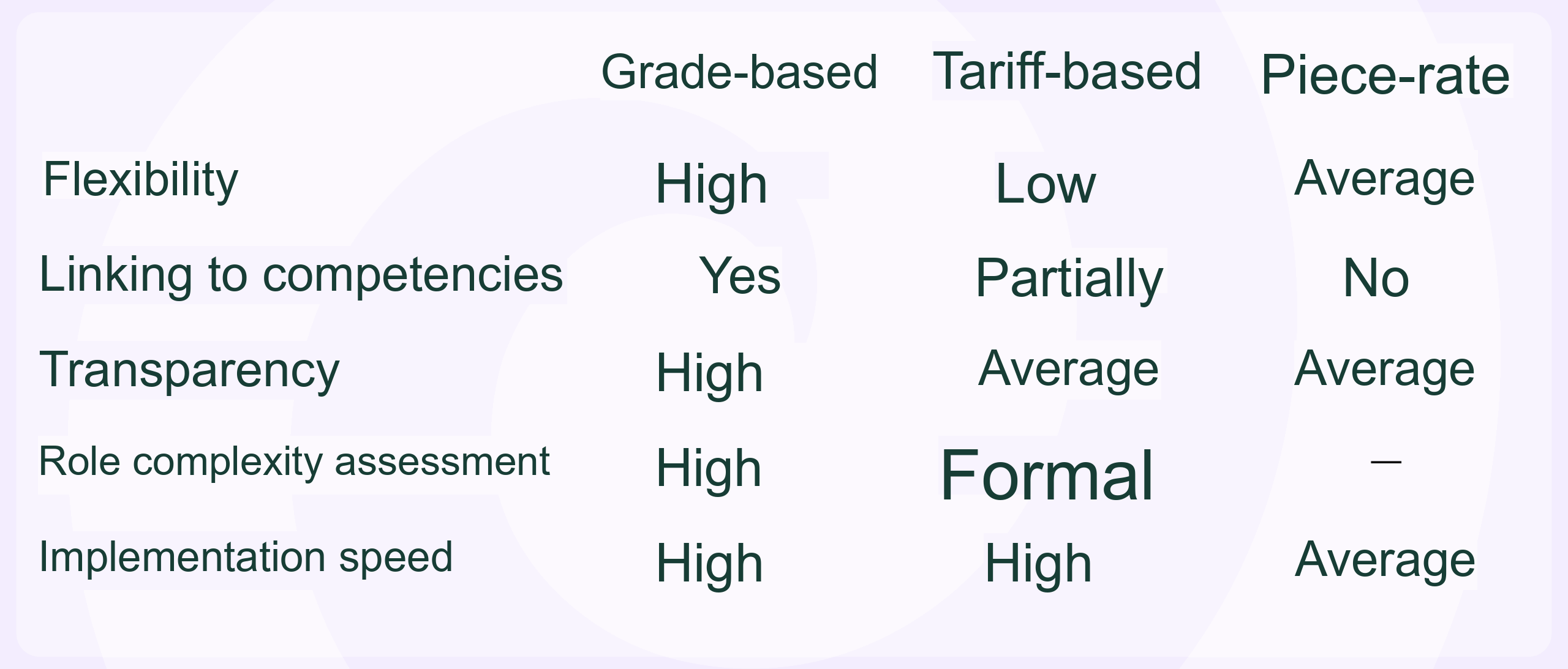
Difference from a pay scale system
A pay scale model is typical of the public sector and manufacturing. It is rigidly tied to categories, coefficients, and length of service.
A grading system:
- is more flexible and considers the value of a role, not just length of service;
- is based on competencies;
- links salary growth to performance and development, not just time in the role.
Difference from a piece-rate system
A piece-rate model is effective where output is easy to measure, such as manufacturing, logistics, and warehousing.
A grading system:
- is designed for office-based and knowledge professions;
- works where quality, responsibility, and impact matter in addition to output.
Job grading methods
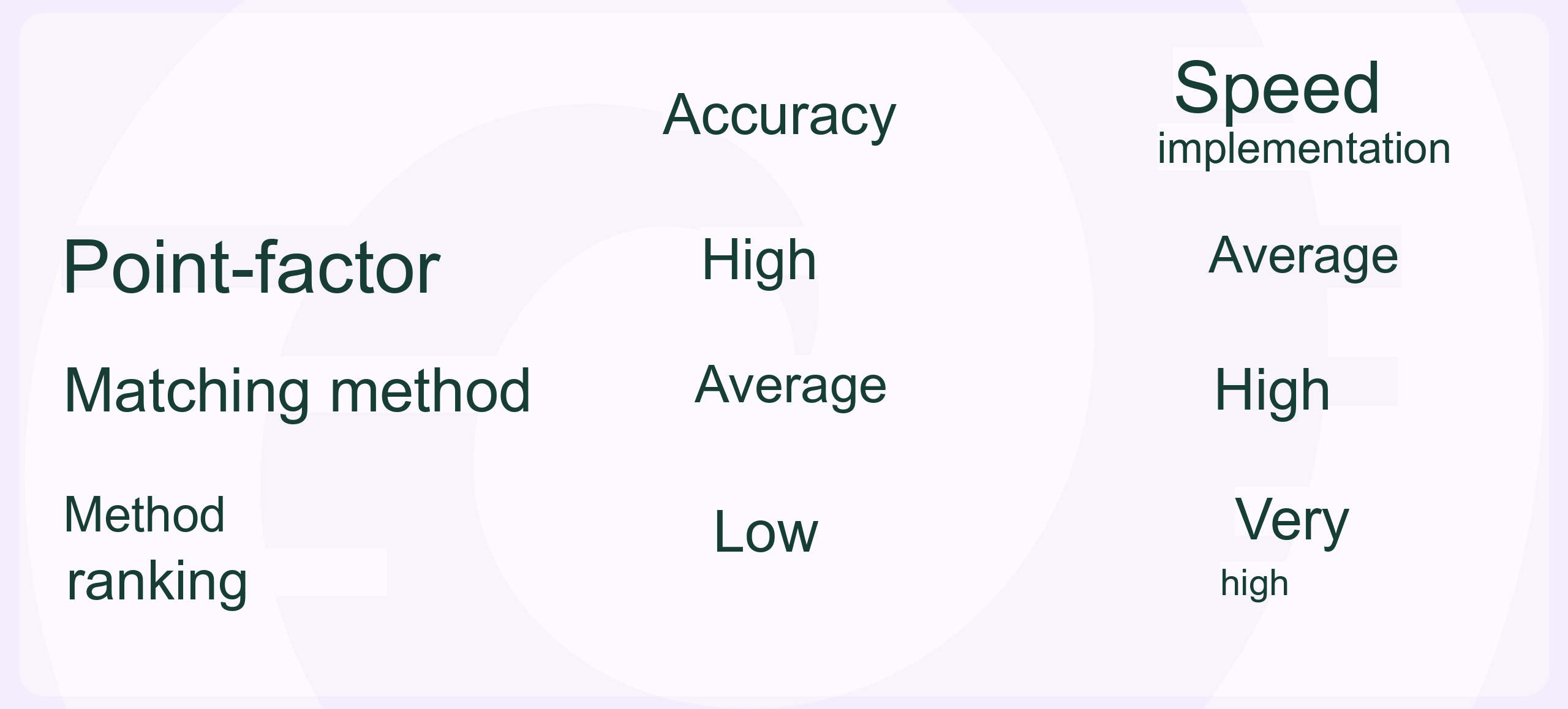
1. Point-factor method (the most accurate)
This is a modern adaptation of the Hay Guide Chart. Each job is evaluated against the same set of factors:
- task complexity,
- managerial responsibility,
- knowledge and experience,
- business impact,
- interaction with other functions.
An employee’s level is determined by their total score.
This system is used by: large IT companies, banks, telecommunications companies, multinational corporations.
Accuracy and objectivity.
Complex implementation requiring extensive analysis.
2. Job matching method (comparison method)
In this method, jobs are compared with:
- internal equivalents,
- market positions,
- industry models.
Used by:
✔ companies with a small workforce (up to 150 people)
✔ startups that have begun building a compensation architecture
Quick to implement, with no complex formulas or methodological nuances.
Less accurate.
3. Ranking method
All jobs are arranged on a scale from the simplest to the most complex.
Used by:
 companies with a small workforce (up to 50 people)
businesses without complex career tracks
Enables jobs to be assigned to grades quickly.
Highly subjective.
How to implement a grading system
There is no universal approach, but we can offer a framework for initially integrating grades into a company’s structure.
1. Audit the current structure
At this stage:
- analyze employees’ actual responsibilities;
- check roles for overlapping tasks and areas of responsibility;
- identify any significant pay disparities among employees with the same tenure, position, department, and so on;
- identify positions that are overloaded or, conversely, underutilized.
2. Prepare role descriptions
You need to create employee profiles for each role. They should include:
- functions,
- areas of responsibility,
- knowledge requirements,
- KPIs or OKRs,
- key competencies.
Important: base descriptions on the actual tasks performed by employees at your company rather than using descriptions from the internet.
3. Choose a grading method
You can use the descriptions of methods and industries in the previous section. To begin with, it is best to choose between the matching and point-factor methods. The decision depends on how many resources you are prepared to allocate to this task.

Free guide
Career tracks: what they are, why they matter to business, and how to create them
4. Evaluate the jobs
At this stage, it is important to determine how complex, critical, and valuable each position is to the business. This provides the foundation for the future grades.
Several parties conduct the evaluation to ensure the most objective result possible:
- HR team. Analyzes roles in terms of the company’s structure, competencies, and labor market.
- Department managers. Evaluate the actual complexity of tasks, level of responsibility, the role’s impact on team results, and experience and knowledge requirements.
- External consultants (as needed). They are engaged when the independence of the evaluation must be validated or an analysis based on industry models is required.
5. Create the grade structure
A grade structure is a scale of levels that reflects increasing complexity and responsibility within a role. A model typically contains 6 to 12 levels, although the exact number depends on the size of the company and the variety of roles.
- G1 — entry-level professional. Performs simple tasks under a mentor’s supervision, with a focus on learning.
- G3 — independent professional. Manages tasks independently, makes decisions within their area of responsibility, and influences processes.
- G5 — team- or function-level expert. Takes on complex tasks, advises colleagues, and influences the quality of decisions.
- G7 — manager or function director. Manages a team and is accountable for strategy and key results.
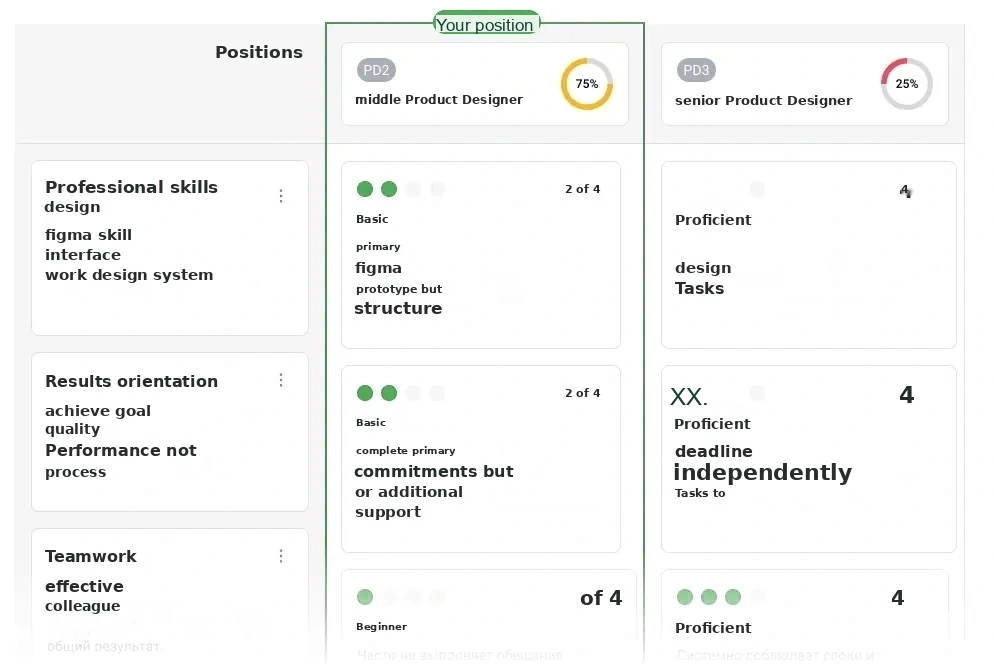
Example visualization of a grading system — Appraise
6. Establish salary ranges
Once all jobs have been assigned to levels, salary ranges are established, defining the minimum, midpoint, and maximum compensation for each grade.
This helps:
- prevent pay gaps between employees at the same level;
- make the system transparent and fair;
- adjust compensation to market conditions;
- forecast expenses;
- accelerate hiring processes.
According to Hays, companies that use formalized salary ranges receive 17% more relevant applications and encounter conflicts over salary expectations during hiring 25% less often.
The next step is to begin a systematic rollout and actively communicate the grading system within the company. It is important to explain its value to all employees so that they do not resist the process or prepare to leave the company.
Who job grading is suitable for and who it is not
There is no universal answer: grades are a tool that works only where there is a need for transparency and structure.
Below is a checklist to help you determine whether a grading system is right for your company.
Grades may be right for you if:
- the company is growing and roles need to be organized;
- key employees are overloaded;
- promotion decisions are made inconsistently;
- you need to build career tracks.
Grades may not be right for you if:
- you run a startup;
- responsibilities change every week;
- the company has 10–20 employees;
- there are no resources for setting up HR processes;
- business processes are highly unstable.
How salary depends on grade
Each grade has a range consisting of a minimum, midpoint, and maximum. For example:

Grade
Minimum
Midpoint
Maximum
G5
110 000 ₽
130 000 ₽
150 000 ₽
- Control payroll costs
Grades make it possible to understand in advance how much the team will cost as it grows, what should be budgeted ahead of time, and how payroll costs will change after raises. - Stabilize compensation across the company.
Without grades, two professionals performing the same tasks can easily receive different salaries. Ranges limit such disparities, help identify inconsistencies quickly, and align compensation.
According to Willis Towers Watson, companies with a grade structure save up to 20% of payroll costs through sound architecture.
Tools for implementing grades
Companies use:
- HRM systems;
- competency modules;
- Performance Review systems;
- compensation management platforms.
Managing a grading system and building a competency library takes considerable time and is often poorly integrated into a company’s HR processes, as if it existed in a parallel universe.
Appraise connects the steps of employee growth into a single chain: Grade → Assessment → Development Plan, helping identify and retain top performers.
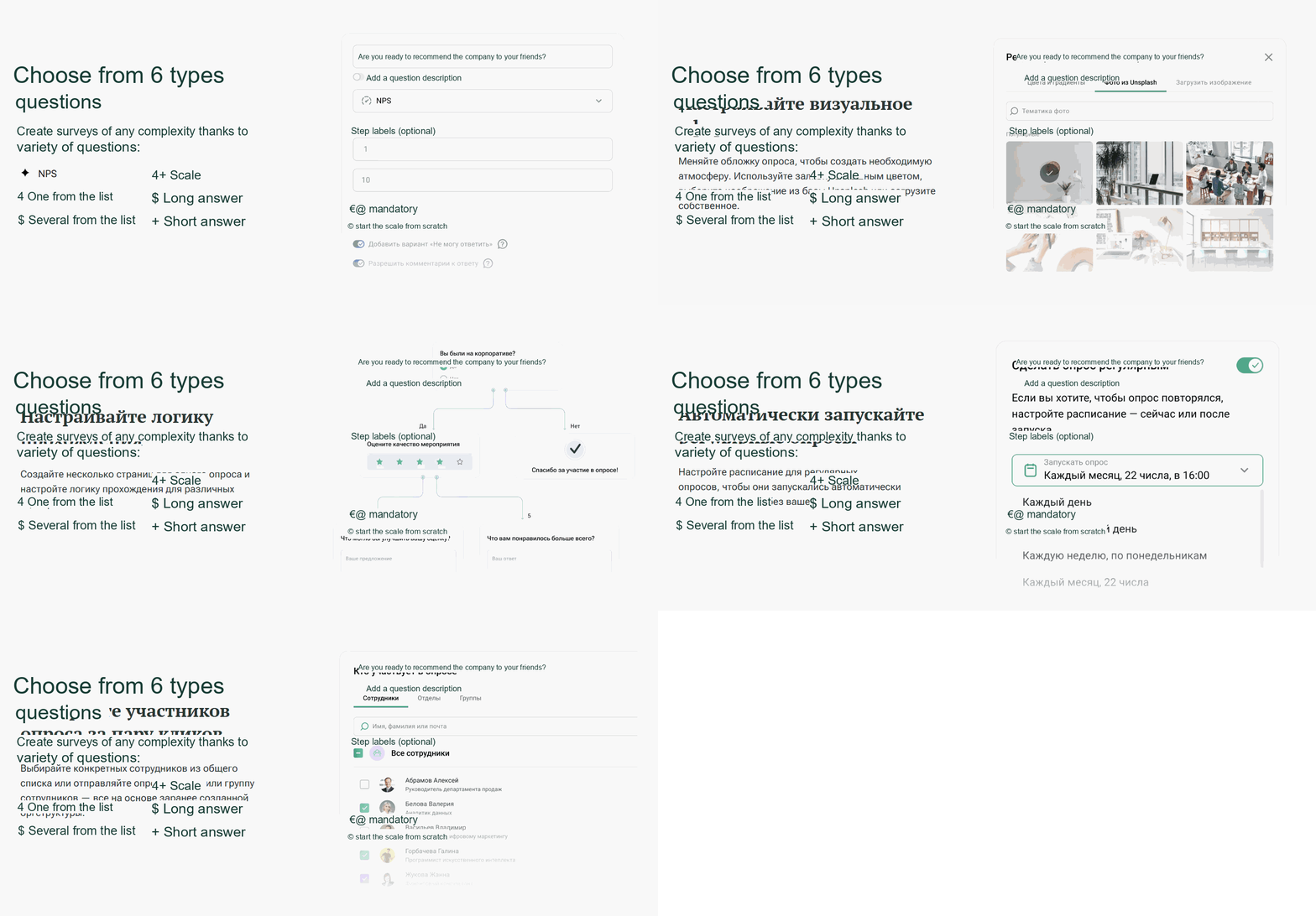
Appraise reduces the HR team’s workload and helps implement grades even without external specialists.
Conclusion
Career tracks are a development “map” within a company. They give employees not merely a plan, but a clear understanding of where they can go and why. Grades serve as waypoints or intersections along this route. After reaching one, an employee can pause and consider where to go next.
A grading system is a modern, manageable approach to compensation design. It helps companies retain talent, avoid inconsistent decisions, and build long-term career tracks.
If a company is ready for structure and consistency, grades become a powerful growth tool that supports the business’s long-term resilience.