




Mariam Gordiashvili
HR Project Manager
April 2, 2026
How to increase employee engagement through game mechanics. We analyze real cases, implementation errors and practical scenarios for surveys, training and feedback.
Contents
Low employee engagement is one of the most costly problems for business.
According to Gallup, only about 20-30% of employees are truly engaged at work. The rest are in “quiet dismissal” mode or simply don’t see the point in investing in tasks.
This is why HR is returning to gamification again, because it:
- encourages participation in surveys and assessments;
- forms a stable habit of giving feedback;
- increases employee engagement;
- develops a culture of gratitude.
For example, Deloitte introduced gamification elements into corporate training. As a result, engagement soared — daily employee activity increased by almost 47%.
And at first glance, here it is, the magic pill. Add points to any process and it will become better. But, as in that very joke, there is a nuance: geimification either strengthens the processes, or makes them even worse.
In this article we will look at how to strengthen your HR tools with gamification, and not spoil what already works.
What is “gamification” in HR
Gamification is the introduction of game mechanics into non-game processes: work, training, employee evaluation. It is important to understand that gamification is not for entertaining employees. This is a way to gently control and encourage desired behavior.
Why it works:
- games cause dopamine release;
- give instant feedback;
encourage further progress through recognition of achievements;
- make the result measurable.
As a result, familiar processes become not an obligation, but a part of the game scenario.
Gamification shows itself especially well in processes related to learning: the game format leads to a multiple increase in involvement. For example, in the case of a large feed manufacturer the proportion of employees who reached the end of the training increased almost 3 times after the introduction of game mechanics.
In which processes does gamification give the maximum effect
There are many mechanics that can be applied in HR. We have collected several of the most popular and proven ones in a table:
❌ Problem
✅ What mechanics should be used
Employees ignore surveys
Enter reward for completing survey. You can also add bonus points to those who completed all surveys for the month/quarter to tap into the FoMO effect (fear of missing out).
Employees exchange feedback, but it has no managerial value
Tie feedback to competencies: so that an employee can easily mark the ones they need when giving feedback to colleagues. And then refine the mechanics a little, for example, so that in the employee’s profile you can assess the degree of “pumped up” skills, like a character from a game.
Training not completed
Break the course into short steps with instant reward. Each completed stage or lesson is rewarded with a small number of points and/or adding a new achievement to your profile.
Low engagement on onboarding
Turn onboarding into a task sequence with rewards upon completion. For example: met the team → +1💜, completed training → +3💜, etc. It’s most convenient to track progress using internal tools, for example, by creating individual development plans in Appraise.
Remote team does not feel connected to other colleagues
Organize regular cross-functional sessions: small teams from different departments are given a common task (for example, improving a process or analyzing a case) and preparing a solution in a limited time.
HR initiatives are ignored
You shouldn’t suddenly introduce new mechanics. Try first running limited campaigns: when there are bonus or themed periods with additional prizes for participation. For example: “feedback week”, “day of declarations of love for the AXO team”, etc. Each campaign has a goal, a deadline and a final reward.
Gamification only works when it solves a specific problem, provides real benefit and is built into the processes of the company.
Implementing everything at once is difficult and expensive. Therefore, we recommend starting with something simple: introducing points to stimulate participation in HR initiatives and a store where employees can exchange them for something useful.
We wrote a separate article about this: we looked at the principles of operation, stages of implementation, filling options and more.
When gamification doesn’t work: analysis using real cases
If we analyze real cases from the HR market and our clients, then almost all failures fit into several repeating scenarios. The key reason is the conflict, but not between HR and other employees, but between gamification and how it is perceived.
Let’s look at the most common errors and methods for solving them.
1. Game mechanics do not match employee motivation
When choosing game mechanics, you need to take into account the difference in the age of employees and their grades.
According to TalentLMS, game elements are better perceived by younger employees, while older colleagues are more focused on meaningful work and recognition, rather than “game” incentives.
What to do? Develop different gamification scenarios! They may be broadly common to all employees, but the end result may vary. For example, let’s look at several approaches using the example of the difference in grades.
🎲 Junior: fast dopamine and clear rules
For beginners, shoulder feel and support are very important. That’s why small, neat stimulations using points and simple game mechanics are perfect for them.
What to implement:
- points for each action;
- short challenges (for 1–2 weeks);
- simple rewards.
Example:
“Feedback Week.” Goal: give feedback 5 times. Reward: merchandise / bonus
Recently, our editorial team spoke with Sergey Andreev, co-founder of the Appraise HR platform, about how Gen Z’s entry into the workforce affects HR processes, which expectations of Gen Z employees companies most often overlook, and what actually helps build effective relationships with young teams. You can read the article by following the link.
🎤 Middle: progress and recognition
It’s better not to limit yourself to just issuing points. For such specialists, a sense of progress and status within the team is also important.
What to implement:
- visualization of the level of competency;
- achievements for specific skills or contributions;
- opening mentor status or the opportunity to grow to team lead;
- public recognition tools.
Example:
“Employee Development Card”
- an employee’s profile stores competency assessments;
- each feedback or result strengthens a specific skill – reflected in this assessment;
- upon reaching a level (for example, 4/5), new opportunities open up for the employee: participation in a project, transition to more complex tasks, increase in grade.
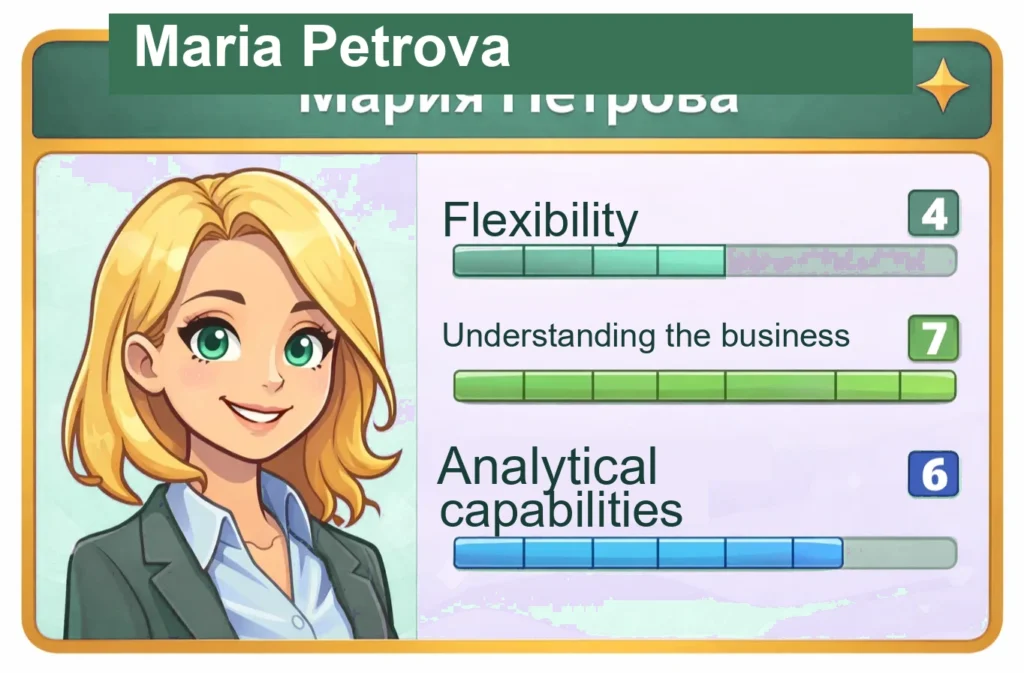
And such cards can also be made part of merch or given as gifts for the holidays. A small thing, but nice.
👑 Senior: influence and access to resources
For senior employees, any “game” mechanics quickly become meaningless if they do not provide real impact or tangible benefits.
What to implement:
- opportunity to influence decisions within the team;
- direct access to the guide to discuss ideas;
- material or career bonuses for initiatives;
- recognition through real changes, not badges.
Example:
“Program of Initiatives”
- employee proposes an idea (improving a process, product, team);
- idea undergoes quick evaluation;
- if implemented:
– the employee receives a cash bonus;
– or a one-time salary bonus;
– or priority for promotion.
“It is very important to understand that gamification is not always about points and ratings. It’s more about a system in which an employee’s actions do not go unnoticed, but are converted into a clear result: recognition, development or influence on processes.”
Valery Meshkov, founder of Appraise
2. Gamification is being implemented “from above” by order
Gartnerresearch shows that initiatives that are perceived as a new form of control and coercion cause employee resistance and reduce employee engagement. But the goal of gamification is different: to improve the quality of feedback and response from employees.
So set a strict rule for yourself: gamification should not become an obligation.
3. No connection with real benefit
Deloitte research shows: engagement increases when employees see a direct connection between actions and results (recognition, development, bonuses).
Therefore, in any game mechanic there must be a “reward”: money, new opportunities, recognition or influence.
4. Gamification Increases Toxic Competition
A double-edged sword is any format for ratings and leaderboards. Yes, they will really motivate some employees to work and try harder, but some, on the contrary, will receive a strong charge of demotivation. According to the Harvard Business Review, excessive competition can reduce team effectiveness and increase stress.
It is especially dangerous that if teams already have tops and outsiders, the gap between them can increase even further. Therefore, it is better to move away from open team ratings and create challenges that are unique for each employee.
5. Game mechanics are not built into company processes
According to McKinsey, any initiatives that are not built into daily processes quickly lose their impact. Therefore, it is very important that gamification is not screwed on from above, but is integrated into routine processes: for example, feedback should be given easily and in employees’ usual channels. Participation should not require separate accounts, registrations, etc.
Don’t take employees out of their usual routine.
Checklist for successful implementation of gamification
Step 1. Select a specific problem
Step 2. Select one key mechanic to start
Step 3. Link to real benefit
Step 4. Embed in processes
Step 5. Announce to team
Remember to choose a platform where you can combine gamification and HR processes
Appraise already has everything you need to make your employees love taking surveys and giving feedback: a gift shop, virtual currency, a ready-made reward system for action and more.
Increase engagement with clear gamification tools from Appraise. Come to the demo, we’ll show you the platform’s capabilities in action.
Conclusion
Gamification in HR is a powerful tool for increasing employee engagement, but its effectiveness directly depends on proper implementation. Success is achieved when game mechanics are seamlessly integrated into existing processes, take into account the characteristics of different groups of employees and provide real value.
The main thing to remember: gamification is not a magic pill, but a tool that requires a thoughtful approach. When used correctly, it helps create a more transparent and motivating environment where every employee sees their progress and understands the connection between their actions and results.
Share