




Tatyana Smirnova
Product Owner
April 10, 2026
KPIs and OKRs serve different purposes: KPIs measure current performance, while OKRs set the direction for development. In 2026, as businesses face uncertainty and rapid change, companies are shifting to a hybrid model. The growing trends of goal personalization and Continuous Performance are also making traditional assessment systems obsolete.
Tatyana Smirnova
Product Owner
Contents
- Challenges and trends in 2026
- The goal-setting crisis is the main problem
- KPIs: stability amid turbulence
- OKRs: flexibility for breakthrough goals
- KPIs vs. OKRs: final comparison
- Why hybrid models are winning
- Goal personalization: from templates to individual paths
- From Performance Reviews to Continuous Performance
- Practical recommendations for HR directors
- Conclusion
In 2026, the business environment continues to transform under the influence of the prolonged economic crisis, global digitalization, and changing employee values. Companies are looking for flexible goal-setting systems that will help them not only survive but also identify opportunities for growth. Two popular approaches are at the center of the debate: KPIs (Key Performance Indicators) and OKRs (Objectives and Key Results).
In this article, we explore which method is more effective in the new environment and why hybrid models are taking over the market.
Challenges and trends in 2026
- The economic crisis requires companies to adapt quickly and maintain a clear focus on critical metrics.
- Against the backdrop of market saturation and consumer fatigue, brands are seeking breakthrough solutions, increasing the value of creativity and team autonomy.
- AI and automation are taking over routine tasks, shifting the focus to strategic thinking and cross-functional collaboration.
- Gen Z and younger millennials value meaningful work, flexibility, and regular feedback more than formal bonuses. According to Sci-Tech Today, 42% of employees leave companies due to a lack of progress and recognition.
These challenges impose new requirements on goal-setting systems: they must be both measurable and flexible, transparent and motivating.
Amid economic uncertainty and constant transformation, simply measuring results is no longer enough for businesses: they must be able to quickly restructure goals and connect them to teams’ actual work.
Valery Meshkov, founder of Appraise
The goal-setting crisis is the main problem
In 2026, trying to choose between KPIs and OKRs as if choosing between the red and blue pills is a fundamental framing error. We live in an age of extraordinary turbulence. The conditions in which businesses operate have changed radically, and neither system alone meets a company’s needs.
Five to seven years ago, the task was to “implement OKRs or KPIs.” In 2026, it is to “make the goal system work again.”
This problem has three common symptoms:
- KPIs exist but do not affect results;
- OKRs have been implemented, but employees ignore them;
- goals are disconnected from actual work.
Research shows that businesses face growing uncertainty and are being forced to rethink their approaches to managing goals and strategy
At the same time, the performance management model itself is changing. Companies are moving away from annual reviews toward continuous feedback and personalized goals.
👉 As a result, the traditional choice between “KPIs or OKRs” no longer works.
KPIs: stability amid turbulence
KPIs are quantitative metrics that reflect how effectively predefined goals are achieved. In 2026, they remain indispensable where the following matter:
- predictable results;
- standardized processes;
- a direct link between results and rewards.
Where KPIs work best
- Operations. Manufacturing, logistics, and call centers are areas where productivity can be measured precisely, such as the number of requests processed per hour or the defect rate.
- Sales. Revenue, average order value, and conversion are classic KPIs that directly affect profit.
- Financial control. Budgeting, cost management, and profitability are areas that require strict reporting.
Disadvantages of KPIs in 2026
- Rigidity. Long-term KPI planning for an entire year loses relevance amid rapid change.
- Focus on the past. KPIs evaluate results already achieved rather than encouraging innovation.
- Demotivation. Tying bonuses solely to KPIs causes a dangerous shift in focus: employees hit targets at any cost while ignoring quality and customer experience.
OKRs: flexibility for breakthrough goals
OKRs are a methodology for setting ambitious Objectives and measurable Key Results. In 2026, they are especially relevant for:
- startups and innovation departments;
- cross-functional projects;
- companies operating in dynamic sectors such as fintech and EdTech.
Experts note that tightly linking OKRs to assessment and compensation often reduces their effectiveness.
Advantages of OKRs
- Ambition. Goals are set at the limit of what is possible, encouraging creativity.
- Flexibility. OKRs are reviewed quarterly, allowing teams to change direction quickly.
- Transparency. All employees can see company and team goals, improving coordination.
Disadvantages of OKRs in 2026
- Implementation complexity. Adapting OKRs requires teams to invest significant time and resources. Many companies encounter resistance from employees accustomed to more traditional goal-setting systems.
- Dependence on leaders. Successful OKR implementation depends heavily on managers’ ability to set goals and manage processes, placing an additional burden on management.
- Overestimating capabilities. Overly ambitious goals can demotivate the team when they are not achieved, especially if the goals are not supported by the necessary resources.
We published a separate article about OKRs and recommend reading it if you would like to learn more about the methodology. Grow like Google: how and why to implement OKRs in your company.
KPIs vs. OKRs: final comparison
KPI (Key Performance Indicators)
OKR (Objectives and Key Results)
Realistic, achievable goals, often based on past metrics with a modest increase (for example, “increase sales by 15% compared with the previous quarter”).
Ambitious, hard-to-achieve goals that encourage innovation (for example, “become the market leader in our niche within a year”).
The focus is on current performance and process stability, with an emphasis on operational tasks and maintaining performance levels.
The focus is on strategic development, breakthrough change, new opportunities, and growth.
Metrics are clearly fixed for a specific period (month or quarter), and changes are made infrequently.
Objectives and Key Results can be adjusted during the work process as conditions change.
Directly linked to the motivation and reward system (incentives, bonuses for meeting targets).
Goals are generally not tied to financial incentives. Motivation comes from the ambition of the goal and intrinsic engagement.
Goals may be private (available only to managers or the department) and are often used to assess individual employees.
Goals are generally transparent and available to the entire team/company, promoting shared engagement and understanding of the strategy.
Most often used at the individual employee or department level to monitor current tasks (for example, a sales manager’s KPIs).
Used at the company, department, and team levels to achieve strategic goals. Well suited to startups and fast-growing companies.
KPIs answer the question: “How effective are we now?”
OKRs answer the question: “Where are we going?”
Why hybrid models are winning
According to McKinsey research, 68% of companies use hybrid systems combining KPIs and OKRs in 2026.
Combining KPIs and OKRs creates a balanced management system based on the following principles:
- Psychological resilience: employees receive clear benchmarks (KPIs) and room for development (OKRs).
- Economic efficiency: optimizing costs while maximizing the team’s potential.
- Technological adaptability: easy integration with modern management systems.
- Organizational agility: the ability to scale and adapt to the specific needs of the business.
The key advantage of the hybrid model is that it creates a holistic management system in which KPIs provide stability and OKRs drive development, which is especially important amid the uncertainty of 2026.
Goal personalization: from templates to individual paths
In 2026, employees expect goals to account for their skills, interests, and career ambitions. Hybrid systems make this possible: KPIs establish a baseline of performance shared across a role, while OKRs allow employees to choose personal initiatives within team goals.
Deloitte research confirms that companies with personalized goals are 30% more likely to report increased engagement and 25% more likely to report lower turnover.
For example, a marketing employee can:
- meet a KPI for the number of publications;
- set a personal OKR: “Learn to use neural networks for content generation” or “Launch an influencer marketing pilot project.”
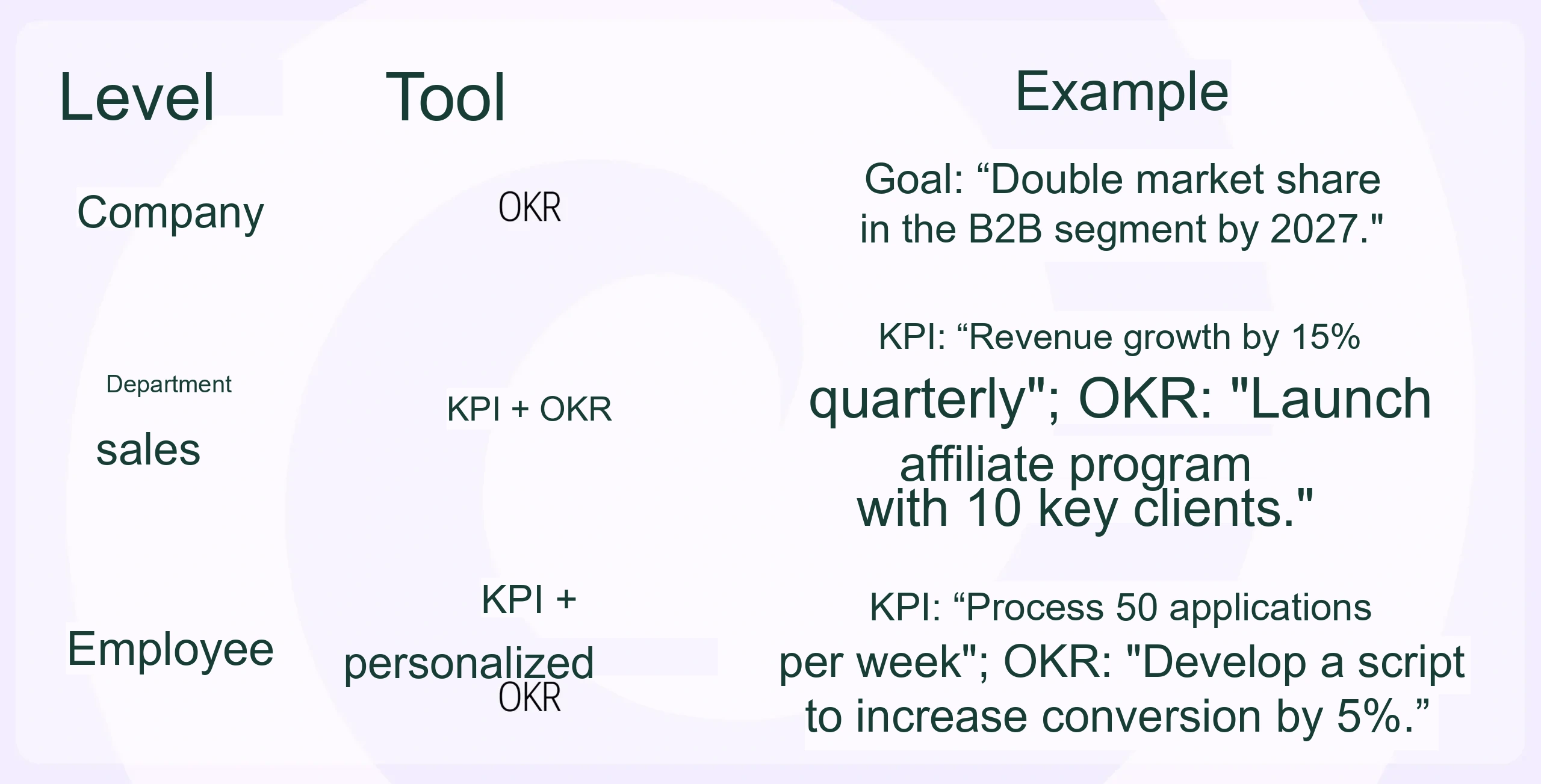
Example of setting goals under each model
From Performance Reviews to Continuous Performance
Traditional annual Performance Reviews are losing relevance. In 2026, they are being replaced by Continuous Performance Management feedback cycles integrated with OKRs/KPIs:
- Weekly check-ins. Brief meetings between a manager and employee to adjust tasks.
- Quarterly retrospectives. An analysis of OKRs: what worked and what barriers arose.
- Automated dashboards. Appraise displays KPI progress in real time, helping teams stay focused on strategic goals.
This approach allows a company to adapt to change faster while maintaining a business-oriented approach to goal setting.
Practical recommendations for HR directors
How to implement a hybrid system in 2026:
Audit your processes. Divide the company’s departments into:
- stable departments (logistics, accounting): KPIs;
- innovative departments (R&D, marketing): OKRs.
Train leaders. Hold workshops on setting OKRs and working with the Continuous Performance methodology.
Run a pilot. Start with one or two departments, collect feedback, and refine the system.
Automate KPI and OKR management and tracking
Add personalization. Give employees the opportunity to formulate personal OKRs within team goals.
Build a culture of transparency. Publish company and department OKRs and encourage knowledge sharing. In Appraise, this takes just a couple of clicks.
Keep metrics balanced. Use no more than three to five OKRs per level and three to four KPIs per role to avoid overload
Conclusion
In 2026, KPIs and OKRs are no longer mutually exclusive approaches but are becoming elements of a single management system. KPIs remain responsible for stability, transparency, and control over operational performance, while OKRs help companies move forward, test hypotheses, and adapt to change.
This is why the most mature companies are adopting a hybrid model in which goals become a practical tool rather than a formality. Such a system makes it possible to maintain control over current metrics while responding flexibly to change without losing focus on strategic objectives. Ultimately, the winners are not those who chose the “right methodology,” but those who built a clear, transparent, and dynamic goal system embedded in employees’ daily work.
Share