



Employee retention is not a one-off initiative or a collection of perks. It is a well-designed system built on transparent processes, respect for people, clear expectations, and a sense of stability.
Research shows that when a company consistently improves onboarding, management, culture, and working conditions, its retention rates increase.
In this article, we explore evidence-based employee retention methods and how to use them.
Contents
Onboarding: a confident start as the foundation of retention
An onboarding plan is the foundation for a long-term working relationship. New hires need not only to understand their tasks but also to feel supported by the team.
A Society for Human Resource Management study found that up to 20% of employees leave within their first 45 days if onboarding is poorly structured.
Deloitte research confirms that a structured plan for the first few weeks reduces the likelihood of an early departure by 30%. An onboarding plan reduces uncertainty and helps employees get up to speed faster.
A major factor in retaining employees during onboarding is mentorship, one of the key elements of successful employee onboarding. Scientific research shows that having a mentor reduces stress among new hires and strengthens their connection to the company, increasing the likelihood that they will complete their probationary period successfully.
Develop a mentorship program that enables employees to meet with senior leaders every month to learn about the challenges they face.
Clear goals. Gallup research highlights the importance of goal setting: clear expectations reduce the risk of misunderstandings and increase employee motivation.
To feel more motivated, people need to know how they contribute to shared goals.
— Ensure that the company’s goals, mission, and vision are discussed regularly in team meetings.
— In meetings with employees, especially lower-paid staff, emphasize how their work contributes to shared goals. For example, a friendly receptionist at a fitness club is one factor that motivates people to work out away from home.
Even technical details, such as providing equipment and access promptly, have a noticeable impact. IBM notes that providing work tools on time increases satisfaction with onboarding by almost 50%.
Development: when employees see a future within the company
Employees stay where they see opportunities. A LinkedIn Talent Trends study found that 94% of employees stay with a company longer if it invests in their development. Therefore, individual development plans are not merely a “nice perk” but a strategic retention tool.
When creating individual development plans in Appraise, you can use AI to generate development activities.
A transparent competency model has proven effective in Boston Consulting Group research. Companies where employees understand what determines their career advancement have employee turnover rates up to 50% lower.
Provide financial support to cover training course fees. According to several studies, investments in employee training, including course fees and professional development, often lead to high engagement and loyalty and, in some cases, a lower intention to leave.
Career counseling. A CIPD study found that employees who receive professional career planning support are more likely to remain with the company, even if they want to change roles.
All research in this area agrees on one point: when a company invests in employee growth, people reciprocate.
Managers: the key driver of engagement and retention
Gallup research has consistently shown for years that around 70% of the factors influencing engagement depend on the manager. This makes management quality one of the key elements of retention.
Regular one-on-one meetings. Retention is higher in teams that hold these meetings consistently.
McKinsey notes, that regular assessments improve team performance and reduce the uncertainty that often leads to burnout and employee departures. Conduct a 360° assessment or Performance Review (PR) twice a year to identify your team’s needs promptly.
Manager training. According to the Zenger/Folkman Leadership Center, strong management skills reduce employee turnover by up to 40%, especially among high-performing professionals.
Corporate culture: an environment that builds loyalty
Corporate culture is one of the most difficult retention factors to measure, but also one of the most powerful. According to research from Stanford GSB (O’Reilly & Chatman), a strong corporate culture is one of the key drivers of employee retention. Alignment between employees’ values and the company’s values significantly reduces the likelihood of departure and increases engagement.
Recognition. According to research by Gallup and Workhuman, employees who receive recognition regularly are significantly less likely to leave, with the risk of departure around 45% lower.
When people do not feel valued, their motivation declines. It is important not only to praise employees but also to do so promptly, as feedback should be thorough and specific. After a month or more, you are unlikely to remember every detail of what happened.
Positive feedback is the secret to employee motivation, especially during periods of stress and burnout.
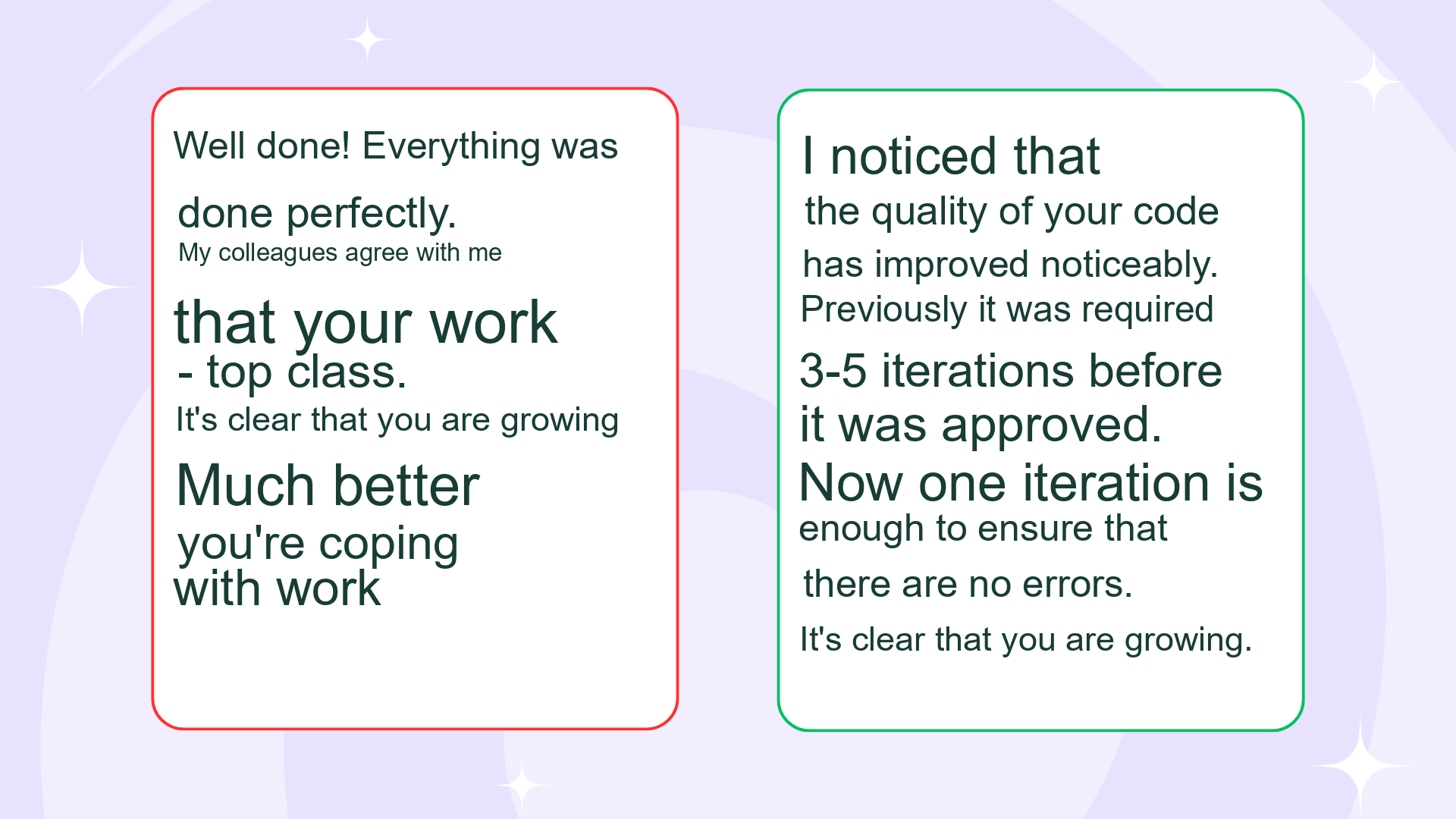
Example of ineffective and effective positive feedback
Team activities. Research from the University of Pennsylvania shows that shared activities strengthen team bonds and increase trust in the company as a whole.
Freedom to experiment is an engagement factor supported by Google’s research (Project Aristotle). Teams where employees can share ideas and mistakes openly operate more consistently and experience less stress, reducing the risk of burnout.
Employees will enjoy their work more and take greater pride in it if they have more autonomy in decision-making.
- Allow flexibility when planning work tasks.
- Let employees manage their own workloads.
- Strike a balance between micromanagement and being too hands-off. Ask employees to provide an action plan for the task at hand and agree on when you can check back for an update.
- Gather feedback from employees: do you give them enough freedom in decision-making, and what should change?
Support and working conditions
Working conditions shape an employee’s daily experience. Flexible schedules are one of the key factors. According to the CIPD Good Work Index, the ability to manage one’s working hours flexibly is a major driver of retention. Employees with flexible schedules report a lower intention to change jobs and higher satisfaction.
Support for mental and physical health. Deloitte research indicates that psychological support programs reduce stress and prevent employee burnout.
To remain engaged and perform well, employees need support for their physical and mental health.
- Include full or partial reimbursement for gym memberships in the benefits package.
- Hire an in-house psychologist or use an online therapy service. Cover the first 2-3 sessions with a psychologist.
- Provide private health insurance.
- Hold an outdoor team-building event.
- Run a company survey. Ask what is missing and what needs improvement.
The quality of work tools affects not only productivity but also fatigue. Microsoft research shows that cumbersome, slow tools increase emotional strain and accelerate burnout. For example, when an AI tool “hallucinates,” meaning it invents nonexistent facts, an employee has to spend time checking them.
Employee referral programs. According to a number of studies and reviews, referral hiring often delivers higher employee retention than traditional recruiting: referred candidates are more likely to remain with the company and demonstrate better onboarding and engagement
Regular feedback and engagement surveys are tools whose effectiveness is supported by Gallup research. Engagement is consistently higher where employees feel that their opinions matter.
Even well-designed offboarding has proven value. Research and expert publications show that proper offboarding is an important part of HR’s work. When the end of the working relationship is handled thoughtfully, employees leave the company with greater trust and respect, increasing the likelihood that they will return, recommend the company, and stay connected.
Offboarding is the process of an employee “exiting” the company. It begins when the employee announces their resignation or receives notice and continues until all formalities and the handover are complete.
Conclusion
When it comes to retention, what matters is not a single measure but a system. Companies that improve all their HR processes simultaneously retain employees significantly longer.
Retention is built on respect, care, transparency, and support. The more consistently a company develops these elements, the more stable its teams become and the stronger its business results are. Create an environment where people want to stay.