




HR Projects Lead
February 27, 2026
A guide to onboarding and offboarding: how to turn hiring and departure processes into a powerful company development tool. Learn how to reduce employee turnover by 20% and improve the effectiveness of new-hire integration through well-designed strategies and feedback tools.
HR Projects Lead
Contents
- Onboarding: More Than Just the First Day
- Surveys during onboarding as essential employee health checkups
- Enhance onboarding surveys with 360° feedback
- How do onboarding surveys differ from 360-degree feedback?
- Use all assessment formats
- Offboarding: How to Part Ways on Good Terms
- Employees Need Support During Offboarding
- Do Not Overlook a Well-Structured Exit Interview
- Onboarding and Offboarding: An Integrated Employee Management System
Companies are accustomed to measuring hiring effectiveness through cost per hire, time to hire, and funnel quality. Yet far less attention is paid to two key points: an employee joining the company and leaving it. These are precisely the moments that shape the actual employee experience: the level of trust, engagement, and even future turnover.
According to Gallup, only 12% of employees believe they received truly high-quality onboarding. Meanwhile, an SHRM study shows that 39 % of new hires leave the company within their first three months, while about one-third of new employees resign within their first 90 days.
Onboarding and offboarding are not formalities but manageable business processes that directly affect team resilience.
Onboarding: More Than Just the First Day
Onboarding is often mistakenly reduced to an employee’s first day or first week of adjustment. Once the documents are signed and the employee has been added to work chats, the task is considered complete.
In practice, onboarding encompasses the entire process cycle, from the moment an offer is signed until the employee completes their probationary period.
Modern onboarding begins before the first day. Preboarding helps reduce anxiety, set expectations, and show that the company is prepared for the person’s arrival. This may include a welcome email, a video from the manager, a clear plan for the first few weeks, and access to the internal portal.
LinkedIn notes that companies with a well-designed preboarding process achieve 20% higher employee retention during the first six months.
However, the key stage is the first three months. This is when a new colleague forms an opinion of the company, and the company forms an opinion of the new employee. Regular one-on-one meetings, clearly articulated expectations, a well-defined area of responsibility, and a sense of support are essential at this stage.
The problem at most companies is that new employees are often left to navigate unwritten rules, hidden expectations, and an unclear decision-making system on their own.
Surveys during onboarding as essential
employee health checkups
Onboarding surveys are a tool for identifying risks early. They enable you not only to assess morale and understanding of corporate values, but also to gather valuable feedback.
According to Culture Amp, employees who regularly provide feedback during their first 90 days at a new company are 30% less likely to leave within the first year.
Timing is crucial in onboarding surveys, both for the survey itself and for the questions it contains. You should not ask on the very first day whether an employee has gelled with the team. However, you should not delay questions about responsibilities and tasks either.
Surveys need to strike a balance between the information you want to obtain and the value they offer the employee. Completing a questionnaire should not take long, so it is best to use closed-ended questions with a field for an optional comment.
Questions you can use:
- At the end of the first day: “What caused you the most stress today?” and “Were your tasks explained clearly enough?” Sample questionnaire.
- At the end of the week: “Which processes are still unclear?” and “How often do you communicate with your manager?” Sample questionnaire.
- At the end of the month: “Do you feel like part of the team?” and “What would you recommend changing in the onboarding process?” Sample questionnaire.
Planning surveys and launching questionnaires, especially with a constant influx of new employees, often turns into a tsunami of routine processes that overwhelms HR professionals. With Appraise, you will not need to launch surveys manually. Simply configure a workflow once: create your own questionnaires or choose from more than 20 ready-made survey templates, then set the delivery time.
After that, all you need to do is add new employees to the ready-made workflows.
Enhance onboarding surveys with 360° feedback
When people discuss monitoring a new employee’s adjustment, they most often mention onboarding surveys. Few consider whether 360° feedback can be used to evaluate onboarding effectiveness. The answer is yes: it can and should be.
How do onboarding surveys differ from 360-degree feedback?
The key difference lies in the approach itself:
- Onboarding surveys reveal the challenges a new hire faces based solely on their own feedback.
- 360° feedback helps you understand how well an employee is adapting to the team, their tasks, and the corporate culture by considering not only their self-assessment but also their colleagues’ opinions.
Use Assessments Flexibly
Running a 360-degree assessment at every stage of onboarding is not always effective. The employee may not yet have had time to work with colleagues from adjacent departments or complete enough tasks, so the feedback may be superficial or biased.
We recommend the following approach:
Two weeks after the start date: begin with a 90° assessment
Use a short questionnaire covering how the first few days went, whether the tasks are clear, and whether the employee has settled in. Ask only the employee and their direct manager.
After one month: 180°
Involve team members. This will help you understand how well the new hire has integrated into the team and how effectively communication and role allocation are working.
After 2–3 months: 360°
At the end of the probationary period, as the finishing touch to onboarding, document initial achievements and growth areas, create an individual development plan, and agree on the next steps.
Remember that no assessment is useful unless the results are discussed in a one-on-one meeting. It is essential to address both positive and constructive feedback, suggest ideas for growth, or simply support the new employee.

Free guide
Guide to 360-Degree Feedback with Questionnaire Templates and a Sample Report
Offboarding: How to Part Ways on Good Terms
Offboarding is difficult for everyone involved, regardless of whether the employee or the company initiated the separation. It is therefore important to handle it properly and respectfully. This can turn the departing employee into a future company advocate and provide valuable insights into working with current employees.
Research by the Work Institute found that employers could potentially have addressed 77% of the reasons employees left.
This means that systematic offboarding is not about saying goodbye but about gathering data to prevent future employee departures.
Employees Need Support During Offboarding
As with onboarding, it is essential not to leave employees on their own. The process should be standardized and understood by everyone involved, with documentation and a timeline prepared in advance.
Here are several key initiatives to keep in mind:
- If you have a feedback system, initiate feedback for the departing colleague. Positive or developmental feedback will support team morale.
- Experts recommend using pulse surveys during offboarding as well. This tool helps you understand how the employee feels and whether they are experiencing pressure, making it easier for HR to provide support.
- Send an exit survey. The data you obtain is invaluable. Respondents answer questions more candidly when leaving, enabling you to gain a more complete and realistic picture of the company’s situation. Sample questionnaire.
Analyzing survey results is an important part of offboarding. This is where you will find insights that can help reduce turnover and increase employee engagement.
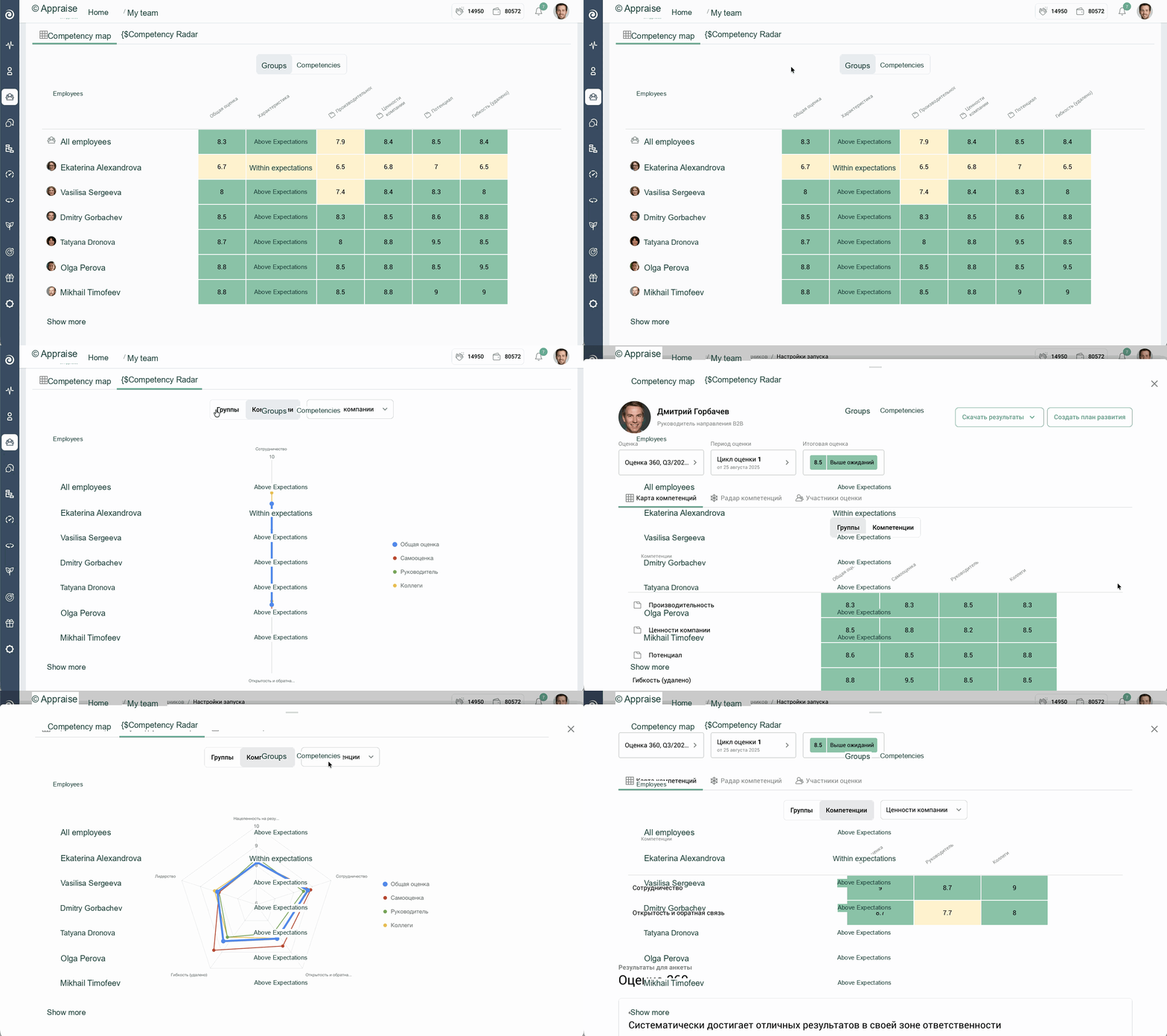
In Appraise, you can view detailed statistics for each survey, compare assessment cycles, and track problem areas on a heat map. This saves specialists time on manual analysis and turns assumptions into facts backed by data. You can download a detailed report as a ready-to-use presentation with heat maps, charts, and recommendations to share with a manager immediately.
Do Not Overlook a Well-Structured Exit Interview
The most challenging part of an employee’s final day is the exit interview. Combining it with exit-survey data allows you to view internal processes through the eyes of a departing professional, identify weaknesses, and find ways to improve them.
A Harvard Business Review study notes that more than 90% of Fortune 500 companies conduct exit interviews, yet only about 40% of surveyed employees at these companies consider the process genuinely useful.
It is important to prepare properly so that the interview and survey questions do not overlap. We also recommend grouping questions by sensitivity and ending with something more general or scheduling a brief moment of appreciation.
We have prepared a list of 45 questions you can ask in an exit interview to gather the most comprehensive feedback possible. Here are a few of them:
- Overall impressions and motivation: “What are you most proud of?” and “Were there any aspects of your work that disappointed or discouraged you?”
- Benefits and compensation: “Do you believe your salary does NOT reflect your skills and contribution to the company?”
- Career growth and development: “Are there any skills or experience you wanted to gain but could not?” and “Were learning and development opportunities available and useful?”
Collecting responses is only the beginning. It is important to analyze the results effectively before taking further action. Focus on identifying patterns, such as recurring reasons for leaving and trends within specific teams or departments.
Onboarding and Offboarding: An Integrated Employee Management System
Onboarding and offboarding are often treated as two separate processes. In practice, they form a single approach to managing the employee lifecycle.
A high-quality entry experience increases engagement and reduces early turnover. A high-quality exit helps refine processes and improve the next onboarding cycle.
Companies that:
- systematically collect feedback;
- supplement it with competency assessments;
- hold regular one-on-one meetings;
- analyze the reasons employees leave.
Stop relying on intuition and begin managing HR processes with data.
If you want to improve retention, start not by raising salaries but by analyzing an employee’s first 90 days and final 30 days. These periods contain more management insights than may be apparent at first glance.
Share