



Pulse surveys are short, regular employee surveys that help quickly identify risks and track changes in sentiment. This article provides a step-by-step implementation guide, sample questions, and common mistakes.
Contents
What are pulse surveys?
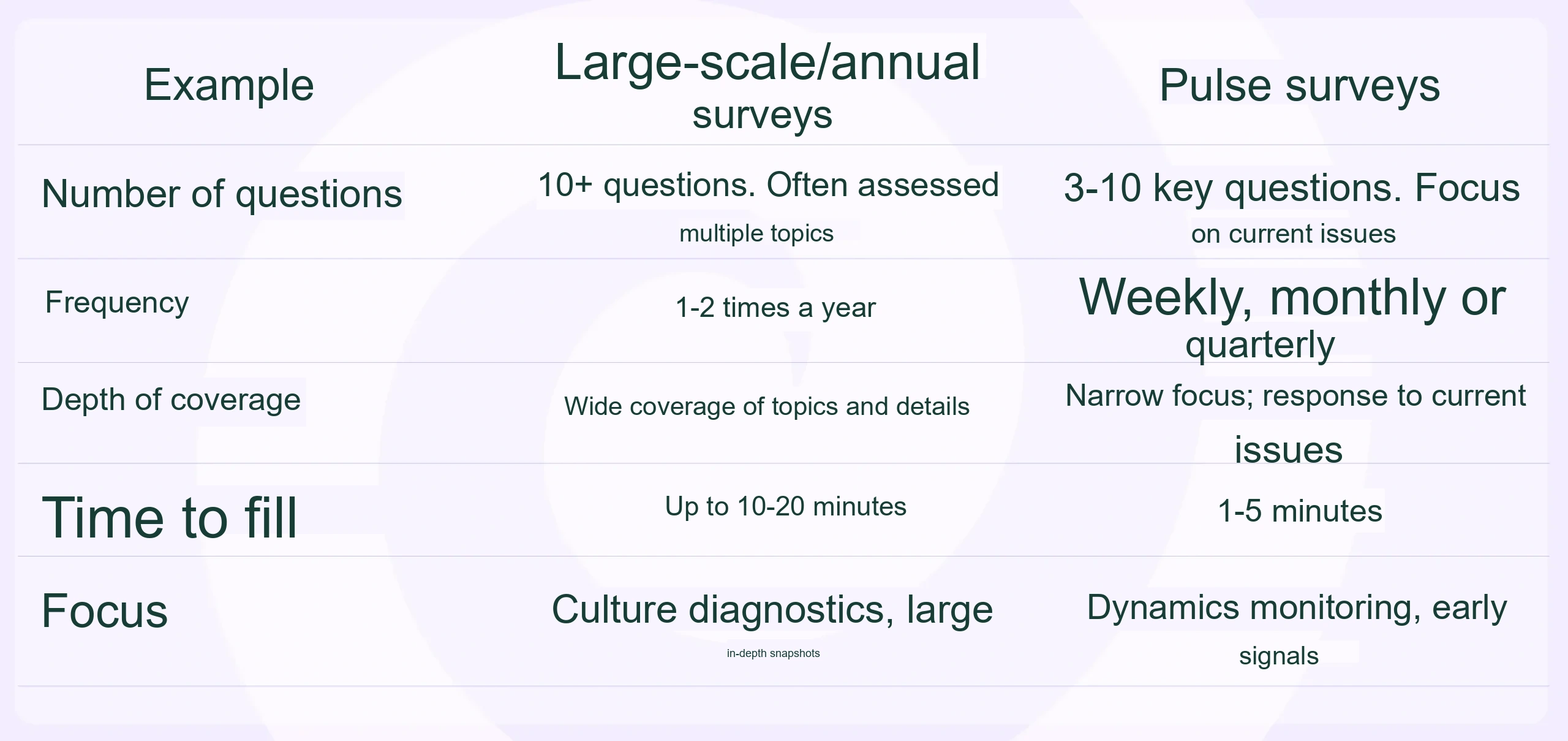
A pulse survey (pulse survey) is a short, regular employee survey that provides a snapshot of sentiment on key topics. It usually contains 3 to 10 questions, allowing the team to provide reliable data without survey fatigue.
The main rule for pulse surveys is consistency and prompt action. These surveys are not designed for in-depth research or collecting large volumes of data. The goal is to quickly capture sentiment on a specific issue and respond promptly to the team’s needs.
Key characteristics of pulse surveys:
- Simple closed-ended questions.
- A regular schedule (weekly, monthly, or quarterly).
- Similar anchor questions across survey waves to track trends.
- The flexibility to adapt topics to current HR and business priorities.
- Complete anonymity to encourage honest answers.
Important: pulse surveys do not replace large-scale studies such as engagement and loyalty assessments. Instead, they complement them with real-time signals.
How pulse surveys differ from traditional surveys and large-scale studies
Why pulse surveys have become popular
- Sensitivity to change. During internal change or external challenges, they provide early warning signs of risk and problem areas.
- Minimal burden on employees. Responses take only minutes, reducing fatigue and resistance.
- Building a feedback culture. Regular surveys and action on their results demonstrate that employee opinions influence the company’s internal processes.
- Connection to KPIs and business metrics. Companies increasingly see correlations between pulse survey trends and turnover, productivity, and retention metrics.
 The Future Forum report, which surveyed more than 10,000 employees in the United States, Europe, Japan, and other countries, notes that employees working in hybrid and remote formats who participate in regular surveys feel just as connected to their teams as office-based employees, or even more so.
Why businesses and HR need pulse surveys
Strengthening corporate culture
When employees regularly have an opportunity to voice their opinions and the company responds, they see that the organization is not simply conducting surveys for the sake of it, but is actively listening and taking action. This builds trust and encourages open dialogue.
Rapid assessment of employee sentiment
A leadership change, the launch of a new process, or a stressful phase of a project all require a rapid response. In these situations, a pulse survey provides an immediate snapshot.
For example, if surveys reveal low usability scores after a new CRM system is introduced, HR and IT can quickly revise the instructions or arrange training.
Increasing employee engagement
When people take part in surveys and see their opinions being considered, they feel more connected to the company and the business. This strengthens intrinsic motivation and employee loyalty.
What pulse surveys measure
These surveys most often cover the following areas:
- overall satisfaction / emotional climate;
- stress / burnout / well-being;
- purpose / mission / company values;
- work environment: communication, resources, support;
- relationships with leadership / management;
- understanding of goals and one’s role in the company;
- employee loyalty score (eNPS).
Important: some questions should remain consistent so that changes across departments and the company as a whole can be tracked between survey waves.
How to conduct pulse surveys effectively
Step-by-step guide
1. Define the survey objective
What exactly do you want to measure? For example: sentiment after restructuring, perceptions of hybrid work, or the impact of a new incentive program.
2. Select key topics and metrics
Choose 1-3 topics to track consistently, while adapting some questions to the current context.
3. Formulate the questions
Use Likert scales (1-5 or 1-7) and avoid ambiguous wording. Questions should be closed-ended. You may also include 1-2 optional open-ended questions.
Sample list:
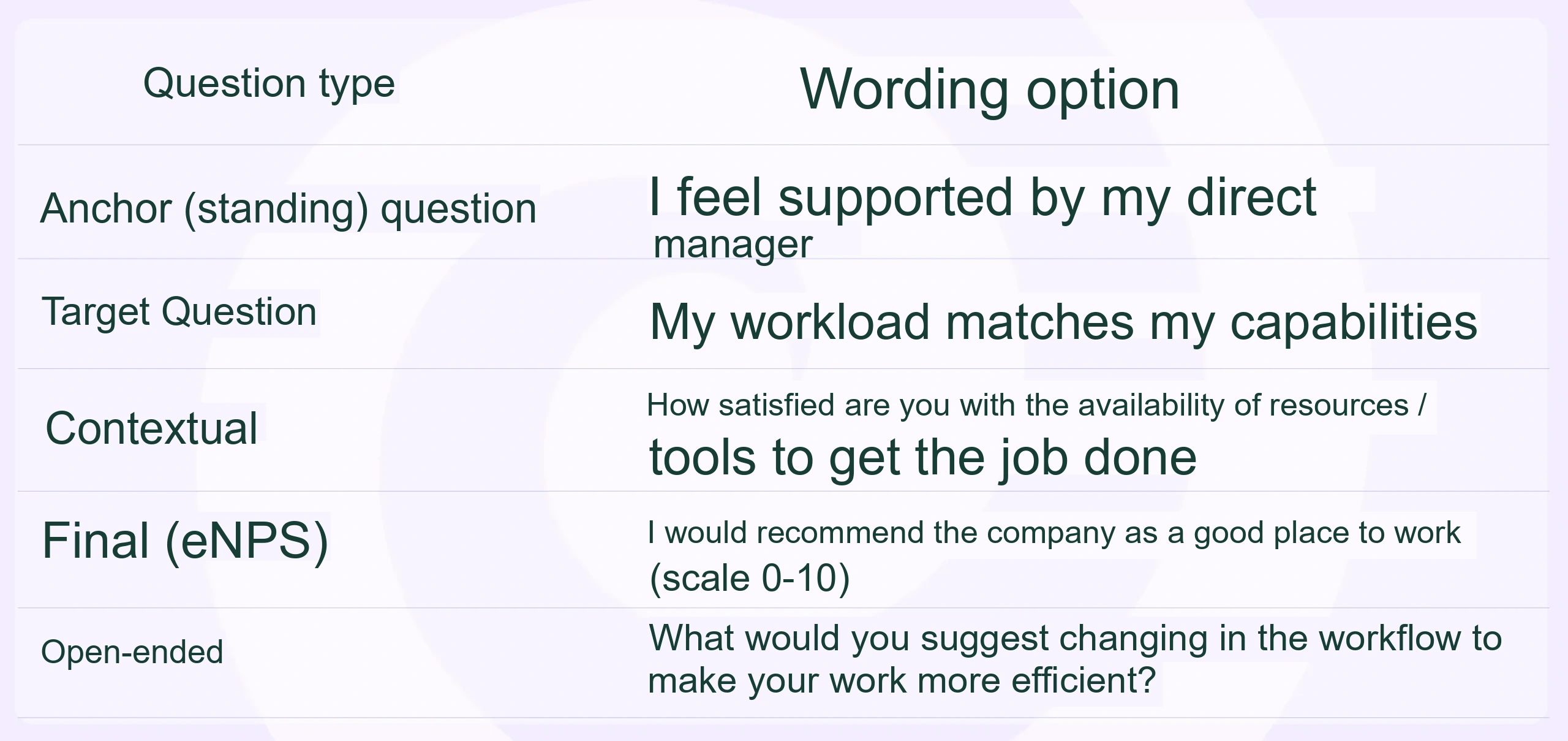
- I receive sufficient support from my manager.
- I have everything I need to do my job.
- I understand how my work contributes to the company’s goals.
- I would recommend the company as a good place to work (eNPS).
- Open-ended question: what would help you be even more effective?
4. Select the survey frequency
At launch, consider starting quarterly to avoid overwhelming employees.
For mature HR processes, run surveys monthly or every 6-8 weeks.
5. Ensure confidentiality / anonymity
Clearly state at the beginning that all responses are anonymous. This will encourage more honest answers.
You can add a minimal set of demographic attributes (department, location, work format) to analyze results across relevant segments.
6. Send the survey and reminders
Send an email / notification explaining the survey’s purpose and estimated completion time. Send reminders 1-2 days before the survey closes.
7. Collect and analyze the results
Analyze the results across different segments and identify trends and insights from open-ended responses. AI is the easiest way to do this.
If pulse surveys have been conducted before, compare the results with previous cycles to identify areas of improvement and problem areas.
8. Develop an action plan
Select 1-2 key areas that require change and assign owners. Be sure to set clear deadlines.
9. Present the results
Share the main findings and action plan with the team. Explain why these particular actions were selected.
10. Monitor progress
Track the status of the selected actions and assess changes in the next survey wave.
If you want to launch a pulse survey without Excel or manual analysis, Appraise lets you create a template in 5 minutes and automatically receive department-level data.
Examples of effective questions
Metrics and their interpretation
Every business designs pulse surveys around its specific needs, so the metrics tracked will vary from company to company. However, the following universal indicators provide a useful starting point:
- Average score (for example, 3.2 out of 5).
- Percentage of top ratings (the share of respondents who selected 10 out of 10).
- Change between waves – increase / decrease.
- Correlations between drivers (such as management support) and outcome metrics (such as eNPS or employee satisfaction).
- Segmentation by department, tenure, and location.
- Key themes from open-ended responses – clusters and recurring requests.
- Heat maps by department/location.
It is important to consider how tracked metrics change over time. Without historical data, the meaning of a specific score for a particular company may be unclear. Is an eNPS of 30% good or bad for us? This question cannot be answered until the company has established internal benchmarks.
Case study: how pulse surveys reduced turnover at an IT company
At a company with 230 employees, signs of team overload emerged during a period of rapid growth. KPIs were formally being met, but sick leave and voluntary resignations increased.
HR launched monthly pulse surveys with five questions:
workload level;
quality of communication with the manager;
availability of resources;
work-life balance;
eNPS.
After the second wave, scores for the workload category had already declined within the engineering team.
The department head held a series of 1-1 meetings, redistributed tasks, and hired two additional employees.
After three months:
the average workload score increased from 3.1 to 4.2;
eNPS increased by 18 points;
turnover in the affected department fell by 27%.
The key factor was not the survey itself, but its regular cadence and the prompt management decisions made after each wave. This impact is only possible with consistent surveys and thorough analysis of the data collected.
7 common mistakes when conducting pulse surveys
- Surveys are too frequent
– employees become fatigued and completion rates decline.
Solution: run surveys no more than once a week, and preferably less often, while monitoring whether completion rates are falling. - Too many questions
– the survey becomes burdensome, so people either abandon it or select answers at random.
Solution: use no more than 5-7 closed-ended questions and one open-ended question. - No action after the survey
– if employees repeatedly report the same issue but see no change, completing surveys loses its purpose.
Solution: always respond to key or recurring requests and present an action plan to the team. - Lack of anonymity
– people may be afraid to answer honestly, especially on sensitive topics.
Solution: clearly communicate the anonymity policy and define appropriate report access levels. - Questions change constantly
– the HR team loses the ability to identify trends and track changes.
Solution: retain anchor questions in every wave. - No segmentation
– an average result can conceal groups or departments experiencing problems.
Solution: analyze results separately by department, region, company tenure, and other relevant segments. - Responding to anomalies without further validation
– random statistical spikes can lead to incorrect decisions.
Solution: review results over time and validate hypotheses through methods such as in-depth studies or employee interviews.
Tools for conducting pulse surveys
When selecting survey tools, consider:
- the ability to segment responses by important attributes;
- clear dashboards and intuitive data visualization;
- the ability to export data in any format;
- scheduled automatic survey launches and automatic reminders for those who have not completed the survey;
- response anonymity and data protection;
- AI-powered analysis of open-ended responses.
All these features are already available in Appraise, ensuring that launching surveys does not take much of the HR team’s time. Popular survey templates are also available for a quick start: use them as-is or tailor them to your needs.
Frequently asked questions about pulse surveys
1. How often should pulse surveys be conducted?
The optimal frequency depends on the maturity of your HR processes. A quarterly format is a good starting point. In fast-changing companies, surveys can be conducted monthly or every 6-8 weeks.
The key is to maintain a regular cadence without overwhelming employees.
2. How many questions should a pulse survey contain?
The optimal format is 3-7 closed-ended questions and one open-ended question. More than 10 questions increases fatigue and reduces response quality.
3. Should pulse surveys be anonymous?
Yes, especially when questions concern leadership, workload, or the internal climate. Anonymity encourages honest answers and increases trust in the process.
4. How does a pulse survey differ from an annual engagement survey?
An annual study provides an in-depth assessment of culture and processes. Pulse surveys provide regular snapshots of sentiment, enabling a rapid response to change and timely adjustments to management decisions.
5. Can eNPS alone be used as a pulse survey?
eNPS is a useful indicator, but it does not reveal the reasons behind the score. To understand what influences it, add topic-specific questions about workload, communication, and resources.
6. At what company size do pulse surveys become worthwhile?
There is no minimum threshold. However, pulse surveys are particularly useful in companies with 50-70 employees or more, when it becomes difficult for a manager to keep a finger on the pulse without systematic tools.
Conclusion
Pulse surveys are not just another questionnaire, but a systematic approach to meaningful dialogue with employees. When we listen, analyze, and respond regularly, we create a culture in which people feel heard and engaged, and are therefore more motivated to achieve the company’s business goals.