



NPS (Net Promoter Score) is a popular tool for measuring loyalty. In HR management, it helps identify key organizational issues, improve employee engagement, and create a more supportive work environment. In this article, we explain the differences between NPS and eNPS, share best practices for using eNPS in surveys, and provide ready-to-use questions for various HR scenarios.
What NPS is and why it is used
NPS is a metric that measures customers’ willingness to recommend a company or its products to others. The methodology is based on a simple question: “How likely are you to recommend our company or service to your friends or acquaintances?” Responses are rated on a scale from 0 to 10, where:
- 0-6 – detractors: employees who are dissatisfied with the company.
- 7-8 – passives: satisfied, but not active advocates.
- 9-10 – promoters: actively recommend the company.
The formula is quite simple:
NPS = % promoters − % detractors
NPS vs. eNPS: what is the difference
Employee Net Promoter Score (eNPS) is an adaptation of the traditional NPS used to assess employee loyalty within a company. It focuses on how willing employees are to recommend the company as a place to work. eNPS provides a quick assessment of the internal climate, reveals potential issues, and identifies the organization’s strengths. Its calculation formula and score ranges are the same as those of the standard NPS.
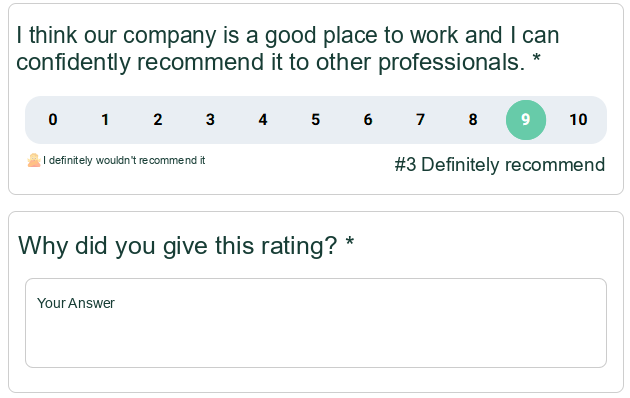
Example of an eNPS question with an option to leave a comment
NPS (Net Promoter Score)
eNPS (Employee Net Promoter Score)
Focuses on overall customer loyalty to a brand or company
Is an adaptation of NPS for internal use within companies
Key question: "How likely are you to recommend the company/product to your friends or acquaintances?"
Key question: "How likely are you to recommend the company as a place to work to your friends or acquaintances?"
Used to assess customer satisfaction and willingness to recommend the company or its products
Assesses employees' loyalty to and satisfaction with their work and the company
Often used in marketing, sales, and service delivery
Used by HR to monitor the internal climate, employee engagement, and workforce sentiment
How to use eNPS effectively
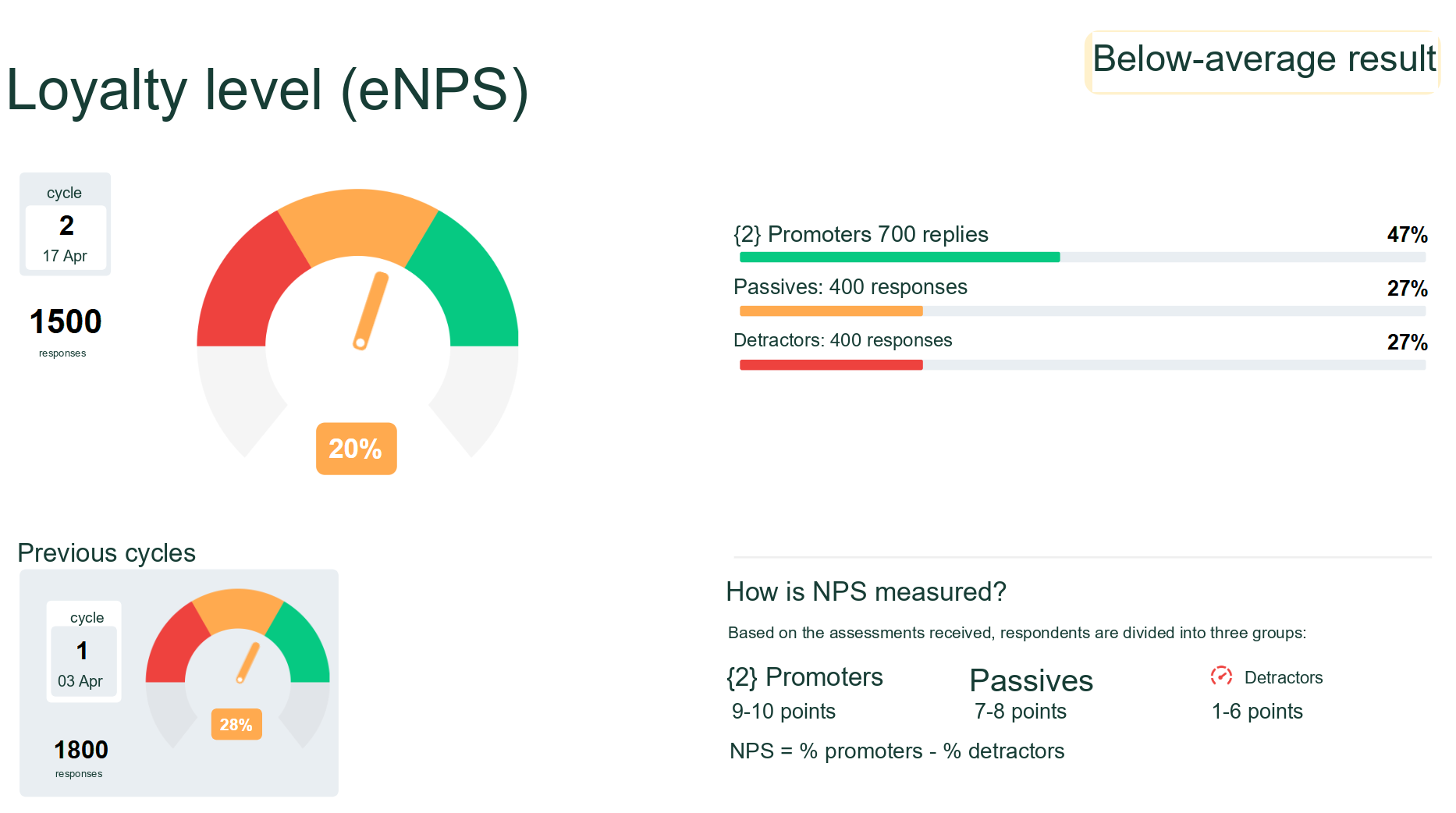
Overview of eNPS results from an engagement and loyalty survey, including previous survey cycles
To obtain the most useful and reliable results, consider several factors:
- Choose the right time. Conduct the survey when employees can provide an objective assessment, such as after a major project, an annual performance review, or an onboarding period.
- Ensure anonymity. To receive honest responses, employees need to feel safe and able to express their opinions openly.
- Add open-ended follow-up questions. To understand the reasons behind the responses, supplement the survey with questions such as: “What do you like most about working at our company?” or “What do you think could be improved?”
What to do with your eNPS results
Interpreting eNPS correctly is essential for making informed decisions about next steps. Benchmarks vary by industry, but the scores can generally be interpreted as follows:
Low eNPS (-100 to 0)
Indicates serious organizational issues, such as dissatisfaction with working conditions, weak leadership, or a toxic corporate culture.
- Conduct additional surveys or interviews to understand the root causes.
- Develop an action plan to improve working conditions, and review employee communication and support.
- Clearly explain to the team what steps will be taken.
Moderate eNPS (1 to 30)
Indicates that the company has satisfied employees, but loyalty is not yet strong enough.
- Work on strengthening corporate culture and engagement.
- Improve career development opportunities and the feedback system.
- Communicate regularly with employees about improvement plans.
High eNPS (31 to 100)
Shows that most employees are satisfied with their work and willing to recommend the company.
- Maintain the current level of satisfaction while avoiding stagnation.
- Recognize employee achievements and share the team’s successes.
- Use the results as an example in external HR branding.
Examples of other NPS questions in HR
Although NPS is generally used to measure loyalty to a company or its product, this question type can also serve other purposes, such as assessing the performance of departments or the company’s internal processes. Here are examples of questions that can be used in surveys in an NPS format:
- How likely are you to recommend our company as an employer to your friends or acquaintances? (eNPS)
- How would you rate the level of support you receive from your team?
- Are you satisfied with the career opportunities provided by the company?
- How comfortable do you feel within the corporate culture?
- To what extent does the company provide the resources you need to do your job?
- How would you rate the transparency of internal communication?
- How effectively does management act on employee feedback?
- Are you satisfied with your current work-life balance?
- How would you rate the level of fairness and equality within the company?
- How likely are you to remain with our company for the next 2 years?
Get free ready-to-use NPS survey templates for service departments – learn how to structure questionnaires and download a sample report that can be generated automatically when you run a survey through Appraise.
NPS survey templates for service departments