



In this article, we explain how to use the Johari Window in business to increase transparency and trust among employees.
Contents
What Is the Johari Window?
Definition and History
The Johari Window is a psychological model that describes a person’s strengths and areas for growth based on their level of self-awareness and how well others know them.
The model was developed in 1955 by American psychologists Joseph Luft and Harrington Ingham. Its name combines the first syllables of their first names.
The model is used in employee management and training, coaching, and corporate culture development. Its simple visual structure provides a clearer understanding of how people see themselves and how others perceive them, helping identify opportunities for more effective collaboration in business.
Model Structure: Four Areas of Perception
The Johari Window consists of four areas, each reflecting a particular type of information about a person and their behavior.
Consider the example of Anna, a head of sales.
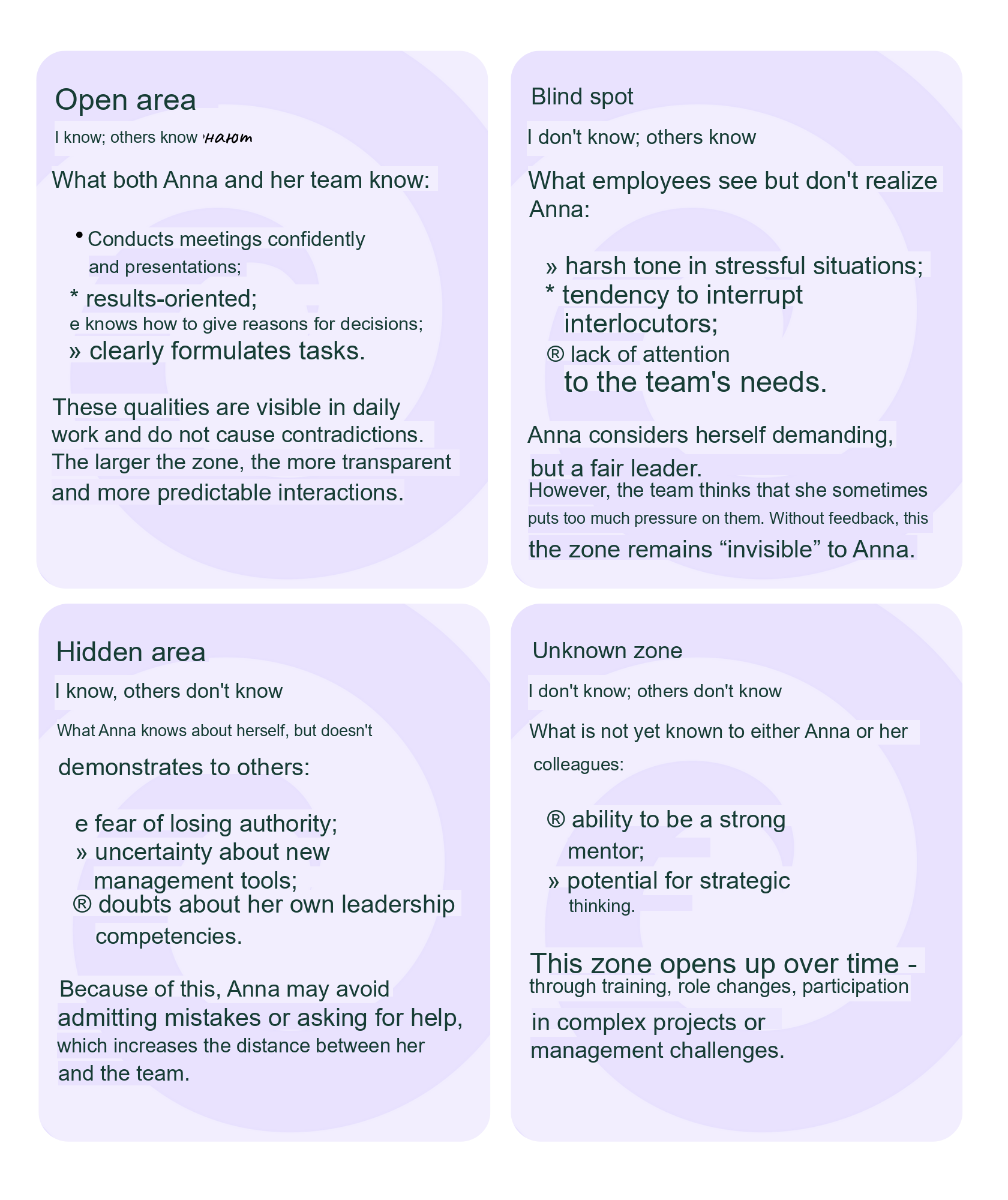
Open Area (Arena)
The open area contains information known both to the person and to others. This includes professional skills, communication style, values, and evident strengths. The larger this area, the easier it is to build trusting relationships within a team.
In business, a well-developed open area means transparency, predictability, and mature communication. Managers with a large open area find it easier to build dialogue, gain team support, and resolve conflicts more quickly.
Blind Area (Blind Spot)
The blind area includes qualities and behavioral traits that others notice but the person is unaware of. These are often habits, intonation, reactions to stress, or management mistakes.
For example, an employee may believe they behave appropriately, while the team perceives them as harsh or reserved. Working with this area is directly linked to a culture of feedback. If colleagues do not typically give one another feedback within a company, no one will learn about their blind spots.
Hidden Area (Facade)
The hidden area contains information known to the person but intentionally concealed from others. This includes fears, doubts, and past experiences.
At work, a large hidden area reduces trust. However, it is important to respect boundaries: the model is not intended to encourage complete openness, but rather a conscious choice about what a person is willing to share to improve collaboration.
Unknown Area (Unknown)
The unknown area comprises potential, abilities, and reactions that are unknown both to the person and to others. It emerges in new circumstances, such as a change of role, a crisis, or participation in challenging projects.
This area is particularly important for businesses because it contains growth opportunities and hidden talents that can provide a strong foundation for building a talent pool.
How to Use the Johari Window
Methods for Working with the Johari Window
The primary goal when working with the model is to expand an employee’s open area. This is achieved through regular feedback:
- one-on-one meetings with a manager;
- performance reviews or 360° assessments;
- pulse surveys;
- team retrospectives;
- requests for situational feedback (instant feedback);
- coaching sessions, etc.
With Appraise, you can launch an employee assessment in just two minutes and receive an automatically generated report in presentation format. The Johari Window is completed automatically based on respondents’ answers.
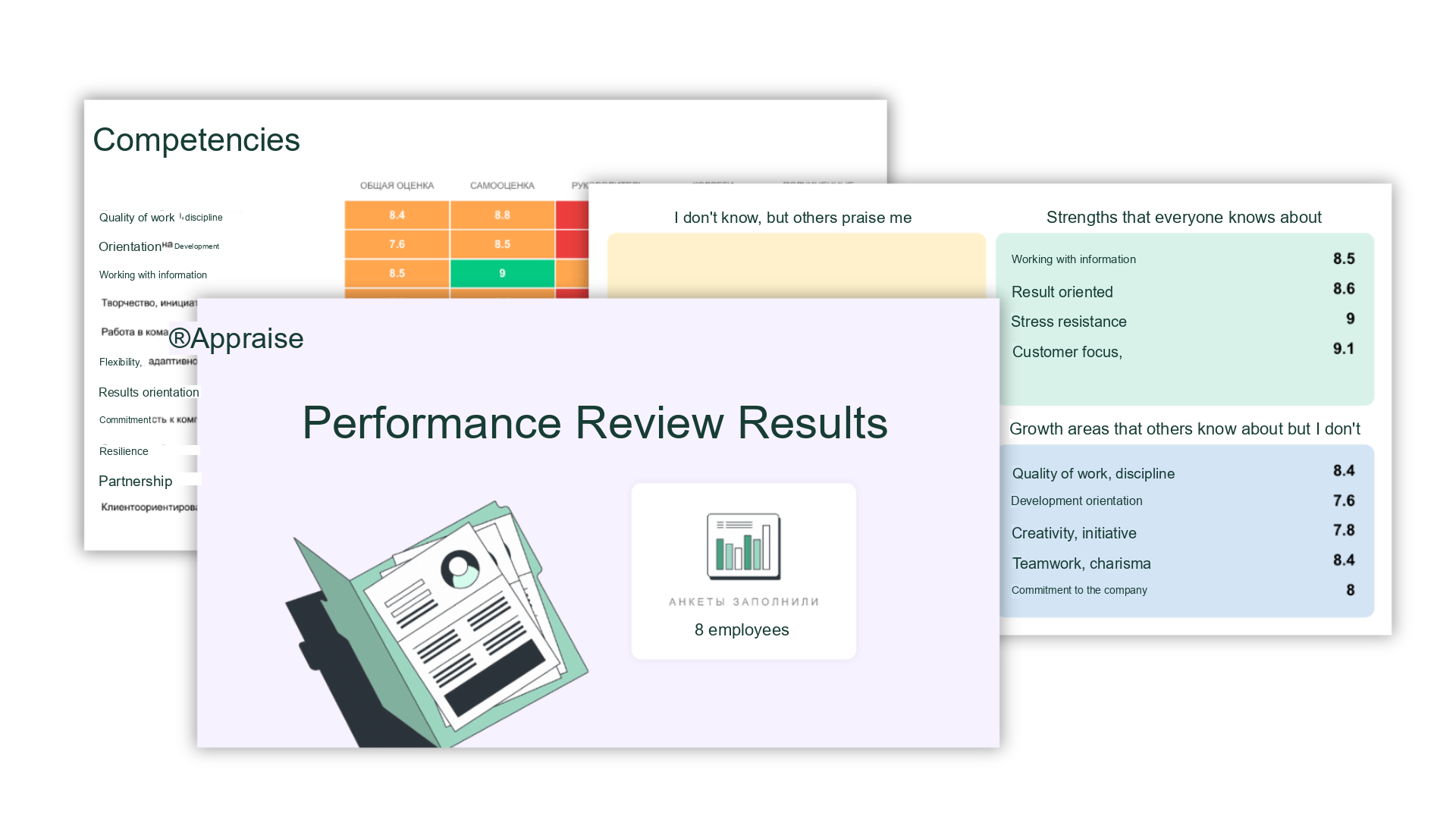
Download the Performance Review guide to learn more about assessments in Appraise.
All these tools help safely reduce the blind and hidden areas, improving the quality of team communication. However, they must be used with constructive feedback and psychological safety.
Benefits of Using the Johari Window in Business
The model’s popularity stems from its clarity, versatility, and practical applicability. The Johari Window requires no complex preparation and is easily adapted to different business needs, from onboarding to leadership development.
Building Trust Within Teams
Teams with a well-developed open area reach agreements faster, experience fewer conflicts, and adapt better to change. The Johari Window helps identify communication barriers and ease tensions between roles and levels of hierarchy.
Improving Management Style
For managers, the model is a tool for understanding their impact on the team. Working with blind areas helps them adjust their management style, increase employee engagement, and reduce turnover.
Supporting a Culture of Open Dialogue
Companies that use the Johari Window as part of their culture create an environment where asking questions, discussing challenges, and talking about development are normal. This is especially important for distributed teams and fast-growing businesses.
Limitations and Important Considerations
The Johari Window does not replace a comprehensive employee assessment. It is only one component and a convenient way to visualize data. However, if you decide to use it as a standalone employee diagnostic tool, make sure your company has a well-developed feedback culture.
Not all employees feel safe when receiving negative feedback. Only at companies with a transparent culture do people view developmental feedback not as criticism (or grounds for dismissal), but as support from colleagues and an opportunity to improve their skills.
Assess how well developed your company’s feedback culture is, or learn how to improve it.
Key takeaways
The Johari Window is a simple tool that helps businesses develop communication, trust, and conscious leadership. When used effectively, the model becomes a foundation for sustainable team growth and unlocking human potential.