


Myths about HR negatively affect not only how the profession is perceived, but also HR processes. As a result, tools designed to improve employees’ working conditions become ineffective. In this article, we examine which myths are easy to dispel and which are actually true.
Contents
Myth 1. 360-degree feedback is one of the most objective assessment tools
360-degree feedback is a powerful tool that can easily be “gamed” when used incorrectly: problems arise when HR leaves it to employees to distribute their own questionnaires. On the one hand, this increases engagement in the process. On the other, the assessment loses its objectivity.
A Harvard Business Review study found that 30% of managers believe 360-degree feedback results may be distorted by colleagues’ personal preferences or biases.
- Set rules for selecting respondents. You can do this manually or use third-party tools.
- Refine the questionnaires. Add marker questions and remember to include screening questions: When did you last work with the employee? How often are you their internal client?
Myth 2. Performance Reviews are only needed to assess KPIs
A Performance Review (PR) is more than just a report on KPI achievement. It is a tool for employee development, feedback, and goal setting. It should not be viewed solely as a means of control. A PR can motivate the team and help it grow.
According to a Willis Towers Watson study, companies that implemented agile performance management systems were 1.5 times more likely to report financial performance above the market average and 1.25 times more likely to report higher productivity.
Conducting a Performance Review requires deep self-reflection from the team. Unfortunately, successes and failures are rarely documented as they happen, which reduces the tool’s value. Performance Reviews should therefore be supplemented with other solutions.
1. Set goals, not KPIs
The three most popular goal-setting frameworks are:
- SMART — Specific, Measurable, Achievable, Relevant, Time-bound. This classic framework is used for personal, project, and corporate goals, helping make them clear and measurable.
- CLEAR — Collaborative, Limited, Emotional, Appreciable, Refinable. Here, goals are the result of a collective effort. The framework emphasizes collaboration, emotional engagement, and the ability to make adjustments along the way.
- FAST — Frequently discussed, Ambitious, Specific, Transparent. This modern approach is particularly effective in strategic and team planning, where rapid adaptation and flexibility are essential.
💡Interesting fact: these frameworks are also successfully used to set tasks.
The traditional approach to goal setting cannot keep pace with market changes. This is precisely why large companies have begun looking beyond SMART to FAST. These companies include: Google, Burger King, and Kraft Heinz.
OKRs (Objectives and Key Results) are an example of goals based on the FAST framework.
The OKR system focuses on setting ambitious objectives and measurable key results. It allows employees to see how their work contributes to the company’s overall goals and motivates them to achieve outstanding results.
2. Regular one-on-one meetings
Hold brief weekly or monthly meetings where employees and managers can discuss progress, challenges, and goals. This will help you make timely adjustments and sustain engagement.
3. Real-time feedback exchange
Build continuous feedback from peers, direct reports, and managers into the company culture. This will help employees adapt and develop more quickly.
Companies with a strong feedback culture have 31% higher engagement. Feedback is not just praise, but also a retention tool: employees whose achievements are recognized and valued are four times more likely to stay with the company.
This can include:
- developmental feedback — helps people adjust their actions and grow faster;
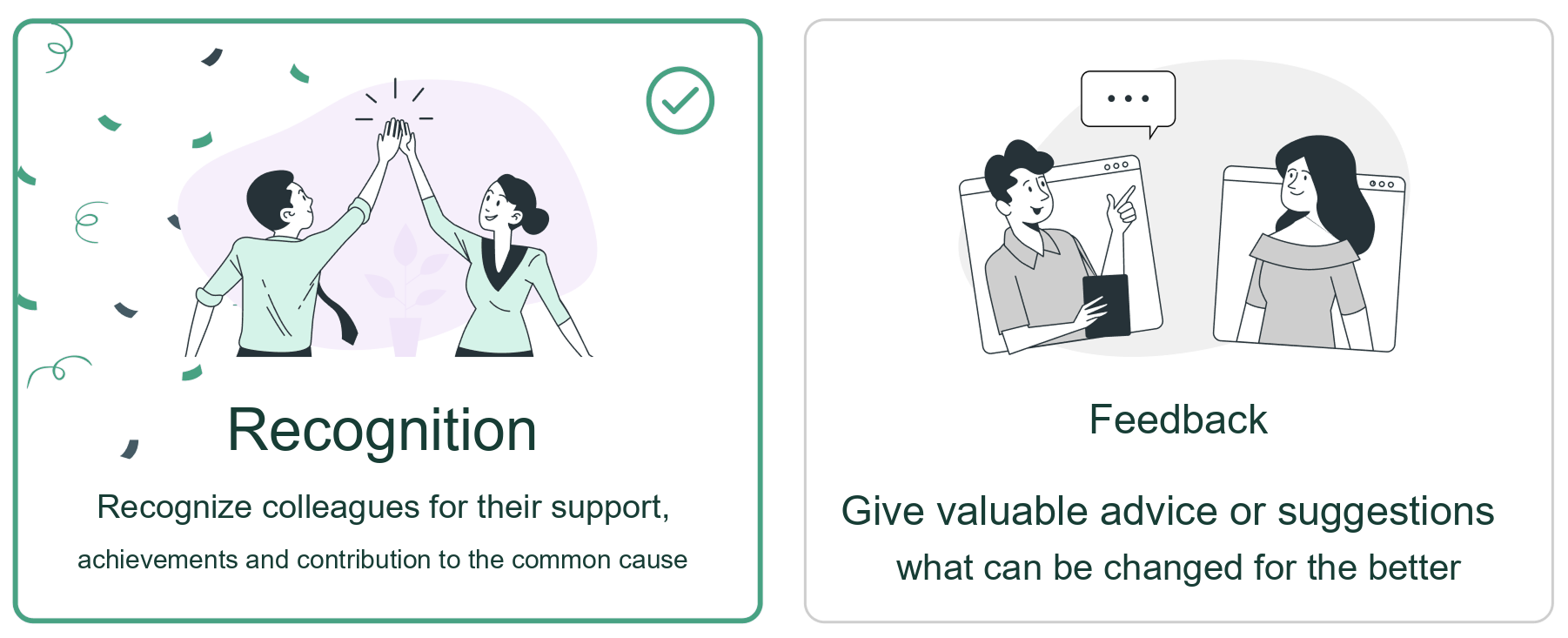
- public recognition — strengthens a culture of appreciation;
- cross-functional feedback — highlights an employee’s contribution to other teams’ work;
- recording a demonstrated competency — when you want to highlight a specific skill or behavior;
- requesting situational feedback — to prepare quickly for a one-on-one by gathering project outcomes.
Myth 3. HR analytics is complex and expensive
Yes, this myth is actually true, but only partly. Analytics in any field is an expensive and complex tool that requires attention and resources.
Why has HR come to see analytics as an overwhelming task? HR professionals typically use numerous tools to collect feedback and conduct surveys and assessments. Weeks of manual work consolidating data from hundreds of Excel files leads to frustration, making it nearly impossible to obtain a clear overall picture.
A BCG study found that 70% of HR department leaders consider analytics a key decision-making tool, but only 15% of companies use it to its full potential.
Analytics costs can be reduced by taking a gradual approach: start with basic metrics and progressively make the system more sophisticated.
We have prepared short cheat sheets to help you find your bearings or… realize that it is time to move to the next level.
Beginner level
An excellent choice for small teams and HR professionals who are just beginning to take a systematic approach to data: when you want to understand what is happening without complex tools or high costs.
At the most basic level, tracking headcount, employee turnover, and average employee tenure is enough to understand the company’s overall processes.
Quick to implement, requires minimal investment, and provides a general overview of HR processes.
The metrics do not provide deep insight into causes and can be misleading without context. Hidden problems and behavioral patterns generally remain undetected.
It is time to move forward if you often ask “why” and cannot find the answer. This means basic metrics are no longer enough.
For example, Experian analyzed employee turnover and compared it with team sizes. This helped the company save approximately $10 million in one year. It found that employees in teams of more than 10 people were almost twice as likely to leave, leaving the company to optimize its organizational structure.
Advanced level
Suitable for HR teams that are ready to examine processes more deeply and make data-driven decisions. Most importantly, you should only move to this stage when you have the time and people required for in-depth data analysis.
At this level, metrics such as employee engagement, employee loyalty, and the percentage of internal appointments come into play.
Provides deeper insight into employee behavior and the factors that influence retention. You can forecast risks, build career paths, and make strategic HR decisions.
Specialized tools and data expertise are required. Surveys must be conducted regularly to deliver value.
It is time to move forward when the person-hours required for data processing begin to spiral. You can see relationships and want to go further, look deeper, and begin to make a meaningful impact on business results.
For example, Best Buy increased operating profit by $100,000 per store by raising engagement by just 0.1%. Regular eNPS measurements helped reveal this relationship.
Expert level
And now we have reached the summit. This is where HR does not merely track metrics, but influences the business. At this level, we are talking about accurate forecasts, automated reports, and data that can support discussions with leadership.
The HR team uses every tool available: assessment tools, advanced analytics solutions, AI assistants, and more.
Enables accurate risk forecasting, HR budget optimization, and a stronger position for the company in the labor market.
Without automation tools, this workload snowballs, consuming time, reducing accuracy, and creating business problems:
- the cost of replacing one employee can reach 200% of their annual salary;
- routine operations consume up to 80 hours per HR professional each year;
- poor data visibility hinders decision-making.
If your reports become outdated faster than you can prepare them and your employees are overwhelmed with data collection, Appraise will help you bring order to the process and focus on decisions rather than routine work.
At Appraise, we place a strong emphasis on collecting objective data and automating analytics. You can easily compare assessment cycles and apply filters by group or specific parameters. In just a few clicks, you can download detailed reports with conclusions and competency development recommendations, or ready-made presentations that can be shared with leadership immediately.