




The Appraise team surveyed 515 representatives of Russian companies: HR directors, HR business partners, and HR professionals. We explored how companies streamline and automate their processes, how they measure effectiveness, and which tools they prioritize. We also looked at what hinders automation and how allocating a budget for it relates to the adoption of HR analytics.
Key findings
- Automating basic tasks is the top priority
- As companies grow, their focus shifts to employee development
- HR processes are most mature in finance and IT
- Near-term plans include automating onboarding, assessment, and development processes
- Key HR performance metrics are time to fill and HR ROI
- Exit interviews are the primary tool for employee assessment and management
- The main barrier to HR process automation is financial
- Only 47% of Russian companies measure the effectiveness of implementing HR automation platforms
- 43% of companies that measured the effectiveness of HR automation will increase their automation budgets
Automating basic tasks is the priority, while companies are moving toward strategic processes selectively and gradually
The most streamlined and automated processes relate to hiring and day-to-day HR operations: payroll, personnel records, and recruitment. These form the foundation of HR departments.
Processes related to employee development and retention are less streamlined and automated. These include onboarding, training, surveys, employee assessment, compensation, and benefits.
Complex strategic processes are the least streamlined and automated: goal setting and feedback. Individual development plans are at the bottom of the list.
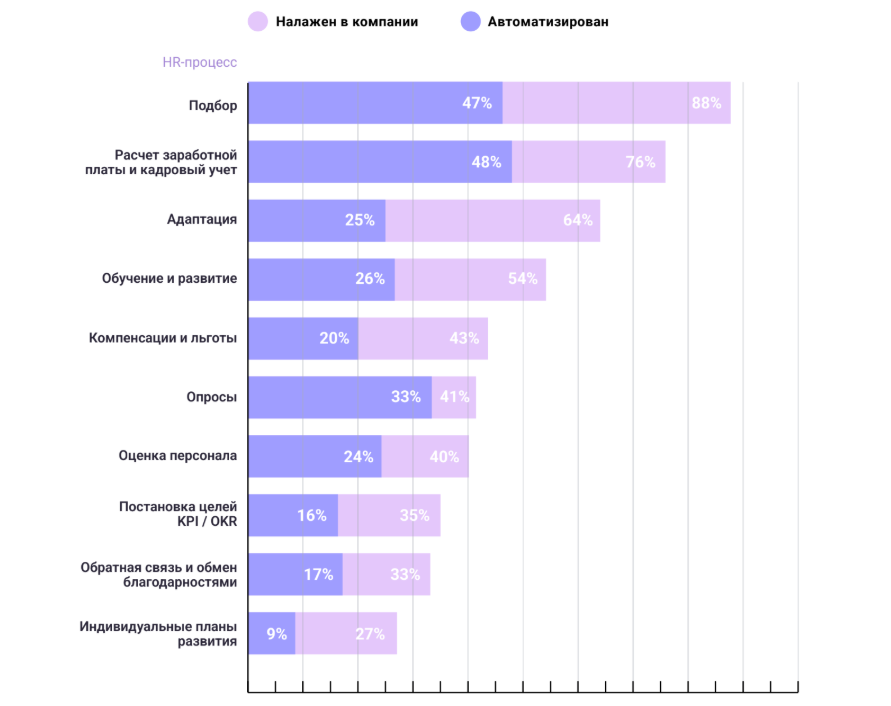
Which processes are streamlined and automated at Russian companies. Appraise research findings
🔍 20% of companies have not automated a single HR process, including companies with more than 500 employees. A lack of automation increases the risk of losing the competition for candidates, especially amid a talent shortage. At the same time, this indicates enormous potential for the adoption and development of HR tech solutions.
As companies grow, their focus shifts to employee development
For small businesses, automating employee assessment is the priority. Onboarding, surveys, and goal setting are equally important.
As businesses scale, they increasingly automate surveys and feedback, make greater use of compensation packages, and establish processes for goal setting and individual development plans. Onboarding ceases to be a separate process and becomes part of a continuous employee development cycle.
Large companies focus on individual development plans and onboarding. In addition, mid-sized businesses emphasize automating employee assessment. Payroll and personnel records are the lowest priorities because companies have already automated these processes.
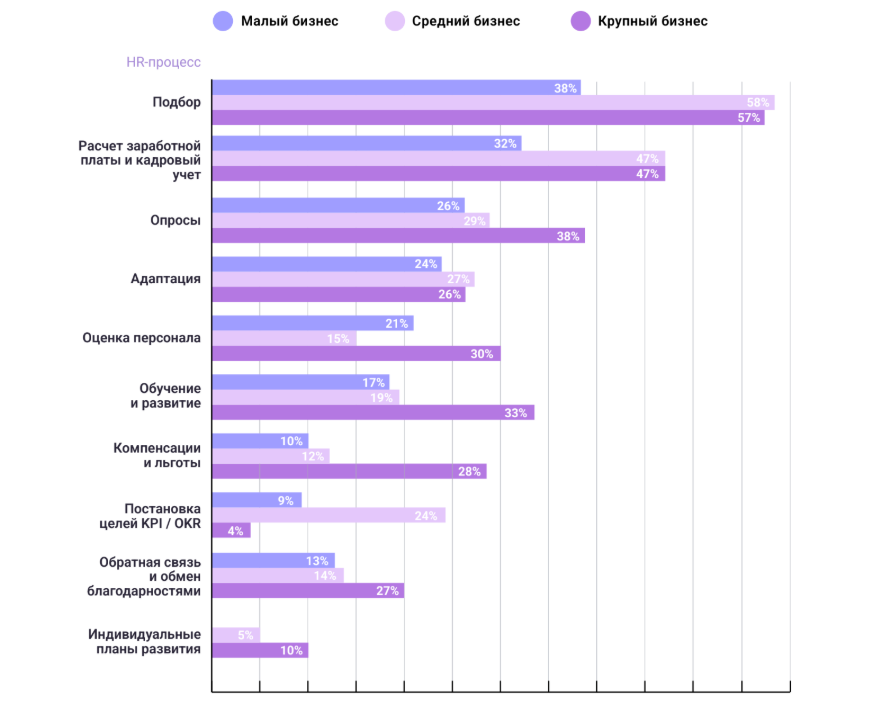
Automation priorities by company size. Appraise research findings
The research findings reflect our clients’ experience. Small businesses are focused on hiring and onboarding, using survey tools to measure the effectiveness of company onboarding and analyze exit interview data. Their primary goal is to staff their teams and analyze the reasons for employee departures from different perspectives. They need to understand how closely expectations at the hiring stage match reality and how managers and mentors immerse employees in the company culture and team.
The talent shortage becomes less acute for mid-sized businesses. Their priorities are to train employees and develop their skills, retain them, and maintain stable team performance. Assessment processes begin to emerge at this stage: HR professionals seek to identify core competencies, break them down into indicators, and select an assessment tool and method suited to the company culture.
At large companies, the priorities are timely workforce decisions, maintaining a target share of high-performing and high-potential employees, and building a talent pool. Other priorities include identifying the company’s key growth areas and defining development paths for leaders and their strong deputies.

HR processes are most mature in finance and IT
Companies in these industries actively automate processes and use advanced HR tools: analytics, 360-degree assessments, and regular feedback.
Maturity ranges from low to moderate in industries with high employee turnover: retail, construction and real estate, and consulting. This compels companies to focus on recruitment and onboarding.
Basic process maturity is most common in manufacturing, education, and healthcare. Companies in these industries focus on personnel records and payroll.
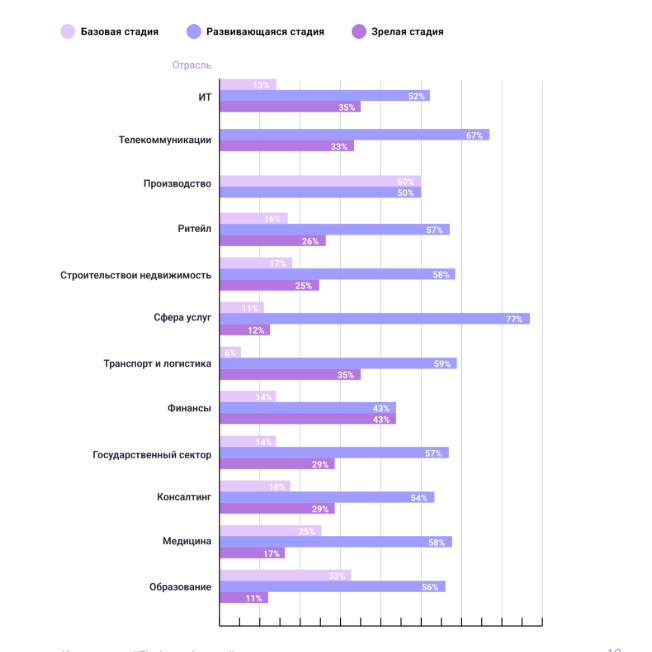
HR process maturity across industries. Appraise research findings
In the coming years, companies will focus on automating onboarding, assessment, and development processes
In 2025-2026, companies plan to automate an average of 2.8 processes. These will be incremental changes, as businesses are not ready to configure a large number of processes at once.
Companies recognize that high-quality onboarding directly affects new employee retention and time to productivity.
Automating employee assessment and training is also high on the business agenda. This demonstrates a shift in focus from operational tasks to strategic talent management and human capital development.
Companies that have already established these processes plan to automate individual development plans and the setting and tracking of goals (KPIs and OKRs).
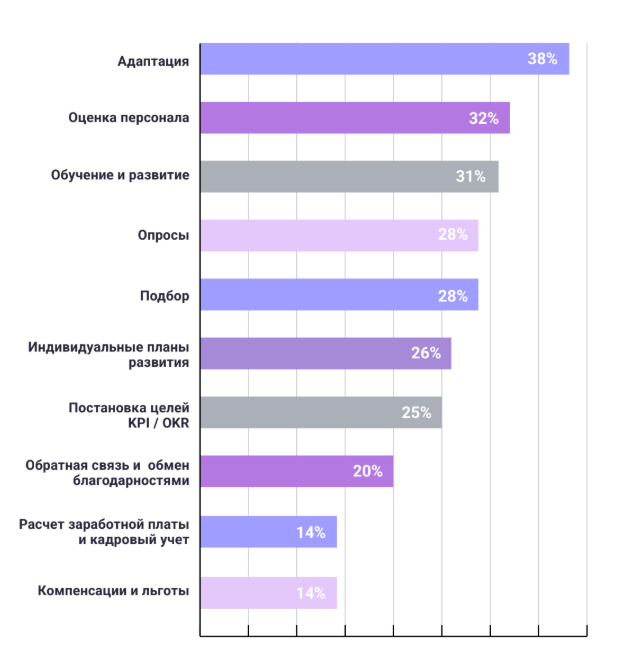
Automation plans for 2025-2026. Appraise research findings
We will not see any dramatic changes in HR automation in the near future. Many companies still manage recruitment in Excel, so even automating basic processes remains a major area for growth and development.
In the long term, companies need comprehensive HRM systems that integrate all processes in one place. This is especially relevant for large corporations: rather than assembling solutions piecemeal like Frankenstein’s monster, they will prefer a unified HR system with all processes already built in.

Key HR performance metrics for small and mid-sized businesses are time to fill, while for large companies the key metric is return on employee investment
Cost per hire, employee turnover, time to productivity, the loyalty index, and the engagement index are also important to small and mid-sized businesses.
Companies with 300 or more employees focus on return on investment in their workforce (HR ROI). Quality of hire, the engagement index, employee turnover, and the employee retention rate also matter to them. Companies want to understand and see the return on their HR investments, making performance indicators a driver of strategic decisions.
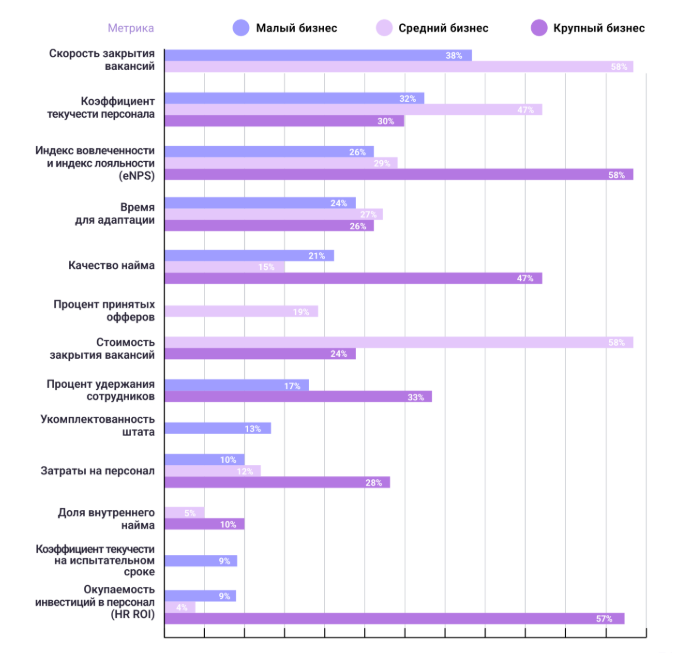
Key HR performance metrics at Russian companies. Appraise research findings
 The shift from operational to strategic HR metrics is a key trend for the coming years. Amid intense competition for talent and rising employee costs, companies understand the importance of working with strategic metrics. The HR department is evolving into a strategic partner that directly influences the company’s financial and management outcomes.
Exit interviews are the primary tool for employee assessment and management
HR professionals track why employees leave, and this information in turn helps retain those who remain with the company. Engagement and loyalty surveys rank second in popularity. These tools are equally relevant to businesses of every size.
The top five include internal department NPS and 360-degree assessments. Pulse surveys, Performance Reviews, and 1-on-1 meetings are also widely used across all business segments.
There are differences, however: onboarding surveys matter to mid-sized and large businesses but are rarely used at companies with fewer than 100 employees. Interest in mNPS, which measures loyalty to a manager, rises significantly as companies grow: large businesses use this tool twice as often as small businesses.
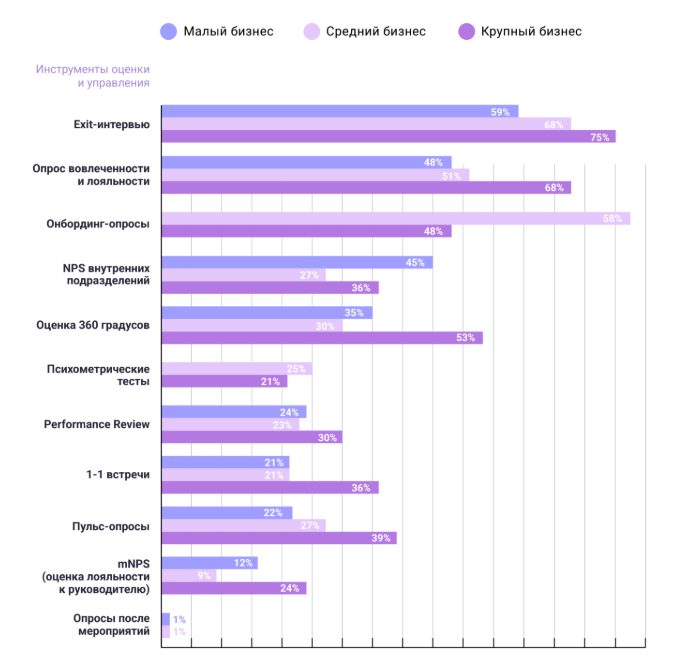
The most widely used employee assessment and management tools. Appraise research findings
🔍 The larger the company, the wider the range of employee assessment and management tools it uses. Large businesses are more likely to combine these tools to gain the most accurate and comprehensive view of their workforce.
The main barrier to HR process automation is financial
The lack of a dedicated automation budget is the key challenge facing Russian businesses. Other common difficulties include a lack of implementation experience, limited HR team resources, and insufficient methodological expertise.
Large companies also face resistance from their security and IT departments. Overcoming this barrier requires choosing a platform that meets business requirements: functionality, integration with other HR solutions, customization, strong technical support, and compliance with Russian law.
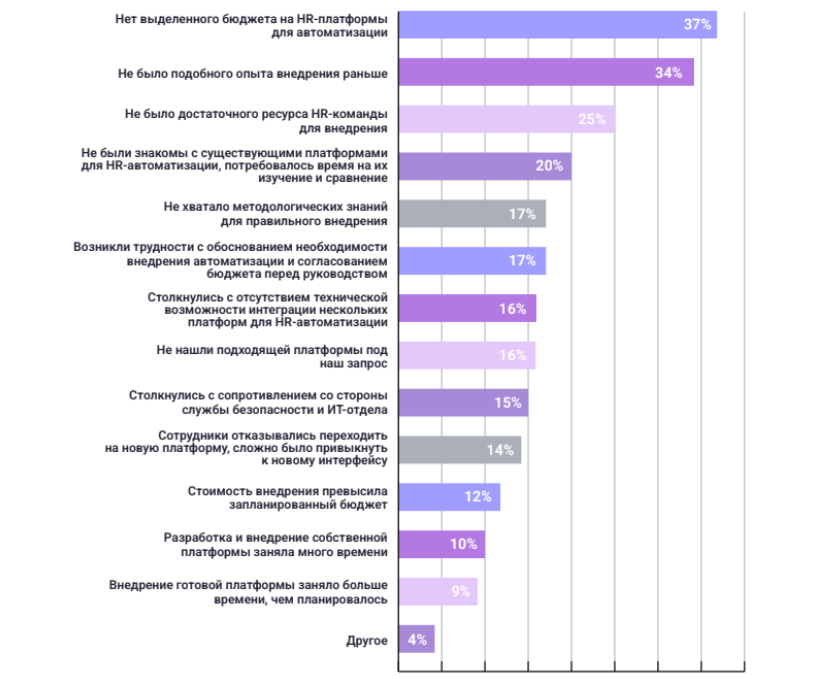
The main barrier to HR process automation is a lack of budget. Appraise research findings
Companies face the following obstacles to automating HR processes:
Limited budgets and resources. Small companies in particular cannot always afford to automate their processes, and sometimes handling everything manually is simply less expensive. How to address this: use affordable modular solutions or demo versions that can be scaled over time or paid for in stages.
Resistance to change: HR teams and management may find it difficult to abandon familiar manual processes. How to address this: provide training, highlight the benefits of automation, and involve “change agents,” the most advanced and engaged employees.
A lack of a clear strategy or management support: automation initiatives often fail when they are not tied to business goals or supported by senior management. How to address this: tie employee metrics and KPIs to the use of these solutions. This demonstrates how automation supports growth, employee retention, engagement, and other business goals.

Only 47% of Russian companies measure the effectiveness of implementing HR automation platforms
53% of respondents either do not evaluate the effectiveness of HR automation solutions or have seen no tangible results. Most of them represent small businesses.
Small and mid-sized businesses have fewer resources for measurement and results analysis, making it difficult to assess the effectiveness of automation and identify positive changes.
Large companies are more likely to measure the results of HR process automation and document the effectiveness of platform implementation. This business segment typically takes a comprehensive approach, tracking both operational indicators (quality of hire and time to productivity) and strategic indicators (engagement and loyalty).
Analytics and transparent performance metrics are essential for successfully securing approval for an HR automation budget.
43% of companies that measured the effectiveness of HR automation will increase their budgets over the next two years and do not plan to reduce them
Companies that tracked the effectiveness of platform implementation and saw positive changes increase their investment in automation significantly more often than those that did not measure the impact or see improvements.
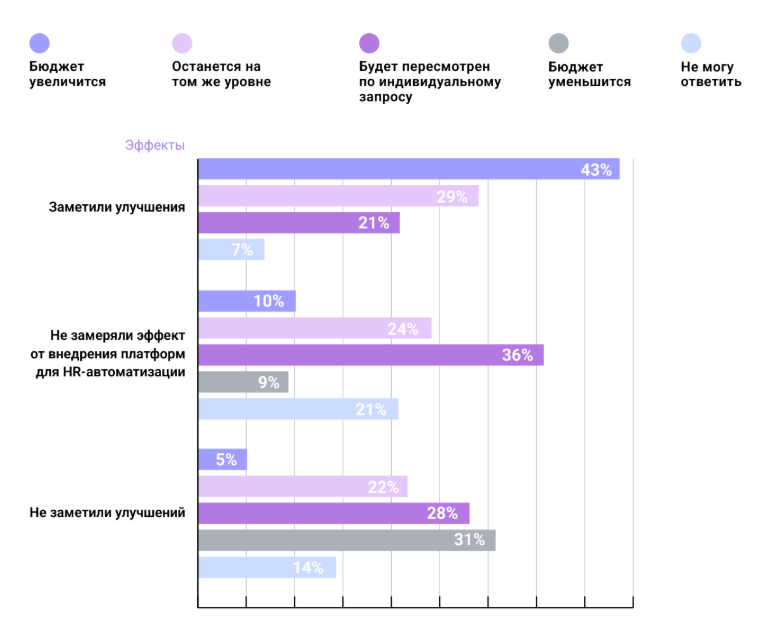
Automation budget allocation by achieved impact. Appraise research findings
The study highlights for HR professionals that automating their work must deliver tangible returns for the business, as only then will a budget be made available for these initiatives. Most companies currently automate routine processes such as recruitment, payroll, and onboarding, using cost optimization to justify budget allocation. Yet employee development and retention metrics such as engagement, eNPS, and HR ROI often remain overlooked. Managing turnover, eliminating blind spots, and obtaining concrete employee performance data directly affect a company’s profit.
It is especially important not to overlook the automation of assessment and feedback. These areas remain largely undigitized today, despite their direct impact on retention and therefore profit. Companies that learn to demonstrate the ROI of HR initiatives will become magnets for talent and partners.

Learn more about how Russian businesses
automate HR processes
Get the full research report with expert commentary