



OKR (Objectives and Key Results) is a goal-setting and performance measurement framework that helps companies achieve ambitious goals. Market leaders, including Google and Intel, have long used this approach, and it is now available to everyone. This article explains how OKRs work, how they differ from KPIs, and how to implement them in your business step by step.
OKR is a goal management framework that encourages teams to take risks and innovate. Employees set ambitious, inspiring objectives and measure them using specific metrics called key results. The system consists of three core elements:
- Objectives: Clear, inspiring goals to be achieved. They may be short-term or long-term and focus on priority areas. For example: Become the market leader in HR tech.
- Key Results: Specific, measurable indicators showing how close the team is to achieving an objective. For example: Generate 100 million in revenue from new sales within a year.
- Projects/Key Initiatives: Actions and activities required to achieve an objective. These are not routine processes. For example: Launch a new version of the website.
Example of setting OKRs for a marketing team
Objective: Increase the number of leads.
Key Result 1: Generate 500 new leads through advertising.
Key Result 2: Increase the advertising conversion rate from 2% to 4%.
Key Result 3: Create three landing page variants.
Key Initiative: Create and launch a new advertising campaign.
The Parable of the Three Stonemasons
One day, a passerby saw three stonemasons carefully building a wall, each absorbed in his work. The passerby asked the first stonemason:
“What are you doing?”
“I am laying stones.”
The passerby asked the second stonemason:
“I am building a tall, sturdy wall.”
And the third:
“I am building a magnificent cathedral!”

Core principles of OKR
1. Clarity and focus
OKRs help identify the most important priorities. Companies typically set 3-5 objectives, each with 3-5 key results. This gives the team a clear understanding of where to focus its efforts and what outcomes are required to achieve each objective.
2. Ambition
Under the OKR framework, objectives should be ambitious enough to push the team slightly outside its comfort zone. However, they should still appear achievable so that employees remain motivated.
Under the OKR framework, an objective is considered achieved when more than 70% of the plan has been completed. Achieving 100% may indicate that you should set more ambitious objectives. If results regularly fall below 30%, it may be time to adjust the objectives and make them more attainable.
3. No financial incentives
Unlike KPIs, achieving OKR objectives should not be tied to financial bonuses. The reason is simple: employees may deliberately set lower targets when defining key results. Employees need to understand that OKR objectives are designed to promote growth, not financial gain.
4. Process transparency and alignment
OKRs create a unified framework in which every employee works toward a shared goal. This improves coordination and communication. It also helps each employee understand how their work contributes to the overall result.
All employees should have access to one another’s OKRs. This helps align and coordinate teams and ensures that everyone is working toward shared goals.
5. Progress tracking and flexibility
Clear key results make it possible to track progress in real time and make timely changes. OKRs allow objectives and key results to be adjusted as circumstances change. Instead of rigidly following a predetermined plan, teams can promptly revise objectives to remain effective.
OKR vs. KPI: What is the difference?
Although OKRs and KPIs both measure performance, they differ significantly:
- OKR is a tool for setting ambitious objectives and driving growth.
- KPI measures stable indicators such as profit or productivity.
OKR
KPI
Objectives are ambitious. They are used to drive innovation and change.
Objectives maintain established performance levels. They track the health of the business.
Objectives depend on company priorities.
Objectives depend on the employee's role and responsibilities.
Objectives are considered achieved when 70% of the plan is completed.
Objectives are considered achieved when 100% of the plan is completed.
Goal achievement is not directly linked to salary and bonuses.
Goal achievement is directly linked to salary and bonuses.
Goal achievement is a transparent process in which every employee understands the company's progress toward its goals.
Goal achievement is a closed process: objectives are usually discussed and pursued only by the employee and their manager.
Set for a specific period (quarter and year).
Set and tracked regularly.
OKRs are flexible and inspiring, while KPIs are more static and designed to maintain performance levels. Nevertheless, they are often used together: OKRs drive ambitious growth, while KPIs help sustain achieved results.
Free guide
What is the OKR framework? A step-by-step implementation plan
Why the OKR approach is effective
Companies that use OKRs operate with greater alignment and efficiency. They adapt to change more quickly because they have a clear understanding of their priorities. Employees become more engaged and motivated because they can see how they contribute to shared goals and understand the results they need to achieve.
🔍 Transparency and focus – employees and teams understand the company’s objectives and how their work contributes to its overall success.
 Flexibility – OKRs make it possible to adapt to change, adjust objectives, and respond quickly to new challenges.
📈 Increased engagement – employees recognize the value of their contributions, see progress, and feel motivated to achieve strong results.
🎯 Results-oriented approach – key results are clearly measurable, allowing performance to be assessed objectively.
💪 Stronger teamwork – OKRs create synergy across teams and improve collaboration among employees.
How to implement OKRs
Step 1: Define company objectives
Step 2: Cascade objectives across levels
Under the OKR framework, objectives should be ambitious enough to push the team slightly outside its comfort zone. However, they should still appear achievable so that employees remain motivated.
Step 3: Define key results
Step 4: Set timelines and assign owners
OKRs are most often set for a quarter, six months, or a year. Choose a planning period that reflects the company’s strategic priorities. If you are implementing OKRs for the first time, we recommend starting the goal-setting cycle six weeks before the new reporting period begins.
Assign an owner to every objective and key result. The CEO or business owner is usually responsible for major company-wide objectives. Department managers typically own team objectives, while individual contributors can be entrusted with delivering the key results for team objectives. Make sure that each owner has everything required to achieve their objectives and key results.
Step 5: Engage employees
Introduce OKRs to the team. Employees need not only to learn about the objectives but also to understand how the new framework works. Keep them informed about:
- why the company is introducing a new goal-setting model,
- who is responsible for creating and tracking OKRs,
- which projects and metrics should be prioritized,
- how their work affects the business as a whole.
Step 6: Review progress and adjust OKRs
Step 7: Support and train employees
Step 8: Analyze results and plan the next cycle
How to set objectives and track OKR progress
There are several ways to create, manage, and track OKRs. Some organizations use Excel or Google Sheets, while others use general-purpose software that only partially meets their OKR needs. However, these solutions often require excessive manual work, lack flexibility, and create access and transparency issues.
To maximize the benefits of implementing OKRs, consider using an HR platform designed for goal management. For example, Appraise offers a flexible OKR module that helps organizations efficiently set, track, and analyze objectives at every level.
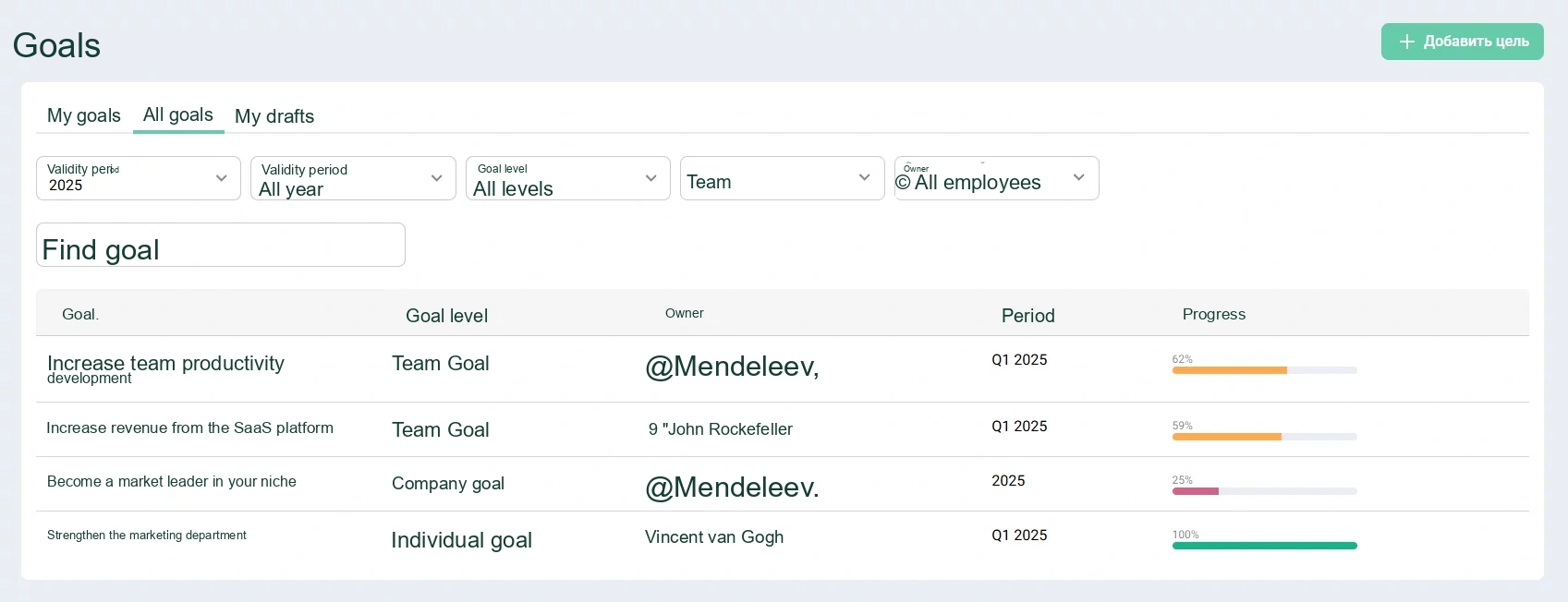
Overview of current objectives in Appraise
Why choose Appraise for OKR management
- Automated goal setting and tracking – eliminate endless spreadsheets and manual progress tracking.
- Simple and user-friendly – an intuitive interface makes it easy to introduce the OKR framework across the company.
- Transparency for the entire team – managers and employees can track progress toward objectives in real time.
Help your team achieve ambitious goals
Learn more about goal-setting features and using the OKR framework in Appraise