



At most companies, employees want to grow, while managers want to see results and motivate and retain valuable professionals. An individual development plan (IDP) helps businesses and employees align expectations, define goals, and move in the same direction. We explain how to make an IDP a genuinely effective tool rather than a box-ticking exercise.
Contents
- What is an individual development plan, and why is it needed?
- Who critically needs an IDP?
- Individual development plan structure
- Who contributes to the plan: the roles of HR, the manager, and the employee
- How to create an effective IDP
- Benefits of development plans and the challenges of using them
- Real IDP examples: from intern to manager
- The most common mistakes when preparing a plan
- How to make IDP work faster and easier
What is an IDP, and why is it needed? From theory to practice
A well-designed IDP is a personalized roadmap that helps employees grow and enables the business to manage that growth systematically and effectively.
According to research by Rabota.ru and SberPodbor, only 49% of Russian companies create individual development plans, and just 8% document them. Yet an IDP directly influences employee growth, motivation, and performance. Here are the challenges it addresses.
Developing key competencies
An IDP helps employees focus on the specific skills they need to become more effective now or prepare for their next role.
Example: if an employee lacks confidence in negotiations, their IDP can include a course on handling objections and a series of practice sessions.
Support when moving to a new position or grade
An IDP provides a smooth introduction to an unfamiliar role. It helps employees build the necessary skills, adapt faster, and reach their target performance.
Career growth planning
A well-designed IDP is not training “just in case.” It is a clear career track that defines the steps required to advance to the next grade or expand an employee’s responsibilities.
Employee retention and increased engagement
When a company invests in employee development, people feel supported and valued by the business. This directly increases motivation and reduces the risks of burnout and resignation.
Building a talent pool
An IDP can also develop employees’ strengths. This is especially important when a company is preparing future team leads or internal experts.
Companies most often integrate IDPs into Performance Reviews or 360-degree assessments: based on the assessment results, the employee receives a plan for developing specific competencies.
Who critically needs an IDP? Three scenarios where it is essential
Onboarding a new employee
When someone is joining a company or learning a new role, an IDP becomes their onboarding roadmap. It helps them understand their tasks faster, learn the necessary tools, and integrate into the corporate culture.
Without an IDP, onboarding is more likely to take too long, mistakes may occur, and the employee may struggle to succeed.
Manager development
An IDP is critical for leaders when the company is growing, changing strategy, or expanding the team. The plan helps shift their focus from operations to people management, delegation, and strategic development.
Without an IDP, a manager can become trapped in routine work and lose effectiveness.
An employee’s career transition
For an employee preparing for a promotion or change of specialization, an IDP provides clear steps and readiness criteria.
Without a plan, the transition can become chaotic and stressful, and the company’s and employee’s expectations may diverge.
IDP structure: five essential elements not to overlook
An individual development plan records:
goals — hard and soft skills;
specific steps — training, mentoring, project participation, and regular practice;
deadlines — specific and realistic;
criteria for evaluating results — quantitative and qualitative;
responsible parties — the employee, manager, and HR.
These are all essential IDP elements. Let us look at how responsibilities are distributed when working with the plan.
Who contributes to the plan: the roles of HR, the manager, and the employee
The employee defines their goals and expectations: what they want to learn and where they want their career to go. They then conduct a self-assessment by analyzing their strengths and development areas. Without the employee’s personal involvement, the IDP becomes a formality.
The manager connects the employee’s development with team priorities and company business goals, identifies priority competencies, provides support, and reviews progress. Their role is to set the direction and help the employee grow through real work tasks.
HR helps structure goals and translate them into clear steps. HR supports the company-wide process by selecting tools, collecting IDP analytics, and sending plan reminders. Its role is to provide methodological and organizational support.
Now to the most important point: how to create IDPs that work within the company.
Free guide
How to create effective development plans
Step-by-step guide: how to create an IDP in seven stages
Here is how to prepare an effective employee development plan.
1. Define the goals
First and foremost, goals should be based on business objectives while also reflecting the employee’s interests.
At this stage, it is important to determine:
- what the employee wants to develop;
- what tasks they will face over the next 6–12 months;
- the team’s or department’s current goals.
Example: learn to deliver client presentations independently, without support from the team lead.
2. Assess the current skill level
To build a roadmap, you need to know the starting point.
What to do:
- Ask the employee to complete a self-assessment.
- Request input from the manager and, where possible, colleagues.
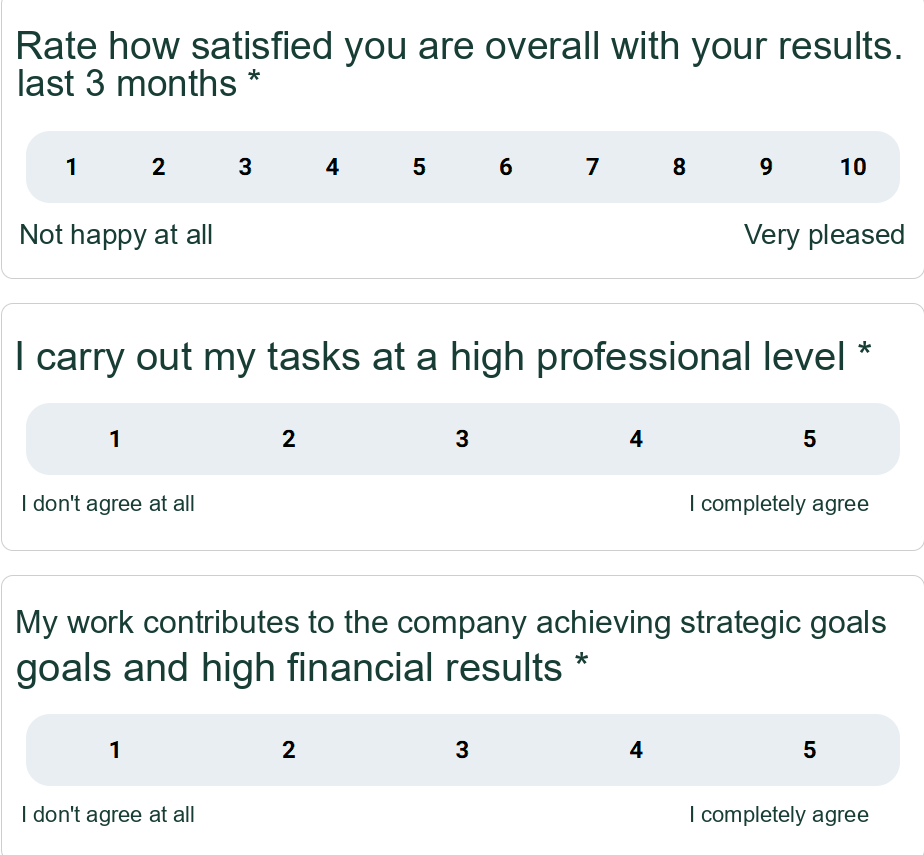
Sample self-assessment questionnaire. Ready-made template in Appraise
Competency matrices, Performance Review results, and 360° assessment results can support objective conclusions.
Example: the employee’s presentation skills are intermediate; they lack confidence and struggle to answer client questions.
Learn more about employee assessments in our articles:
3. Define the required skill level
At this stage, define the desired destination, again focusing on the company’s business goals.
In the previous example, the employee has intermediate presentation skills. The plan should specify: deliver presentations confidently, master persuasion techniques, and handle difficult questions effectively.
4. Create an action plan
Experts recommend structuring development activities according to the 70-20-10 model: 70% real tasks, 20% knowledge sharing and feedback, and only 10% theory and training.
Example: instead of the abstract goal “develop confident presentation skills,” write: conduct five challenging client meetings (70%), receive feedback from colleagues (20%), and take a course on effective presentations (10%). This approach makes goals practical and achievable.
5. Set deadlines and add success metrics
Every action should have a deadline. It must be realistic, as an excessively short timeframe is more likely to demotivate the employee.
Metrics can be quantitative, such as the number of tasks, or qualitative, such as feedback from a manager or client, completion of checklist items, and more.
Example: by September 1, conduct three client meetings independently and receive a manager score of at least 4 out of 5.
6. Agree on the plan
Clearly defining and documenting every development goal and specific step reduces the risk of misunderstandings. Assessment becomes transparent, tasks become achievable, and feedback becomes constructive.
The completed document is agreed upon and signed by all participants: the employee, manager, and HR. It may be a paper or electronic document.
7. Track progress
Employee development does not end when the plan has been created and approved. Results must be monitored regularly to understand what has been completed and where problems remain.
Any difficulties can be discussed during weekly 1:1 meetings. For long-term goals, it is advisable to review the plan and adjust it if necessary once a month or once a quarter.
Benefits of IDPs and how to avoid common pitfalls
Skeptics often argue that individual employee development plans are unnecessary bureaucracy that produces no tangible results. In reality, a well-designed plan is a powerful development tool. Here are the benefits that are difficult to dispute.
1. Clear expectations
An IDP records the skills and results the company expects and the goals set by the employee. This reduces misunderstandings and makes development predictable.
2. Alignment with business goals
The plan connects learning and development to specific company priorities, such as sales growth, client retention, and process efficiency.
3. Increased motivation and engagement
Employees see that the company is investing in them and understand how their efforts contribute to career growth. This reduces turnover and strengthens trust.
4. Managed progress
An IDP establishes a rhythm through defined steps, deadlines, and reviews. Development becomes measurable rather than incidental. However, this only works when the IDP is integrated into systematic processes such as Performance Reviews, quarterly meetings, and dashboards.
Three IDP challenges and how to solve them
Here are the main challenges HR professionals face when creating a plan.
- Vague goals and no measurable outcomes. In this case, the plan contains broad statements such as “improve communication” or “increase effectiveness.” Solution: use SMART goals and tie each task to specific metrics, such as team eNPS or sales target achievement.
- Lack of manager support. HR creates the plan, but the employee’s direct manager does not use it or provide feedback. Solution: involve managers in the process, demonstrate how IDPs help them achieve team KPIs, and integrate IDP discussions into their regular 1:1 meetings.
- Insufficient implementation resources. The plan includes training, mentoring, and projects, but the employee lacks the time or training budget. Solution: agree on resources in advance, including calendar time, a training budget, and access to internal programs.
Real IDP examples: from intern to manager
Let us look at examples of what an individual employee development plan can include.
Example 1: onboarding plan for a marketing intern
Goals:
- Become familiar with the company and understand the marketing department’s core processes.
- Learn to use the key tools.
- Complete the first independent tasks with minimal revisions from the manager.
- Understand the company’s basic brand principles, tone of voice, and communication standards.
Action plan
Month one: introduction and immersion:
- Become familiar with the product, target audience, and positioning.
- Complete introductory training on marketing tools, such as Yandex Metrica and Google Analytics.
- Attend the marketing team’s weekly planning meetings.
- Complete trial tasks: prepare an advertising placement from a template and curate content for social media.
Metrics:
- The intern knows the company’s main products and services.
- They can use advertising platforms and analytics services.
- They have completed at least two trial tasks.
Month two: first independent tasks:
- Manage tasks in the tracker.
- Prepare 1–2 advertisements with mentor revisions.
- Learn to export basic analytics.
Metrics:
- At least two completed advertisements have been published with the intern’s participation.
- Errors in copy and formatting are ≤10%.
- The intern can export reports on basic metrics.
Month three: consolidation and growth:
- Complete an independent mini-project, such as conducting an A/B test of advertisements or preparing a series of promotional posts.
- Use the advertising platform confidently.
- Prepare a campaign results report and present it at a meeting with the mentor.
- Prepare a presentation titled “What I learned in three months and the ideas I can propose.”
Metrics:
- The mini-project is completed on time with a clear result, such as a 5% increase in CTR.
- The intern can launch a campaign on the advertising platform.
- They can independently compile and present a report.
Example 2: plan for a contact center employee
Goals:
- Improve customer service quality: increase call satisfaction (CSI) to ≥85% and reduce the number of negative reviews.
- Develop communication skills: learn active listening techniques and how to manage difficult customers.
- Process requests faster: reduce average handling time (AHT) by 10–15% and increase the proportion of requests resolved at first contact (FCR).
- Master related products and scripts. Learn to offer additional services and increase upsell conversion by 5%.
Action plan
Month one: onboarding:
- Complete introductory training on products and scripts.
- Listen to recordings of successful calls by experienced agents.
- Make the first calls under a mentor’s supervision.
Metrics:
- Pass the product test with a score of ≥90%.
- Complete the first 10 calls without critical errors.
Months two and three: consolidation:
- Work with a mentor and review calls once a week.
- Practice objection-handling techniques.
- Keep a personal log of mistakes and improvements.
Metrics:
- CSI ≥80%.
- Average handling time meets the standard.
- At least 70% of customer requests are resolved by the first line.
Months four through six: growth and development:
- Independently manage the full call cycle without support.
- Master soft-selling techniques for calls.
- Complete a short stress management training course.
- Prepare a short presentation titled “My achievements and proposals for improving the department’s work.”
Metrics:
- CSI ≥85%.
- AHT is reduced by 10–15%.
- FCR is increased by 10%.
- Upsell conversion is increased by 5%.
Example 3: plan for a head of sales
For sample manager IDPs and instructions on creating these plans, see this article →
Eight mistakes when working with individual development plans
This list covers the most common mistakes made when preparing and implementing IDPs.
1. Misalignment with business goals
A critical mistake is to define IDP goals without connecting them to the direction of the team or company. If employees develop skills that are irrelevant to their current tasks or ignore business priorities, every party loses motivation.
An individual employee’s growth plan must be integrated into the overall business development strategy.
2. Too many goals
Trying to cover everything at once divides attention and reduces motivation. It is far more effective to select two or three priority goals: what to learn and which skills to develop first.
You can then move to the next stage and create a new plan. This approach helps employees focus on what matters most and enables the company to monitor progress and the tangible benefits of learning.
3. Lack of specificity
If a goal is vaguely worded, it is impossible to determine whether the employee has achieved it. The IDP then loses its value and becomes a formality.
For the plan to work, goals must follow the SMART framework and specify wording, tool names, deadlines, and evaluation criteria. Measure everything that can be measured.
4. Theory only
A common mistake is to focus an employee development plan on a list of learning materials and courses. An IDP, however, should primarily emphasize practical application.
Without regular practice, skill reinforcement, and feedback from the manager and team, employees retain only a collection of theoretical information. The items may be checked off, but they deliver no value. Development is not a completed course; it is experience and action.
5. Lack of manager involvement
The manager helps set priorities, provide feedback, and create the conditions for development. The manager also understands each direct report’s individual professional and personal characteristics. Together, these insights form the basis for a complete, accurate, and objective IDP.
6. Failure to agree on the plan with the employee
If an IDP is imposed from above without discussion, the employee will resist it or complete it as a formality. Such a plan generally fails to reflect the employee’s real tasks, interests, learning pace, and many other nuances.
An effective IDP results from collaboration among all participants.
7. Lack of regular support and monitoring
A particularly frustrating mistake is to invest significant time and effort in preparing a plan and then never revisit it.
Without regular meetings, interim feedback, and result tracking, the IDP becomes outdated. Checkpoints are essential, especially when a role, project, or priorities change.
8. A manual process
When IDPs are stored across different spreadsheets and documents, they are difficult to monitor. Without automation, it is hard to send timely task reminders, assess progress, or gather analytics.
Specialized tools save team resources: the plan is ready in a few clicks, and all employee information is available at any time in one place.
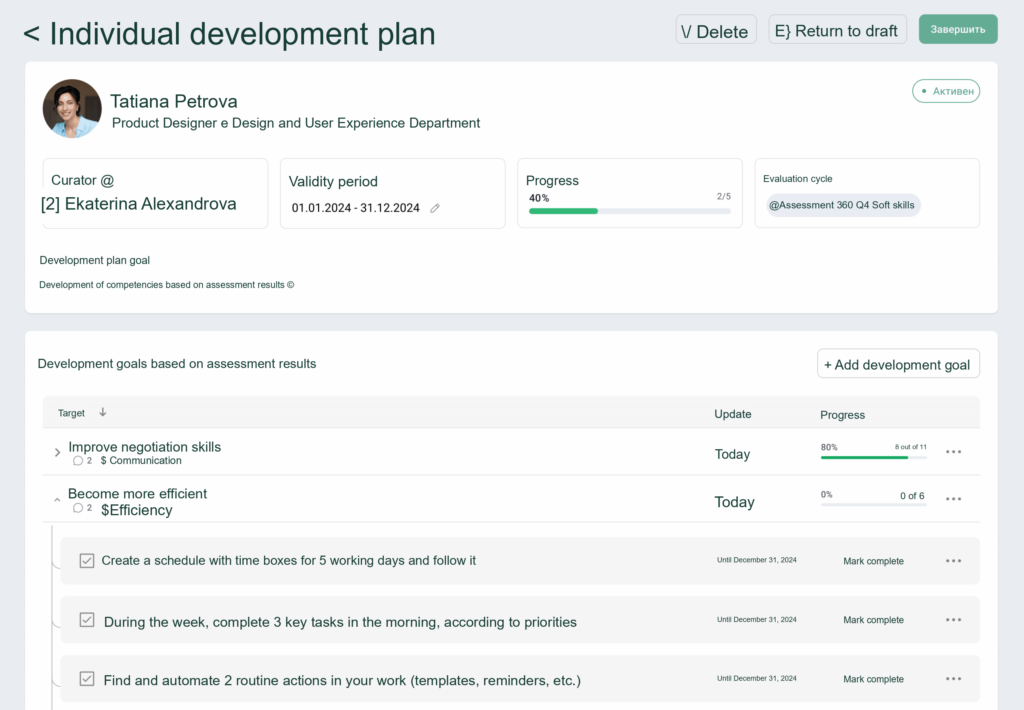
Example of an automated employee development plan in Appraise: all essential employee information is always at hand
How to prepare IDPs faster and more easily
Appraise helps automate the entire employee development cycle, from defining competency requirements and assessing employees to launching IDPs and reassessing the skills they have acquired.
AI suggests development activities based on the 70-20-10 methodology. You can add suitable development activity descriptions to the plan and supplement them with the necessary information.
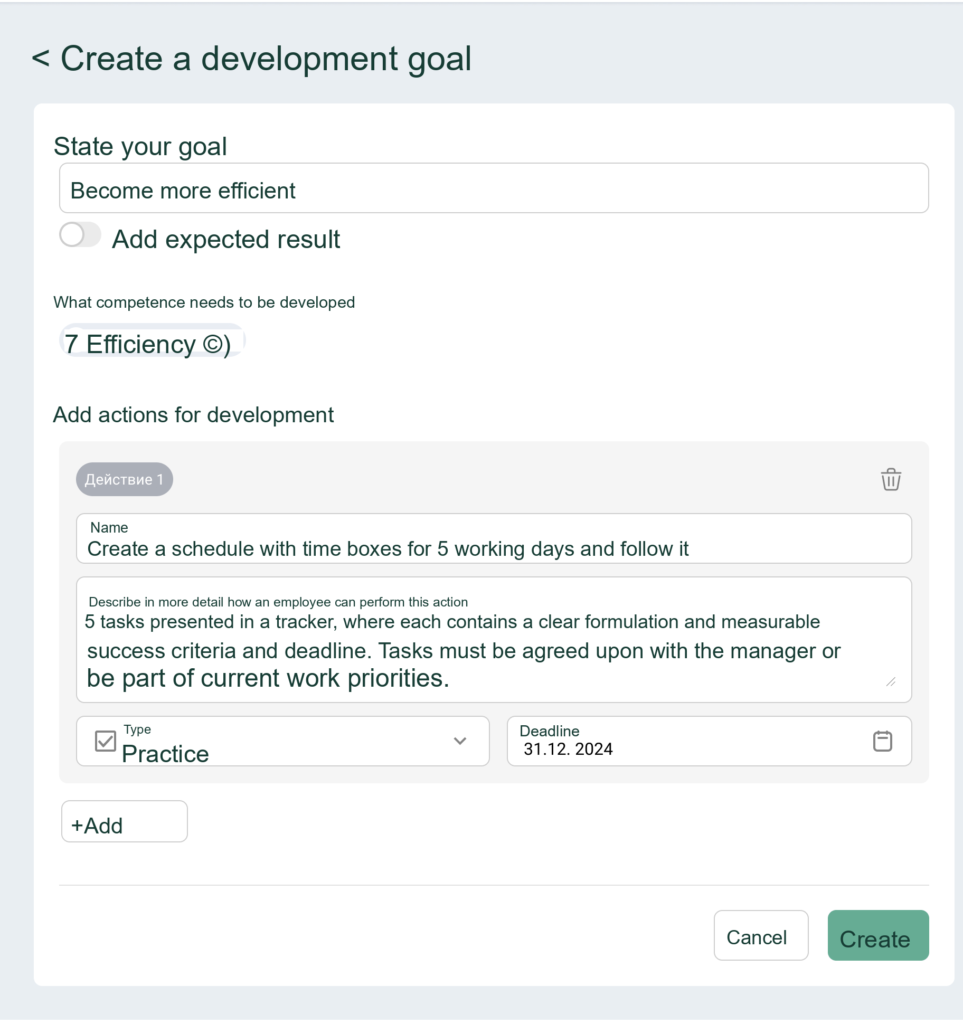
The AI assistant in Appraise creates an individual development plan with specific goals, tasks, and relevant materials
IDP progress is also updated automatically. A manager’s profile provides a convenient way to track plan completion across the company, by team, and for individual employees. If someone falls behind, reminders can be enabled.
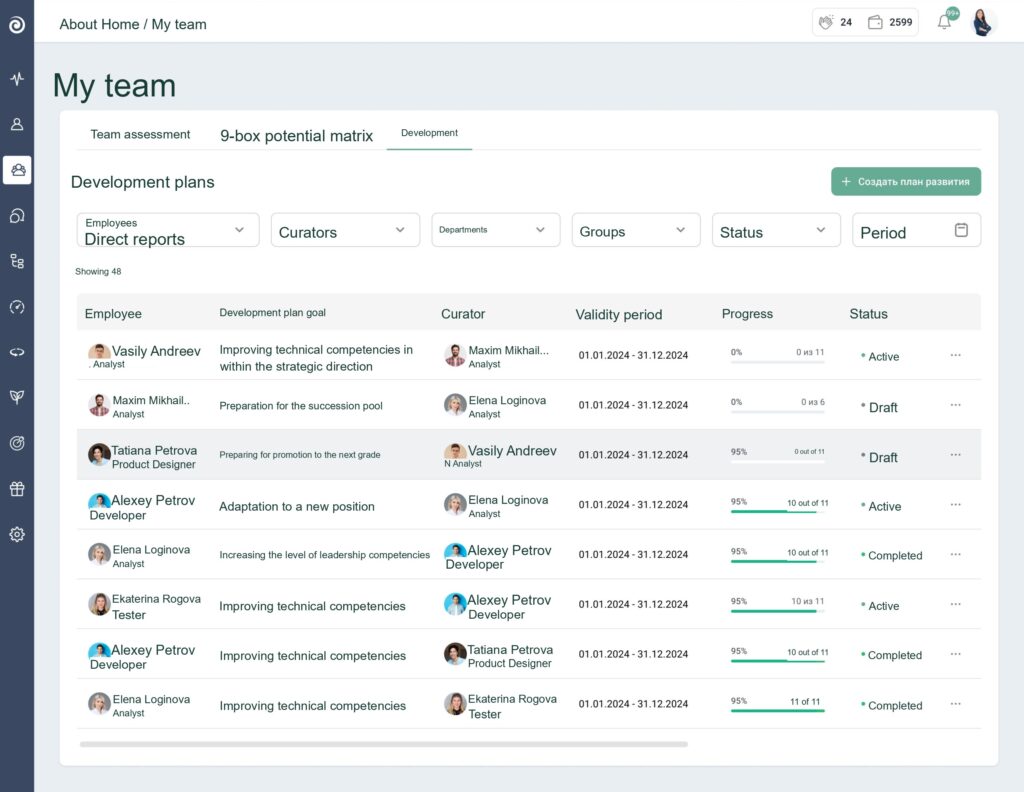
The manager can see how employees are progressing through their plans
Key takeaways
 What is an IDP, and why is it needed?
An IDP is a personalized development roadmap that helps align employee and business expectations. It records goals (hard and soft skills), steps (training, mentoring, and projects), deadlines, quantitative metrics, and responsible parties. An IDP turns development into a systematic and motivating process.
How do employees and the company benefit from an IDP?
Employees gain a clear understanding of what to learn and how to grow, including how to advance to a new grade. The company gains motivated professionals, lower turnover, and a more effective talent pool.
How can an IDP become an effective tool?
An individual employee development plan should be personalized and include specific goals, realistic deadlines, progress metrics, and responsible parties. Ideally, link the plan to 360-degree assessments and Performance Reviews: set development goals after an assessment and evaluate the results after the plan is completed.
What are the most common mistakes when preparing an IDP?
The primary mistake is a lack of alignment with business goals. Other common problems include a box-ticking approach, no specific steps, KPIs, or metrics, and an emphasis on theory without practice in the development activity plan.
How can IDP work be made faster and easier?
Through automation. For example, the Appraise HR platform uses AI to create plans in minutes, send task reminders, track progress, and analyze results, all in one place.
Automate employee development
Receive plans with ready-made materials, monitor completion, and assess employees’ professional growth in one place