



An individual development plan (IDP) helps an employee purposefully develop their competencies and career prospects. While rank-and-file specialists primarily focus on hard skills, an IDP for managers shifts the emphasis to management skills, strategic thinking, and leadership qualities. We have put together a concise guide to creating individual development plans for managers, complete with examples and tips for HR.
Contents
- What is an IDP, and why does a manager need one?
- Who contributes to creating a development plan?
- How to create an IDP: a step-by-step guide
- Real-world examples of IDPs for managers
- How to automate the creation of a manager development plan
- How to implement IDPs without mistakes
What is an IDP, and why does a manager need one?
A manager’s IDP is a strategic document that links the leader’s personal development to the development of their team and the achievement of company goals.
A manager’s plan most often includes developing:
leadership qualities — team management and goal setting;
strategic thinking: the ability to see long-term goals and make management decisions;
delegation skills and oversight;
communication — with senior management, colleagues, and external partners;
corporate culture and team engagement.
A manager needs an IDP as a roadmap: the document links the leader’s personal development to company goals and improves management effectiveness. The plan helps organize learning systematically and build competencies that directly affect the department’s performance. It is also a career advancement tool: an IDP can include the skills needed to progress to Head of, director, or senior executive level.
Who contributes to creating a manager's IDP?
A manager’s IDP is created and adjusted jointly with HR and the CEO because leadership development affects the business as a whole.
The manager defines their career goals and development expectations, such as learning to delegate or strengthening strategic thinking.
The manager’s supervisor — a director or owner — aligns the development plan with the company’s business goals and approves priorities.
HR helps structure the plan, define specific steps and metrics, select tools for achieving goals and evaluating results, and monitor IDP completion.
An IDP is the result of collaboration: the manager defines personal goals, the business aligns them with strategic objectives, and HR turns them into a concrete plan.
How to create an individual development plan: a step-by-step guide
Four clear steps, from assessing skills to defining metrics.
1. Identify strengths and areas for growth
To avoid building a plan based on guesswork, it is important to assess the manager’s competency level objectively. For example, the manager may believe they delegate effectively, while team feedback indicates otherwise; this then becomes a development area.
Useful assessment methods include:
- 360-degree feedback;
- Performance Review;
- team engagement surveys;
- manager self-assessment.
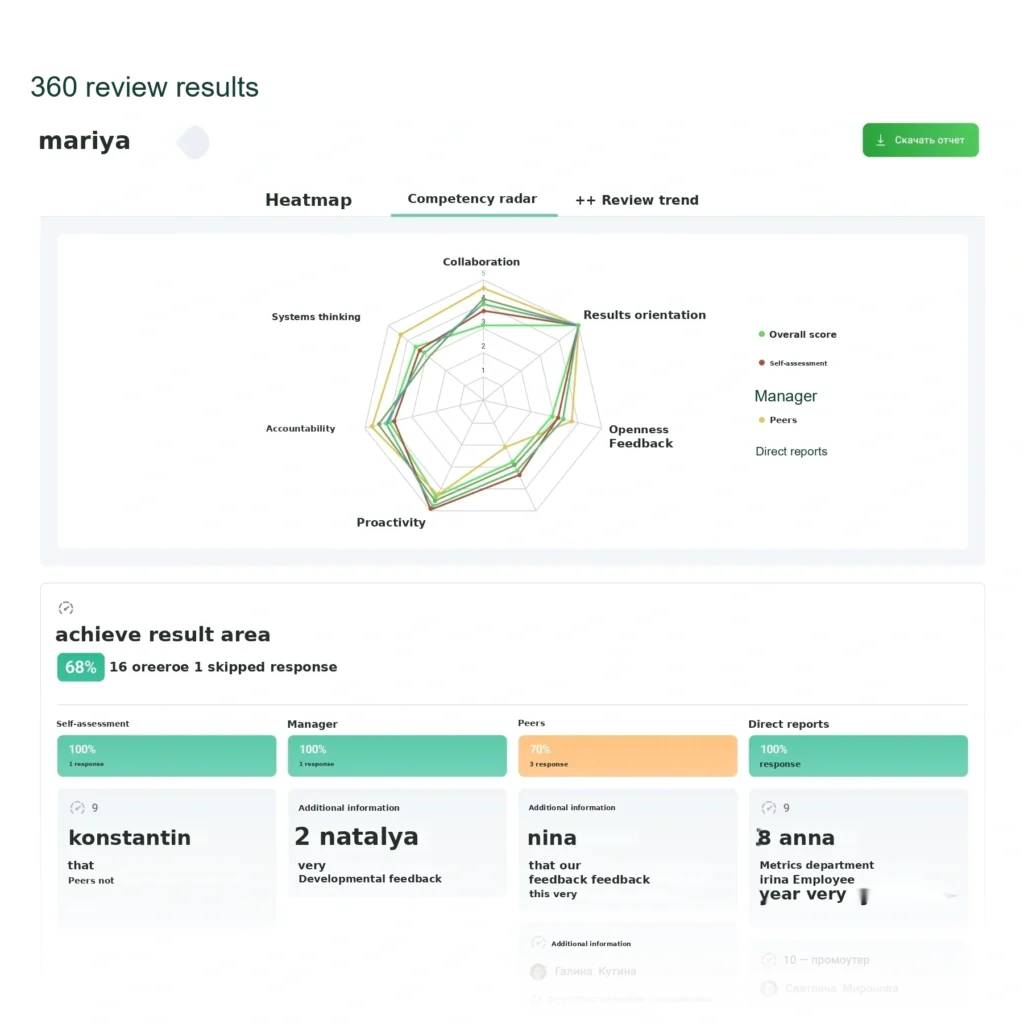
360-degree feedback results
2. Set goals using the SMART framework
A goal set using the SMART framework is specific, measurable, achievable, relevant, and time-bound.
Define plan items not only in terms of “what to learn,” but also “how this will help the business.” For example, instead of “improve delegation skills,” use “reduce the manager’s share of operational tasks from 45% to 25% by the end of the year.”
3. Select development methods and resources
Manager development works best through practice. For example, the 70-20-10 model distributes learning sources as follows:
- 70% — practice: new projects, tasks, and areas of responsibility;
- 20% — interaction: mentoring, coaching, knowledge sharing, and feedback from colleagues and partners;
- 10% — formal learning: courses, books, and training.
Example: a manager is learning change management:
- 70% — leads a large-scale project;
- 20% — discusses progress with a coach every two weeks;
- 10% — takes a change management course.
4. Define timelines and success metrics
For an IDP to become a practical tool, metrics must be added to the goal so that the effectiveness of the actions can be evaluated. The plan must also include deadlines.
For example:
- Goal: reduce the manager’s share of operational tasks from 45% to 25%.
- Impact: frees up the manager’s time to focus on strategy.
- Metrics: share of operational tasks ≤25%.
- Activities: implement RACI (70), mentoring (20), and a delegation course (10).
- Deadline: Q4 2025.
Examples of IDPs for managers
Three examples of individual plans for developing different skills.
Plan for developing soft skills (communication and emotional intelligence)
Development goals (SMART):
- Improve management communication: increase the transparency and effectiveness of team interactions and reduce conflicts and misunderstandings. Metric: ≥80% of employees report in the engagement survey that the manager communicates tasks clearly (an increase of 20 percentage points over six months).
- Develop emotional intelligence (EQ): learn to better recognize and manage their own emotions and those of the team. Metric: team eNPS rises from +10 to +25; in 360° feedback, ≥70% of employees report that the manager listens more and takes their emotions into account.
- Develop active listening skills: learn to give feedback and conduct 1-1s so that employees feel engaged and valued. Metric: ≥80% of the team confirm in an anonymous survey that they feel heard after meetings with the manager.
Action plan (70–20–10).
70% — practice:
Introduce weekly 1-1 meetings (15–20 minutes) with each key employee, using active listening techniques.
Hold monthly team retrospectives to discuss emotions, challenges, and wins.
In stressful situations, use the “pause – breathe – respond without emotion” technique and record the results in an observation journal.
20% — interaction:
Find an internal mentor or coach who can help analyze real cases involving conflict or emotional outbursts.
Gather team feedback through an anonymous quarterly survey.
Discuss progress with HR or a coach every two weeks.
10% — learning:
Take an “Emotional Intelligence for Leaders” course.
Read Emotional Intelligence (D. Goleman) and Crucial Conversations (Patterson et al.).
Attend management communication training.
Individual development plan for a manager — one-year example: moving from an operational to a strategic role
Development goals (SMART):
Reduce the manager’s operational workload.
Goal: reduce personal involvement in operational tasks from 50% to ≤25% by the end of Q3.
Metric: weekly time tracker + task allocation in the system.
Develop strategic thinking.
Goal: develop and present a one-year department strategy aligned with company OKRs by the end of the year.
Metric: CEO-approved plan and agreed KPIs.
Build a system for delegation and succession-pipeline development.
Goal: prepare at least two deputies (team leads/senior specialists) capable of taking on some management responsibilities.
Metric: ≥60% of department-level management decisions are made without escalating them to the manager.
Action plan.
70% — practice:
Audit all tasks → divide them into strategic / operational.
Implement RACI or another responsibility-allocation system.
Delegate at least one recurring operational task to the team each week.
Develop a quarterly strategic plan for the department and present it at a management meeting.
Launch internal mini-projects led by team leads.
20% — interaction:
Mentoring from a senior manager (CEO/director) through a monthly strategic plan review.
Coaching sessions (1–2 times per month) to develop strategic thinking and delegation skills.
Regular team feedback through a quarterly survey: “To what extent has the manager reduced their involvement in operations?”
10% — learning:
A strategic management course.
Book: Playing to Win (A.G. Lafley, Roger L. Martin).
A workshop on delegation and leadership.
Plan focused on mentoring and team growth
Development goals (SMART):
- Develop mentoring and coaching skills.
- Goal: hold regular 1-1 meetings with each team lead in a coaching format by the end of the first half of the year.
- Metric: ≥80% of leads report in a survey that the meetings help them grow and find solutions independently.
2. Improve team capabilities and autonomy.
- Goal: ensure that ≥70% of middle+ level tasks are completed without the manager’s involvement by the end of the year.
- Metric: a 40% reduction in escalations and a 15-point increase in team eNPS.
3. Build a succession pipeline.
- Goal: prepare at least two candidates capable of assuming a team lead/deputy role within a year.
- Metric: individual development plans are in place for the candidates, and they successfully complete internal placements or projects.
Action plan.
70% — practice:
Introduce weekly 1-1 meetings with team leads, where the manager acts as a mentor rather than a supervisor.
- Launch a leadership development program: assign projects to team leads, such as independently implementing a new process.
- Create a team competency matrix and build IDPs for high-performing specialists.
- Fully delegate the management of 1–2 initiatives to deputies.
20% — interaction:
- Mentoring from an external coach on developing mentoring skills every 2–3 weeks.
- Monthly meetings with managers from other departments to share mentoring practices.
- Team feedback through 360-degree feedback on support, mentoring, and development.
10% — learning:
- A Coaching Skills for Leaders or Mentorship Essentials course.
- Book: The Coaching Habit (Michael Bungay Stanier).
- A workshop on building a succession pipeline and succession planning.
Free guide
How to create effective development plans
How to automate development plan management
Creating an IDP involves working with large volumes of information and disconnected files. When everything is done manually, it takes a tremendous amount of time. Under these conditions, tracking progress and updating the plan are nearly impossible.
Automation brings all IDP activities into a single system. For example, in Appraise, an AI assistant can generate an employee or manager development plan in just a few minutes.
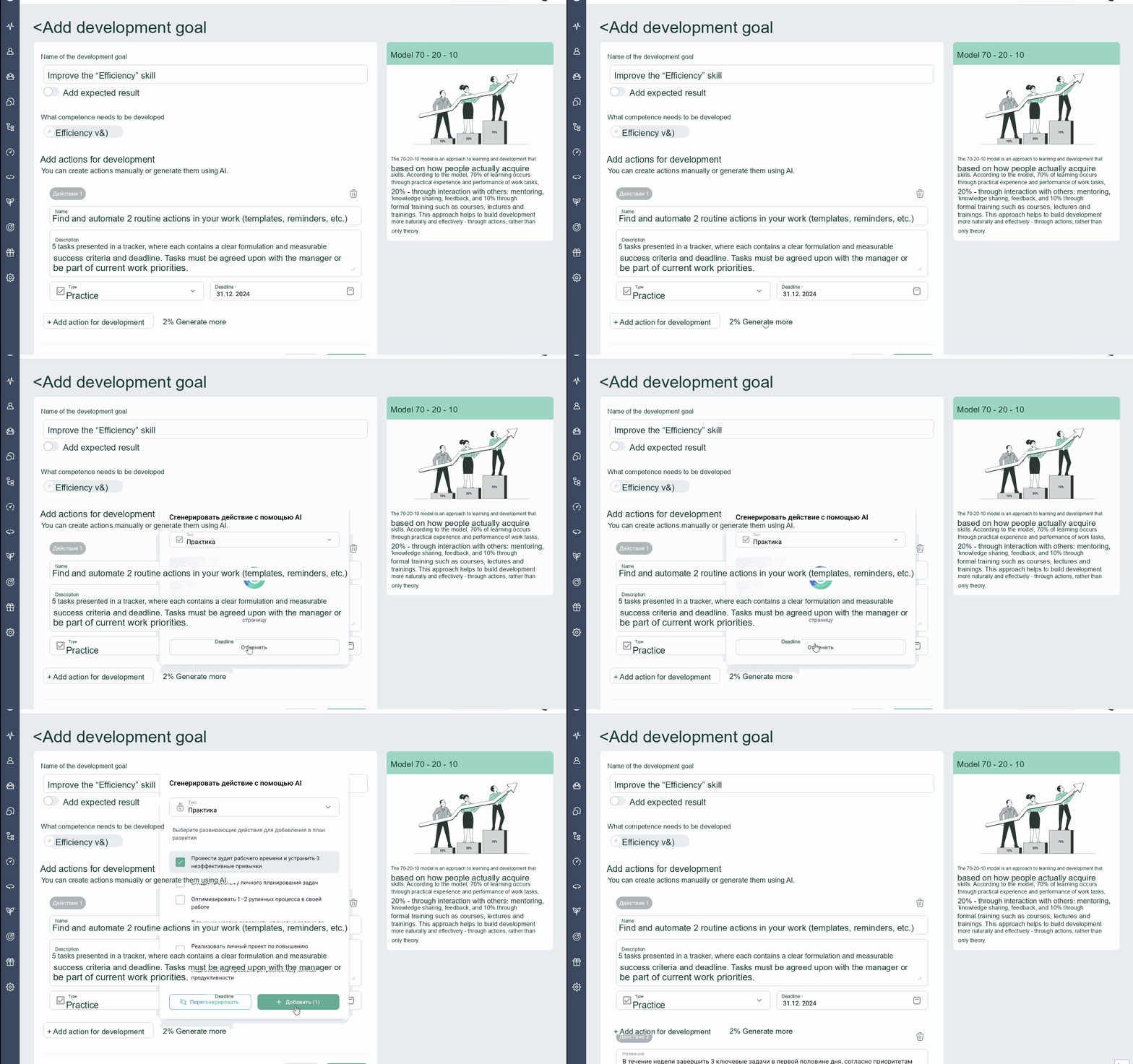
AI-powered IDP generation in Appraise
The plan is generated using the 70-20-10 model. You can use it immediately without making any changes or add any activities you consider necessary.
Plan completion statistics are displayed on the dashboard. These data are useful for 1-1 meetings or Performance Reviews.
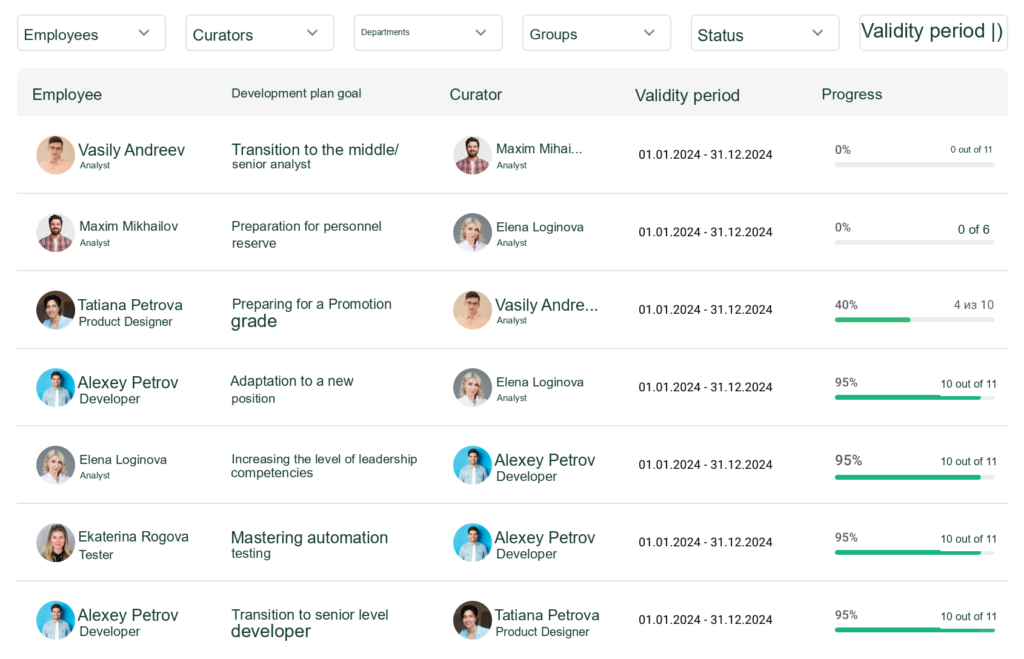
IDP statistics in Appraise
If a manager forgets about their IDP, reminders in Appraise gently refocus them on their goals.
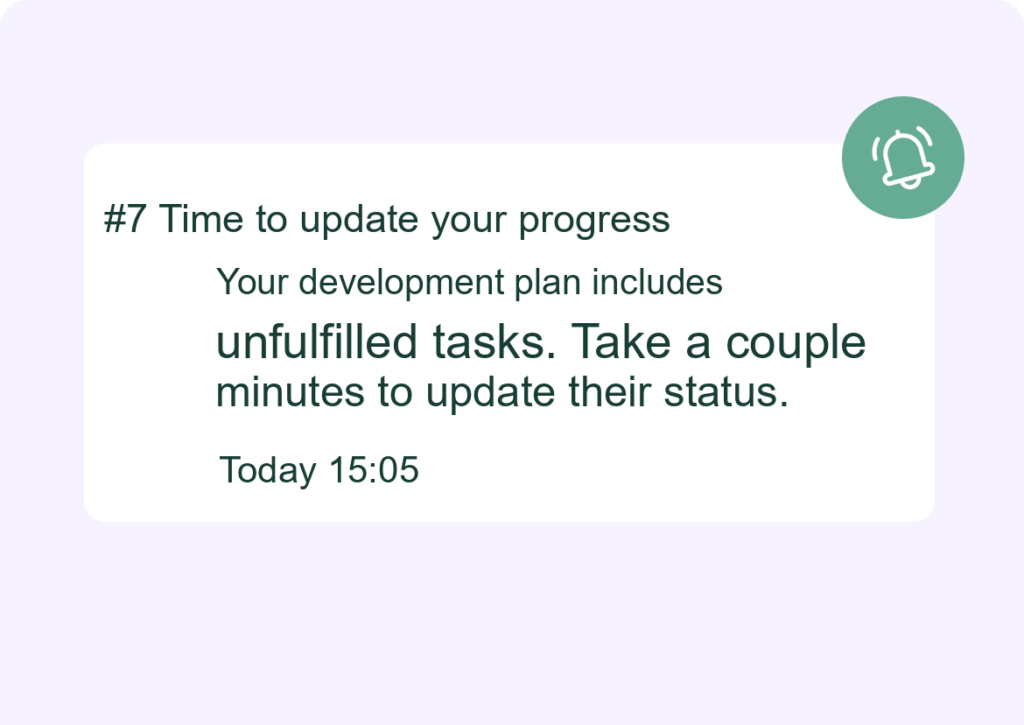
IDP completion reminders in Appraise
Leadership development thus becomes a manageable process with clear steps, from launch to adjusting the plan in line with company goals. The business saves HR time and resources and, most importantly, gains a practical tool for employee growth.
Tips for HR: how to implement IDPs without mistakes
For a plan to work effectively, it must be embedded in the company’s management processes: aligned with business goals, supported by a feedback system, and used as an ongoing development tool. The following six straightforward steps will help avoid common mistakes and turn an IDP into a tool for growth.
1. Involve the manager from the outset
The manager should participate directly in developing the plan by identifying their own development areas and defining goals. This creates personal motivation and commitment to the outcome.
2. Link every goal to a business outcome
For convenience, use the formula “develop skill X to achieve business goal Y”. For example, strengthen delegation skills to reduce the manager’s workload and accelerate project launches.
3. Set no more than five goals
Do not try to fit as many goals as possible into the plan to make it appear more substantial. The optimal number is 3–5. The more goals there are, the more likely they are to remain unrealized.
4. Add metrics
Goals cannot be measurable without quantifiable outcomes. Examples of metrics include:
share of operational tasks ≤ 25%;
team eNPS ≥ +20 after the changes introduced by the manager.
5. Focus on practice
When creating a manager development plan, we recommend following the 70-20-10 model:
- 70 — practice: real projects and new areas of responsibility;
- 20 — mentoring, coaching, and team feedback;
- 10 — courses and books.
This ensures that most development happens through action, while theory fills knowledge gaps.
6. Track results and update the plan
It is a serious mistake to assume that the plan will work on its own. Every 3–6 months, update priorities, mark completed goals, and adjust the focus.
The primary goal of implementing IDPs is continuous development.
Key takeaways
 Why should companies implement individual development plans?
An IDP aligns leadership development with business goals and makes the process measurable. The manager gains clear direction on where to go next, while HR and senior management receive data for analysis and follow-up action.
How do IDPs for managers and individual contributors differ?
Development plans for individual contributors focus on professional skills, while plans for managers emphasize leadership, strategic thinking, delegation, and people management.
What makes a manager’s individual development plan a truly practical tool?
A systematic approach and a consistent sequence of steps: assessing the manager’s current level, setting SMART goals, defining development activities, providing regular feedback, and tracking progress. The involvement of not only HR but also the manager, mentors, and team is essential.
How can development plan creation and management be simplified?
Use automated solutions. For example, Appraise helps create an IDP in one minute, record progress, send plan reminders, analyze results, and scale the practice across the company.
Learn more about Appraise’s capabilities for leaders