



The McKinsey & Company study emphasizes that the relationship with one’s manager is the most important factor in job satisfaction. At the same time, 75 % of respondents cite their immediate manager as the most stressful aspect of their job. A high-quality manager assessment helps improve employee performance and the team environment. In this article, we explain how this works and what is important to consider when conducting one.
Contents
Why businesses should assess managers
The primary purpose of manager assessment is to understand how effectively a manager’s decisions and management style help the company achieve business results.
Identifies strengths and areas for growth
A manager may excel at strategic tasks but be less effective at delegation or communication. Systematic feedback reveals blind spots and helps develop missing skills.
Improves management quality
A manager directly influences the team environment, employee motivation, and performance.
The assessment shows:
- how the manager allocates resources and tasks;
- whether they can inspire employees;
- whether they retain talented professionals.
Improves team collaboration
An analysis of a manager’s performance shows how effectively they organize the team. The following indicators are assessed:
- employee turnover within the department;
- the team’s task completion rate;
- employee satisfaction with the manager (mNPS);
- the level of employee autonomy, meaning how effectively they work without micromanagement.
Helps strengthen corporate culture
The assessment examines how the manager communicates company values and supports a healthy environment.
Metrics:
- team engagement level;
- number of internal conflicts and complaints;
- participation in corporate development initiatives, such as mentoring and training.
Builds employee trust
Employees see that managers, not only team members, also undergo assessment. This reduces tension and increases trust and the sense of fairness within the company.
Identifies leadership potential
An assessment shows whether a manager is ready for promotion, for example to director level, or whether the team needs a different leader to scale. The following factors are analyzed to determine the manager’s potential and readiness for growth:
participation in learning and development;
career development results of employees working under the manager within the company;
the presence of a prepared successor within the team.
Reduces risks
Management mistakes often lead to employee turnover, lower productivity, and even financial losses. Regular assessment helps identify problems before they become critical. The following are examined:
number of resignations caused by conflict with the manager;
level of stressful situations within the team;
compliance with the company’s established policies and standards.
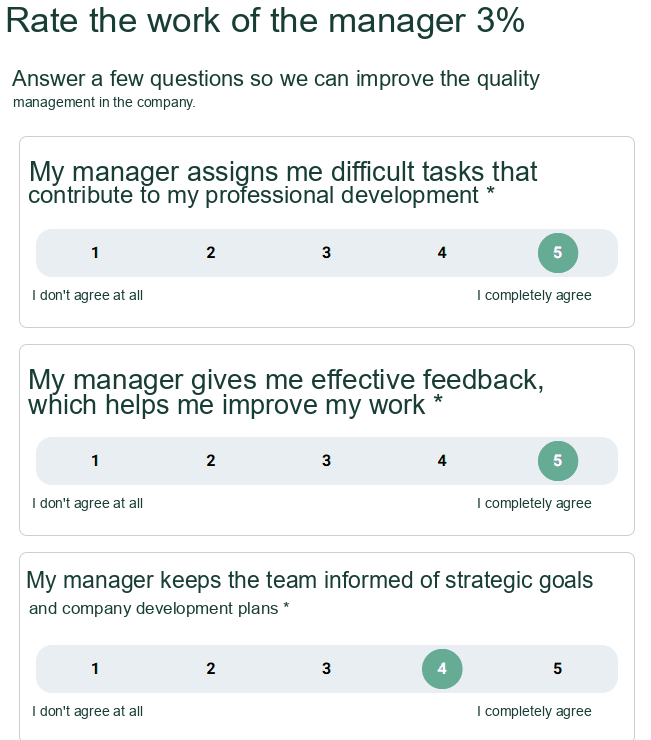
Manager assessment questionnaire in Appraise
When to conduct a manager performance assessment
Regularly, for example, every six to twelve months alongside employee assessments.
In addition, a manager performance assessment may be conducted:
- After significant changes in the company — such as implementing a new strategy or expanding the team.
- When turnover is high or there are numerous employee complaints — a strong signal that it is time to analyze the manager’s management style.
Manager assessment criteria
Manager performance indicators provide the basis for an objective assessment of management quality. Below are the key indicators.
1. Performance and task management
- Achievement of the department’s KPIs / OKRs.
- Meeting project deadlines and quality requirements.
- Ability to prioritize and allocate resources effectively.
- Decision-making skills: speed + quality.
2. People and team management
- Ability to build a team, from hiring and onboarding to retention.
- Task delegation and employee development.
- Managing conflicts and stressful situations.
3. Leadership and personal qualities
- Strategic thinking.
- Accountability and a results-oriented mindset.
- Adaptability in changing circumstances.
- Emotional intelligence: listening skills and empathy.
4. Communication
- Openness and accessibility to the team.
- Ability to provide constructive feedback.
- Ability to negotiate and represent the company’s interests.
- Transparency in decision-making.
5. Impact on corporate culture
- Supporting and promoting company values.
- Creating an environment of trust.
- Participation in corporate initiatives.
- Supporting innovation and change.
6. Development and learning
- Personal commitment to development: participating in training and self-directed learning.
- Supporting employee development and mentoring.
- Willingness to share knowledge and experience.
Important: to provide an objective picture, the criteria must be balanced, combining “hard” indicators (financial results, KPIs) with “soft” ones (leadership, culture, and communication).
Manager performance assessment methods
After defining the criteria, the next step is to select manager assessment methods. Ideally, use a combination of methods to analyze professional competencies and personal qualities comprehensively.
360-degree assessment
Provides a comprehensive view of a manager’s performance. Feedback comes from direct reports, peers, and senior leaders. It also includes self-assessment, in which the manager independently reviews their achievements.
This manager performance assessment method is considered the most objective because it incorporates multiple perspectives.
Learn what a 360-degree assessment is and how to conduct one in this article.
KPI and OKR assessment
A manager assessment system directly linked to business outcomes. It shows how successfully the manager and their department achieve established goals.
Revenue, on-time project completion, cost reduction, and other planned indicators are compared with actual results. The closer they are, the more effective the manager’s performance. However, this approach does not account for their “soft” skills, management style, or the team environment.
Team satisfaction assessment
mNPS is a qualitative indicator used to assess management quality. It helps measure a manager’s reputation and employees’ trust in them.
The survey shows how the manager’s style affects the team environment.
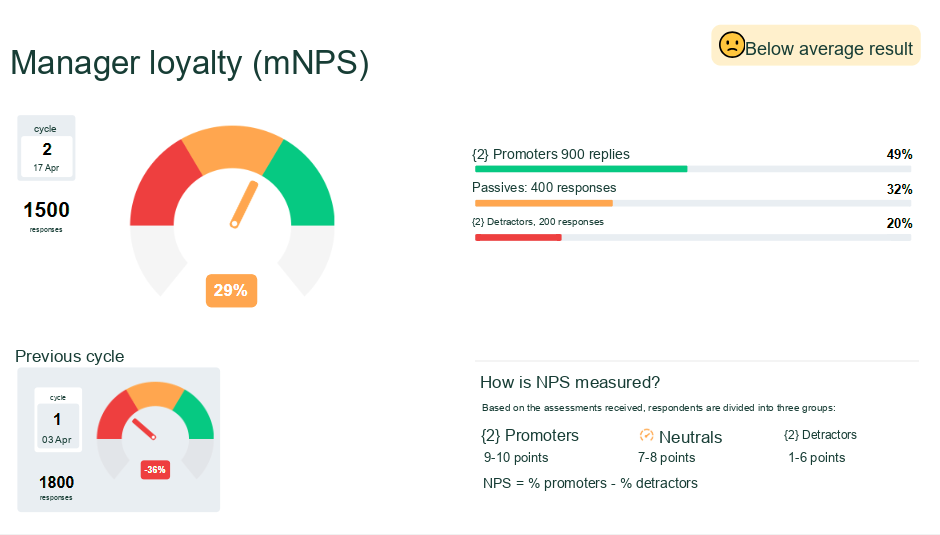
Manager assessment in Appraise
HR metrics analysis
This involves measuring objective indicators within the manager’s team:
employee turnover;
new-hire onboarding speed;
internal mobility;
number of complaints and conflicts.
Although these indicators reflect a manager’s performance, they do not always depend solely on the manager. For example, high turnover may be caused by low pay or labor market conditions.
Assessment center
A combination of comprehensive testing and business simulations that model real management situations. The manager solves cases and participates in role-playing exercises and group discussions while experts observe their behavior and assess their competencies.
This is an extensive and costly process, so it is most often used to assess senior executives. Other methods are more suitable for middle managers.

Free guide
How to conduct a manager assessment: stages
A step-by-step process explaining where to begin, how to launch the assessment, and what to do with the results.
Define the goals and scope
The first step is to define:
- why the company should assess managers;
- who will be assessed;
- how often assessments will take place;
- whether the assessment will affect bonuses or promotions.
The final goal might be phrased as follows: identify the manager’s strengths and development areas.
Define the metrics
An assessment generally covers two areas:
Results: achievement of goals, KPIs, and on-time project completion.
Management style refers to how the manager works with people and whether they can inspire, delegate, and provide feedback.
Possible metrics include:
“hard” indicators: department KPIs/OKRs, project deadlines/quality, and financial targets;
“soft” indicators: mNPS, eNPS, turnover, and onboarding speed;
- competencies: ability to communicate effectively, delegate, and develop people.
Select the methods
Companies typically combine methods to reach objective conclusions.
For example, an annual assessment may use the following mix:
- KPI/OKR — 40%;
- 360-degree assessment — 30%;
- HR metrics: engagement, turnover, and onboarding — 20%.
- mNPS — 10%.
Prepare the materials
For example, a 360-degree assessment or mNPS survey requires questionnaires with rating scales. The Appraise platform already automates everything and is ready to launch: simply select a ready-made template or create your own questionnaire.
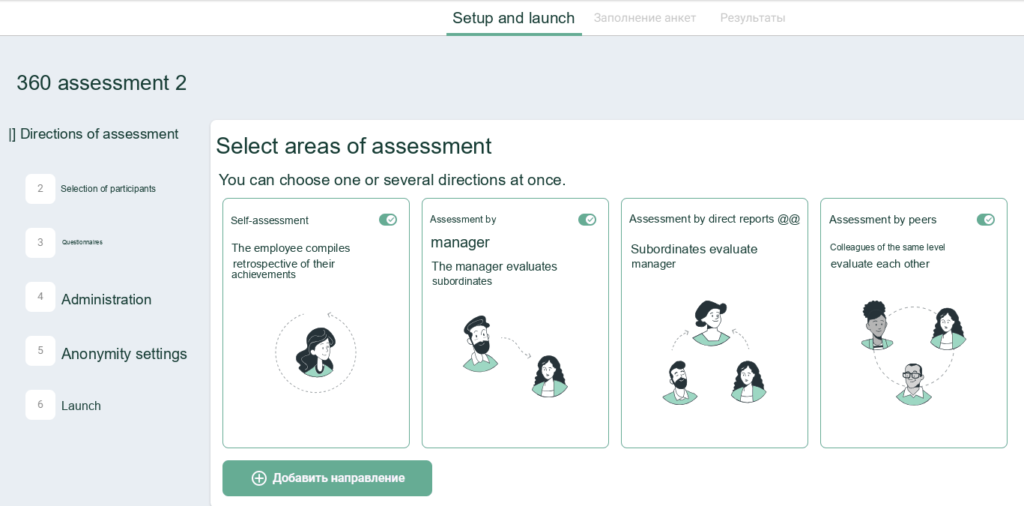
360-degree assessment in Appraise
The questionnaires include both closed-ended rating-scale questions and open-ended questions to provide the most complete and objective view of the manager’s performance.
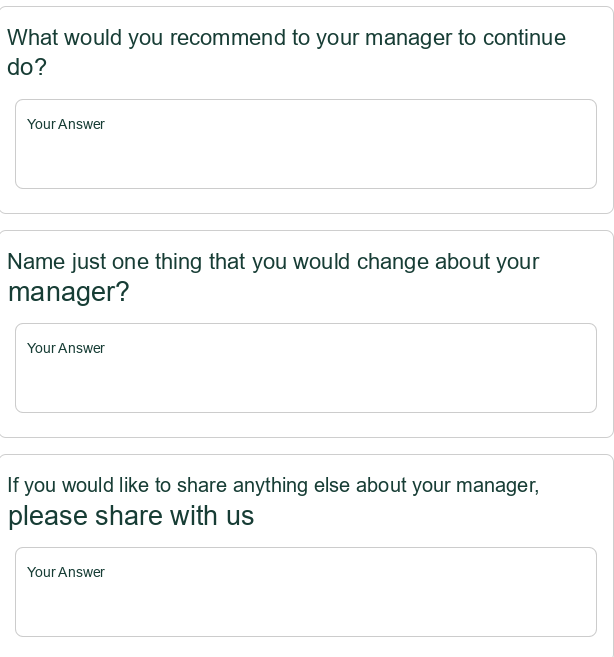
Open-ended questions in the manager assessment questionnaire — Appraise
Launch the assessment and collect data
Before launch, it is important to explain to employees why the assessment is needed and how it will work. This reduces tension and increases the questionnaire completion rate.
It is also advisable to pilot the process with a small group, gather feedback, address any issues, and only then involve all required participants.
Compile the report and analyze the results
Compare the figures and respondents’ answers with the expected indicators. Identify where the manager excels and where improvement is needed.
Appraise helps save time and interpret responses correctly. All reports are automated, giving you a clear overview with conclusions and recommendations.
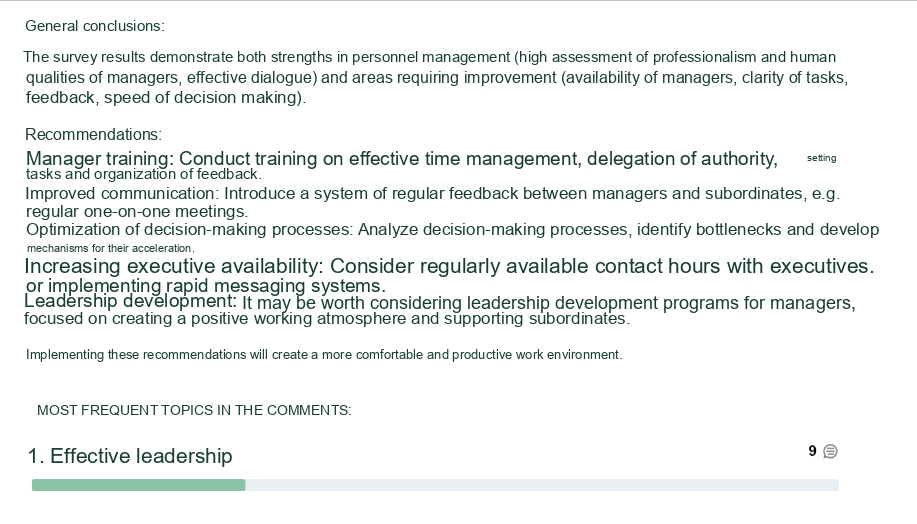
Ready-to-use report in Appraise — with conclusions and recommendations
Provide feedback and create a development plan
At the one-on-one meeting, it is important to discuss strengths, challenges, and areas for growth. The goal is not to assign blame but to identify development opportunities.
Next, create a plan with 1–3 goals and specific actions for achieving them. In Appraise, development plans are generated automatically based on assessment results. The AI assistant creates them using the 70-20-10 model: 70% hands-on experience, 20% real-world assignments, and 10% learning materials.
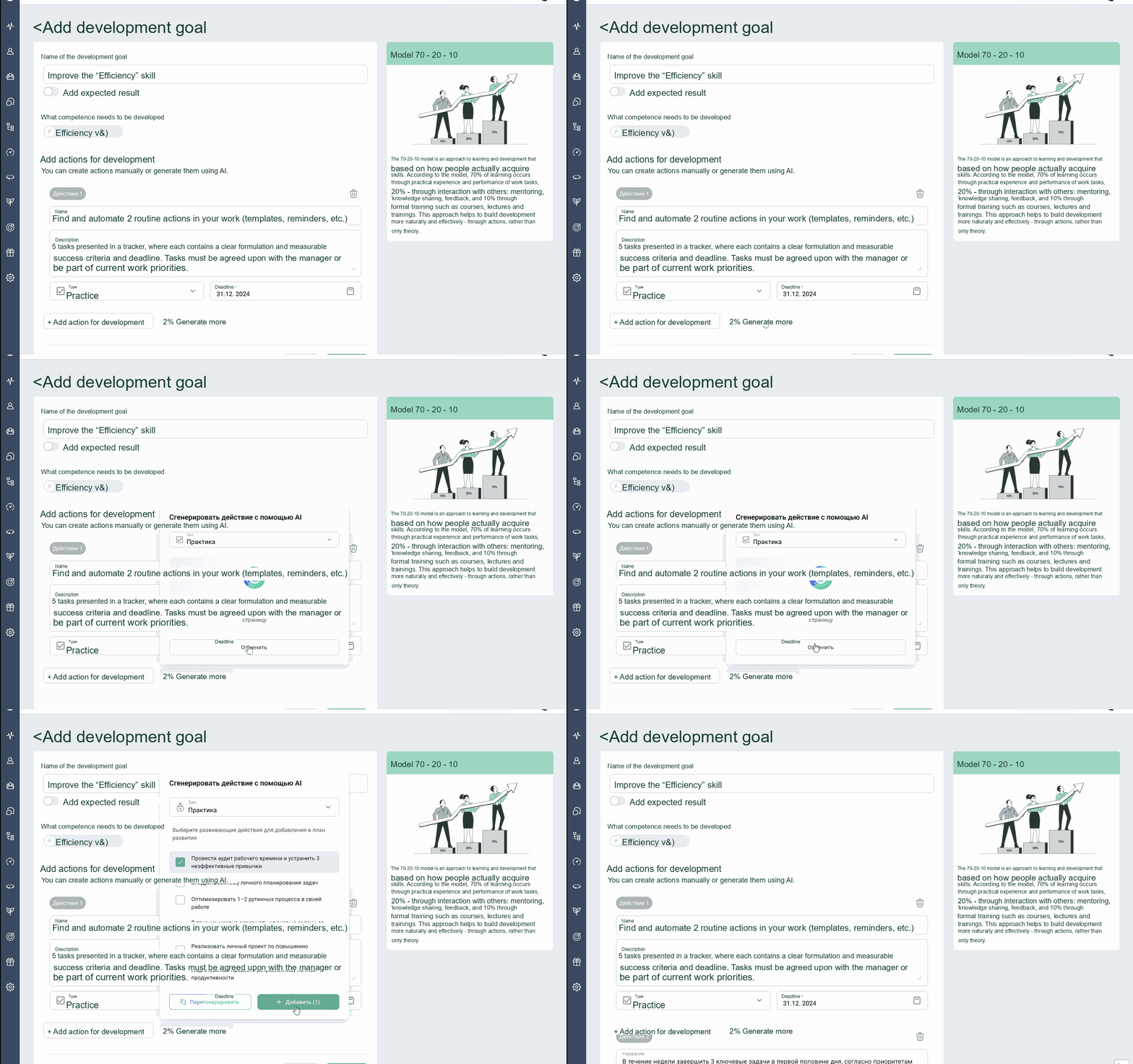
AI-generated development action plan based on the 70-20-10 model in Appraise
Read more on this topic in our articles:
Why companies need one-on-one meetings and how to conduct them →
What the 70-20-10 model is and how it supports employee learning →
Track progress and reassess
Integrate the development plan into quarterly goals. Repeat a short pulse survey, including mNPS, after 3–6 months, compare the results over time, and review what has changed.
Key mistakes in manager performance assessment
Let’s examine the stages of building a talent pool.
No clear goal
The main mistake is launching an assessment simply because “everyone else is doing it.” Managers need to understand why they are being assessed. Without a goal, there is no clear rationale. As a result, the entire process is perceived as a formality and its effectiveness falls to zero.
Focusing only on numbers
For example, HR may assess only KPIs while overlooking other important factors, such as team trust and communication style. This reduces objectivity: a manager may outperform everyone against targets while burning out the team, leading to high turnover.
Ignoring team feedback
When an assessment includes only the views of senior management and excludes direct reports, it creates a one-sided view of the manager’s performance. Their actual impact on the team remains overlooked.
Poorly designed anonymity
If employees believe their responses can easily be traced back to them, they give “safe” ratings. This distorts the results and undermines trust in the assessment.
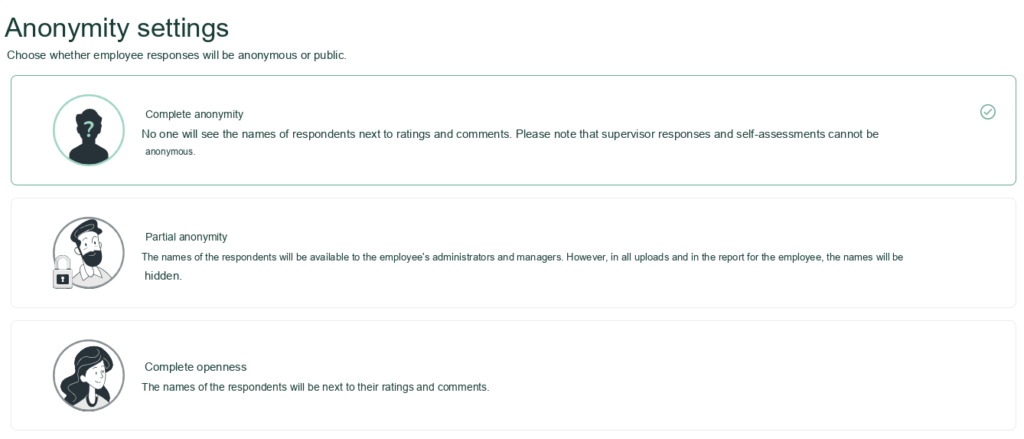
Appraise allows you to make employee responses fully anonymous
No follow-up actions or development plan after the assessment
All the work involved in preparing and conducting an assessment is pointless if the results are not discussed and no development plan is created afterward. Change requires an understanding of what to do next, followed by specific actions, from training to hands-on practice of communication skills.
Read more about developing managers and their employees in our articles:
Key takeaways
 Why should businesses assess managers?
Manager assessment helps determine how effectively a manager’s decisions contribute to the company’s strategic and financial goals. In addition to KPI/OKR performance, the assessment identifies strengths and development areas, people management quality, impact on corporate culture, and employee trust.
What exactly does a manager assessment show?
How effectively they delegate and communicate.
How they allocate resources and motivate the team.
Whether they retain talented professionals.
Whether they uphold the company’s values and environment.
Whether they reduce management risks such as turnover, stress, and conflict.
What criteria are used to assess a manager?
- Performance: KPIs, meeting deadlines, and quality of completed projects.
- People management: hiring, onboarding, delegation, and conflict resolution.
- Leadership qualities: strategic thinking, accountability, adaptability, and emotional intelligence.
- Communication skills: ability to provide feedback and negotiate.
- Support for corporate culture: upholding company values and participating in initiatives.
- Development: learning and mentoring.
How do you conduct an assessment?
- Define the goals: development, increased employee satisfaction, and a stronger corporate culture.
- Define the metrics.
- Select the methods and determine their weighting in the assessment. For example, KPI performance — 50%, 360-degree assessment — 40%, and mNPS — 10%.
- Prepare questionnaires and rating scales. Ensure anonymity and an appropriate respondent sample.
- Launch the assessment. It is advisable to pilot the process with a small group first.
- Collect and analyze the data.
- Provide feedback in a one-on-one meeting.
- Create a development plan.
- Measure progress after 3–6 months.
Automate manager assessments
Use all the capabilities of Appraise to achieve accurate results quickly