



A talent pool helps businesses fill vacancies faster, reduce the risks associated with unexpected resignations, and increase employee engagement and loyalty by offering career prospects. According to the HR Meter study, more than 70 % of Russian companies use talent pools to prepare employees for key positions. A study by Rabota.ru and SberPodbor provides further detail: 51 % build their pools through career websites, 43 % through employee referrals, 35 % from candidates who were previously interviewed, and 17 % from former employees. Let us take a detailed look at how to work with a talent pool.
Table of contents
What is a talent pool, in simple terms?
A talent pool is a preselected list of employees whom a company is preparing for promotion or plans to appoint to positions with new areas of responsibility. The selection process considers each professional’s skills, experience, potential, and alignment with the organization’s values.
A talent pool makes it easier, less expensive, and faster for a business to fill important positions. Employees are already familiar with the company’s internal processes and culture, so they do not need lengthy, complex onboarding. This approach allows employees’ responsibilities to be expanded gradually and enables them to take on more complex tasks and projects. This does not necessarily require an increase in grade.
Why a company should build a talent pool
The goals of creating a talent pool depend on business priorities. Here are some of them.
Fill critical positions quickly
Selecting employees from the talent pool minimizes downtime and business risks.
Develop high-potential professionals
Through systematic training and broader areas of responsibility.
Motivate and retain valuable employees
Professionals are loyal and engaged when they understand their opportunities for career growth within the company.
Prepare for business expansion
For example, when a company opens a new branch or business line, it does not need to recruit employees because the talent pool already has everything it needs.
Build project teams
And accelerate the selection of people with the right skills for specific tasks.
Protect against talent shortages
Even if key employees leave the company, a talent pool helps replace them smoothly.
Save resources
The company does not need to spend money on posting vacancies, interviews, adaptation, and onboarding. Instead of a lengthy and expensive hiring process, it can select from candidates who have already been prepared.
Maintain management team stability
And prevent crises caused by managers leaving.
Types of talent pools
Let us look at the main types of talent pools.
Internal talent pools consist of current employees who may be considered for new or more complex positions. These professionals are already familiar with the organization’s corporate processes, culture, and values and are ready to move into a management position or expand their area of responsibility.
External talent pools are databases of potential candidates from outside the company. They may include applicants who were previously interviewed, graduates of relevant universities, and even competitors’ employees.
Important: when building a talent pool, both external and internal candidates should be considered, with priority given to the latter. Relying solely on an external pool is risky: a person may not be considering job offers at all, or their salary expectations or other requirements may not be a good fit.
Talent pools can also be divided into strategic and operational pools.
A strategic pool includes employees who are ready to work in senior management. They share experience managing large teams, a deep understanding of business processes, strong credibility among colleagues, and a willingness to take responsibility for company-level results.
An operational pool includes employees who are ready to take middle-management or line-management positions. These are usually professionals with experience managing small teams and a high level of engagement in their work.
How to build a talent pool
Let us examine the stages of building a talent pool.
Define the goal
The first step is to understand why the company needs a talent pool and succession planning. The goal must be specific, aligned with the business strategy, and clear to everyone involved in the process.
To formulate the goal, analyze the business’s staffing needs: which new positions or roles are planned, and whether professionals already working at the company can fill them.
Identify key positions and selection criteria
It is important to determine in advance which positions should be prioritized when building the talent pool.
A candidate profile is then created for these positions. To avoid vague generalizations, discuss the criteria with the head of the department for which the candidate is being prepared. For example, these may include:
- specific professional skills;
- leadership qualities;
- flexibility and adaptability;
- determination;
- time-management skills.
Please note: only employees who have consented to being included and are interested in career growth and competency development should enter the pool. Otherwise, even a strong but unmotivated professional will not meet the company’s needs.
Assess candidates
Once the selection criteria have been defined, the remaining task is to identify who fully meets them and select the best candidates. Various methods can help, such as 360-degree assessment. It considers the employee’s self-assessment as well as feedback from their manager, team, and direct reports.
In addition to 360-degree assessment, practical exercises can be used: a project presentation, a business simulation, an assessment center, or a leadership potential assessment (using the Hogan methodology, for example). An in-depth interview that assesses the employee’s willingness to learn and motivation for career growth can also be valuable.
Develop a development plan
Based on the assessment results, an individual development plan is created for the employee. It specifies goals, timelines, a development strategy, and assessment criteria.
Ideally, the plan should be practice-oriented. For example, the 70-20-10 model assumes that employees gain 70% of their learning from real work tasks, 20% through interactions with colleagues and partners, and only 10% from courses and theoretical materials.
Read more about this topic in our articles:
How to work with individual development plans →
What is the 70-20-10 model, and why is it useful for employee learning? →
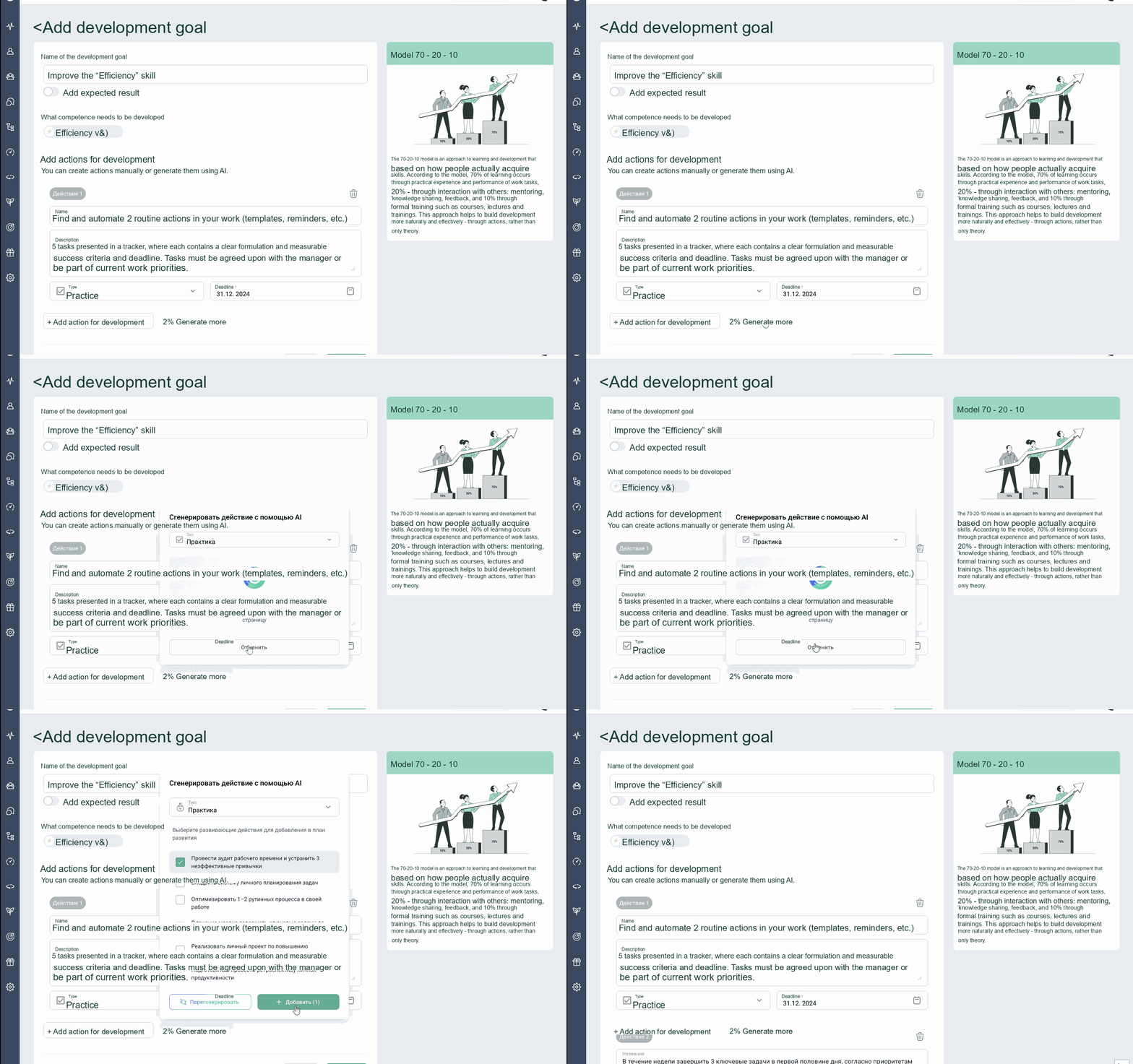
Automatic generation of a 70-20-10 development action plan in Appraise
Free guide
Talent pool development timelines
Talent pool development programs may be short-term or designed for a longer period.
A short-term format is designed to prepare an employee for promotion within 3–12 months of their inclusion in the pool. This is the most dynamic format, but it is not suitable for every position.
A long-term program covers a period of one to two years and involves more in-depth competency development. In such cases, participants are often prepared to become successors, particularly in senior management.
Evaluating talent pool effectiveness: how to know whether it is working
The key indicator of talent pool effectiveness is the appointment rate. In other words, it is the proportion of candidates from the pool who actually received new positions within the company.
💡 The optimal benchmark is 75%.
A 100% result is worth striving for, but it is unrealistic: circumstances and goals change, some employees may resign or relocate, while others learn slowly or are not psychologically ready for greater responsibility. Therefore, 75% is a reasonably strong result.
How to simplify employee development
Appraise provides everything needed for structured, systematic employee growth management, from assessments to development plans.
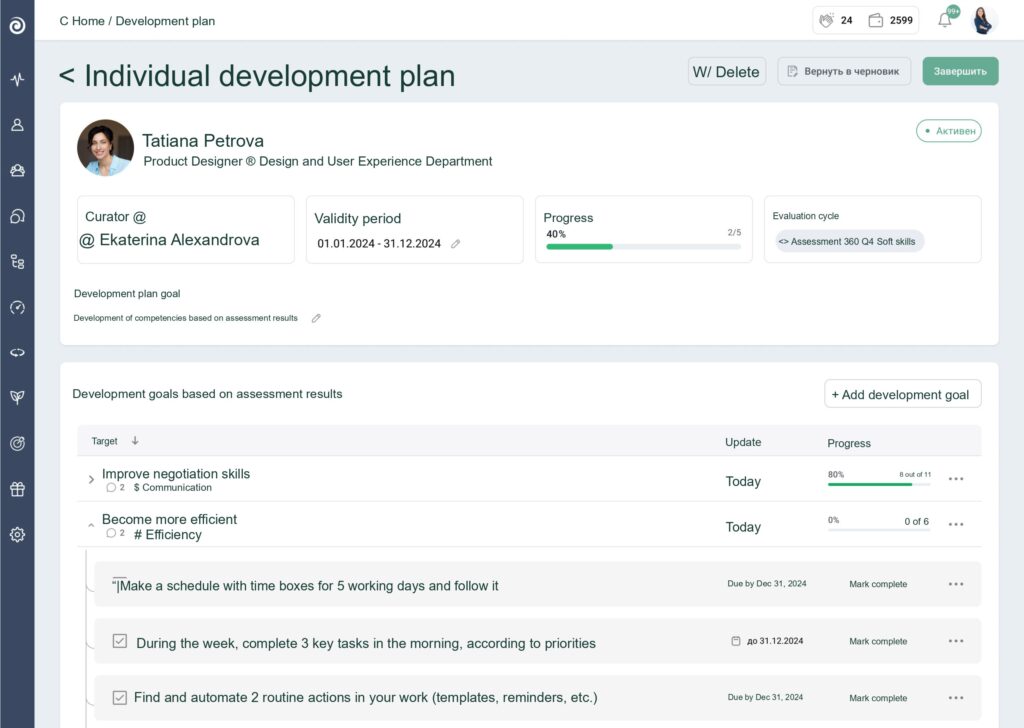
IDPs in Appraise
Development actions are based on the 70-20-10 model, with a focus on practice. You can use the suggested materials or add your own.
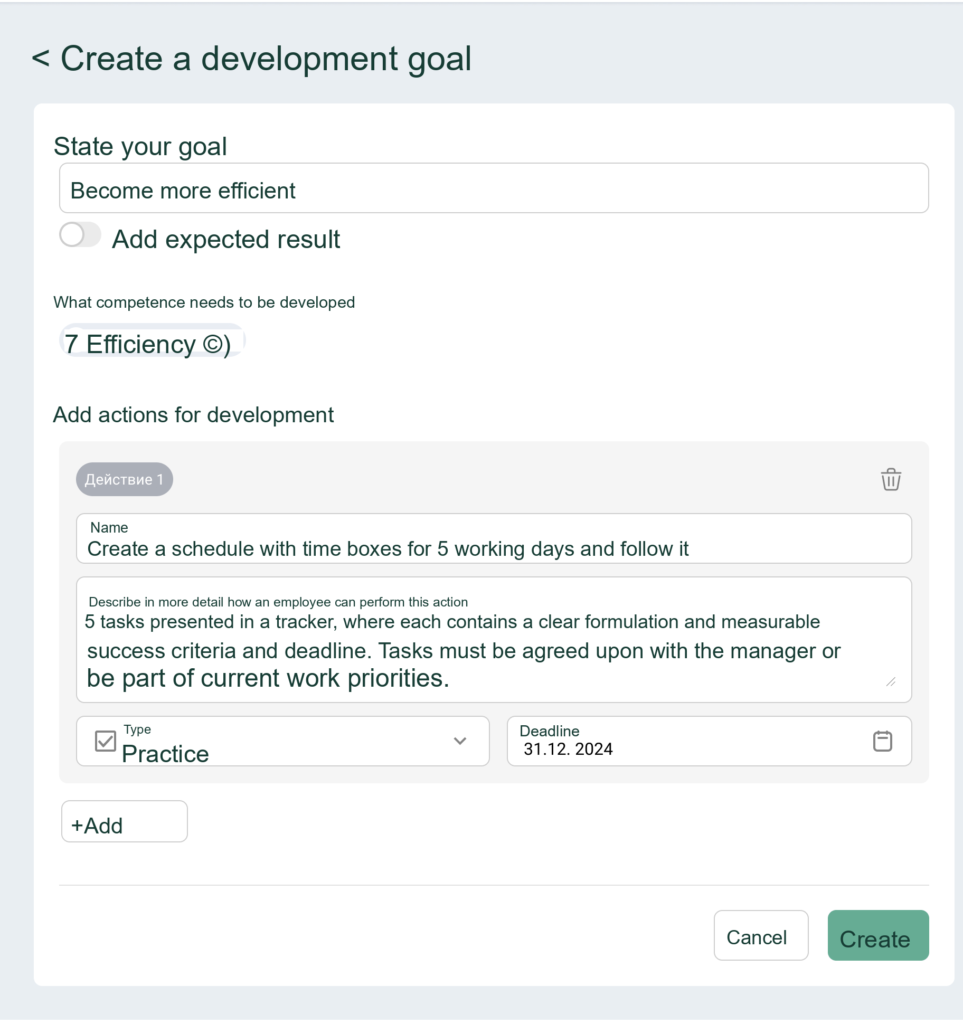
Creating development goals in Appraise
A convenient dashboard displays each employee’s progress. It is immediately clear who is progressing well against the plan and who needs help.
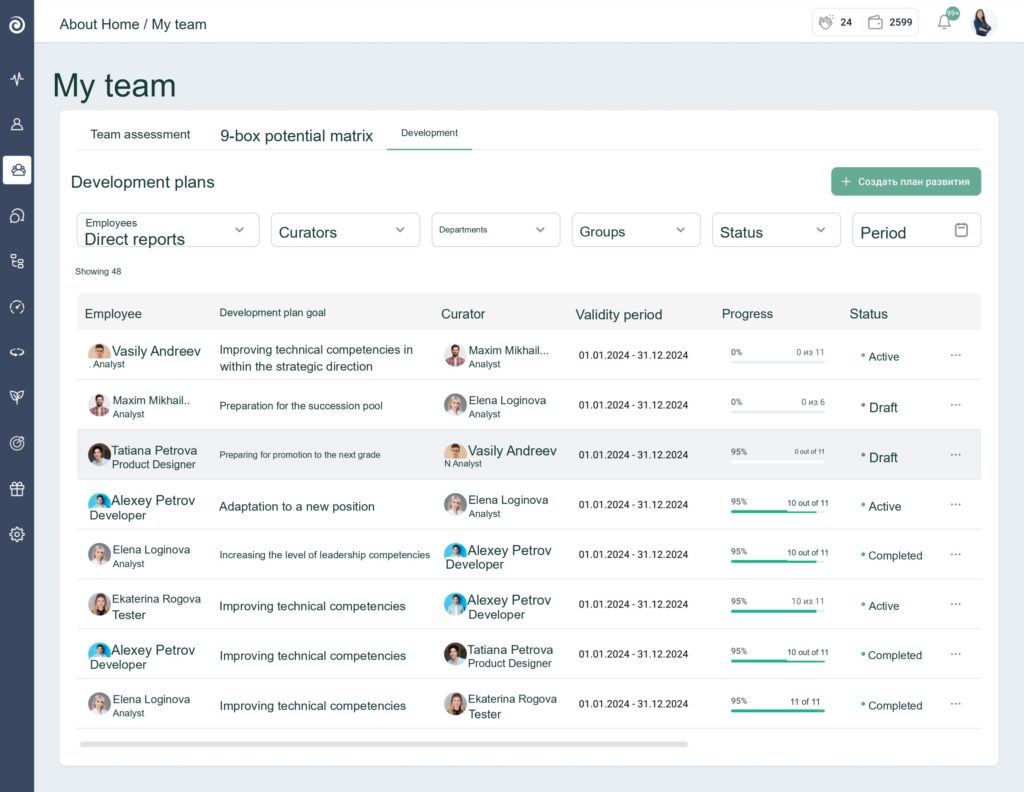
Plan completion progress on the manager's dashboard
The employee receives a clear action plan for advancing their career. HR and the manager gain a clear view of how the professional is progressing through training and whether they are ready for promotion.