




Ambitious goals drive business forward. The OKR (Objectives and Key Results) methodology helps set them and assess results. Together with Tatyana Smirnova, an OKR methodology expert at Appraise, we explore its key strengths, how it supports company growth, and what successful implementation requires.
There is considerable discussion about the talent shortage: 86% of companies have faced a lack of employees. The reasons are well known: the demographic decline of the 1990s, relocation, and Generation Z’s limited interest in traditional work.
There is another side to the issue: alongside its talent shortage, Russia has low labor productivity compared with other countries. According to the International Labour Organization, each hour worked generates one and a half to two times less than in Western countries. OKRs will not solve this globally, but they can work at the company level: rather than hiring more employees, a business can focus on improving the effectiveness of its existing team.

There is considerable discussion about the talent shortage: 86% of companies have faced a lack of employees. The reasons are well known: the demographic decline of the 1990s, relocation, and Generation Z’s limited interest in traditional work.
There is another side to the issue: alongside its talent shortage, Russia has low labor productivity compared with other countries. According to the International Labour Organization, each hour worked generates one and a half to two times less than in Western countries. OKRs will not solve this globally, but they can work at the company level: rather than hiring more employees, a business can focus on improving the effectiveness of its existing team.

Contents
OKR essentials
An OKR is formulated as follows:
I will achieve an Objective, as objectively demonstrated by Key Results through key initiatives.
An objective is a concise, inspiring description of what you want to achieve. It contains no metrics in itself; it is a qualitative description and aspiration.
Key results are the criteria that show the objective has been achieved. They are not steps or a process, but the result itself.
Key initiatives are the actions that help achieve the main objective.
For example, the objective might be to create Russia’s most popular mobile game. Key results could include 10 million app downloads, 500,000 daily active users, and a high rating.
All objectives are public in the OKR methodology: employees can see the objectives of the company, their team, and even other departments. This ends siloed work: teams coordinate their actions and understand the shared result they are working toward.
How OKRs differ from KPIs
OKRs are used to drive ambitious change: they always involve innovation and creating something new. The methodology works especially well under significant uncertainty. For example, a company may plan to enter the European market and set an objective of making its first sales.
KPIs are indicators of business health, used when results and established metrics already exist. Continuing the example, once the company has entered Europe and made its first sales, KPIs become appropriate because the necessary inputs are available and results can be forecast.
Another fundamental difference is the impact on employee compensation. KPIs may be tied directly to compensation, while OKRs should not affect income; otherwise, employees will avoid proposing ambitious objectives.
OKRs and KPIs are not competitors but allies. KPIs can track ongoing processes and their effectiveness, while OKRs — support growth.
We recommend evaluating employees comprehensively using multiple data sources: OKR progress, KPI performance, competency assessments, and feedback from managers and colleagues.
Tatyana Smirnova,
Product Manager and OKR methodology expert at Appraise
Why OKRs benefit businesses
1. Focus on 3-5 key objectives instead of an endless task list
When time is scarce, companies are pulled in too many directions. OKRs eliminate chaos, help teams focus on key priorities, and make visible results more rewarding.
2. Ability to delegate responsibility to teams
Managers give employees the freedom to choose which objectives to set and how to achieve them.
3. Simpler process management
Teams can focus on results and improving them instead of spending time on supervision and micromanagement.
4. Flexibility and adaptation to change
Unlike traditional annual planning, OKRs allow objectives to be reviewed at least every three months and plans to be changed freely.
Free guide
What is the OKR methodology? A step-by-step implementation plan
Appraise case study
OKRs are used successfully in every sector, including government organizations. The key is to adapt the methodology correctly. Here is how we did it at our company.
We adopted OKRs when our objectives became fragmented, a common reason companies turn to this methodology. We had built a strong team of excellent specialists, yet we were standing still rather than achieving a breakthrough. When we examined the causes, we saw that every team was working hard but pursuing its own agenda: marketing increased traffic that did not convert, while sales complained that the product did not meet customer expectations.
We held a strategy session and set an ambitious objective: become the favorite work app of the companies we admire. This raised an important question: who exactly were the companies we admired and our target audience? The team began moving in one direction and received an incredible boost without additional resources or headcount, simply through focus and alignment. Every department focused on the same customers and stopped wasting resources; teams began complementing one another instead of pulling in different directions.
Tatyana Smirnova,
Product Manager and OKR methodology expert at Appraise
6 conditions for successful OKR implementation
1. Define the problems you want to solve and how you will measure the impact
Without a clear objective, results are unlikely.
2. Understand the company's high-level vision and where it wants to go
Only then should you formulate OKRs. Objectives should be inspiring and ambitious, but still achievable.
3. Do not try to cover the entire company at once
Start with a small pilot involving one or several teams. They should be motivated teams that are ready for change.
4. Select an OKR champion to coordinate implementation
This does not need to be a dedicated employee; it can be a motivated team lead who takes responsibility for guidance and support.
5. Build OKR rituals into company processes
These include annual and quarterly planning and review meetings. Weekly check-ins are also needed to discuss OKR progress and barriers. Spotify, for example, holds these meetings every Friday to maintain focus on strategic objectives.
6. Scale successful practices
Once OKRs have proved effective in individual projects, the methodology and successful practices can be expanded across the company and new teams included.
Working with OKRs is an ongoing process, not a one-time exercise. Regularly analyze which OKRs work and which do not, at least quarterly, and ideally hold monthly retrospectives. Collect feedback from employees and team leads and adjust the approach so that it works for your organization.
Tatyana Smirnova,
Product Manager and OKR methodology expert at Appraise
Implementation mistakes
Too many objectives. More than five priority objectives will dilute focus and may prevent the methodology from working.
Unmeasurable objectives. If an objective cannot be measured, its degree of achievement cannot be determined.
Top-down objective setting. In the OKR methodology, teams usually propose objectives themselves, which builds ownership. If an objective is imposed on an employee, they may not even say that it is overly ambitious or unclear, and everyone ultimately loses.
Direct links to financial rewards. This discourages employees from proposing genuinely ambitious objectives.
Set and forget. Without regular monitoring and adjustment, OKRs become outdated and useless to the company.
Lack of automation. Spreadsheets can be used initially, but they require manual work and complicate the process. Data security also remains an issue, as OKR work often requires differentiated access rights.
Read more about implementing OKRs correctly in our article.
How to manage goals quickly and easily
Appraise helps automate goal management. Goals can be set at the individual, team, and company levels.
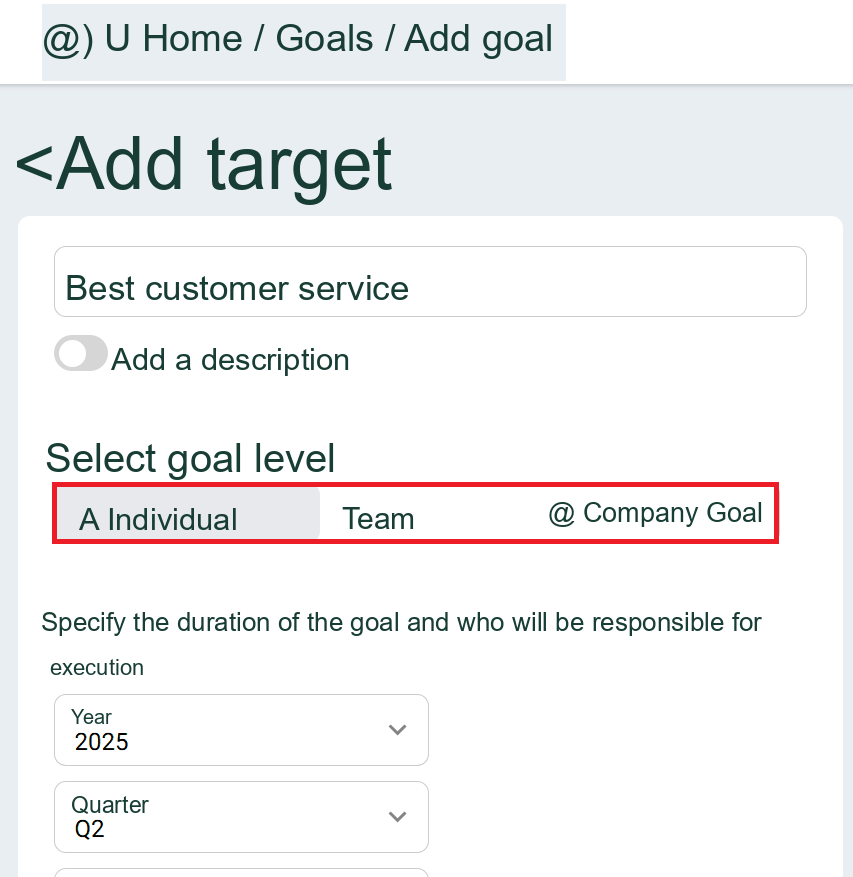
Goals in Appraise
The methodology and guidance on using OKRs, formulating objectives, and defining key results are built directly into the interface.
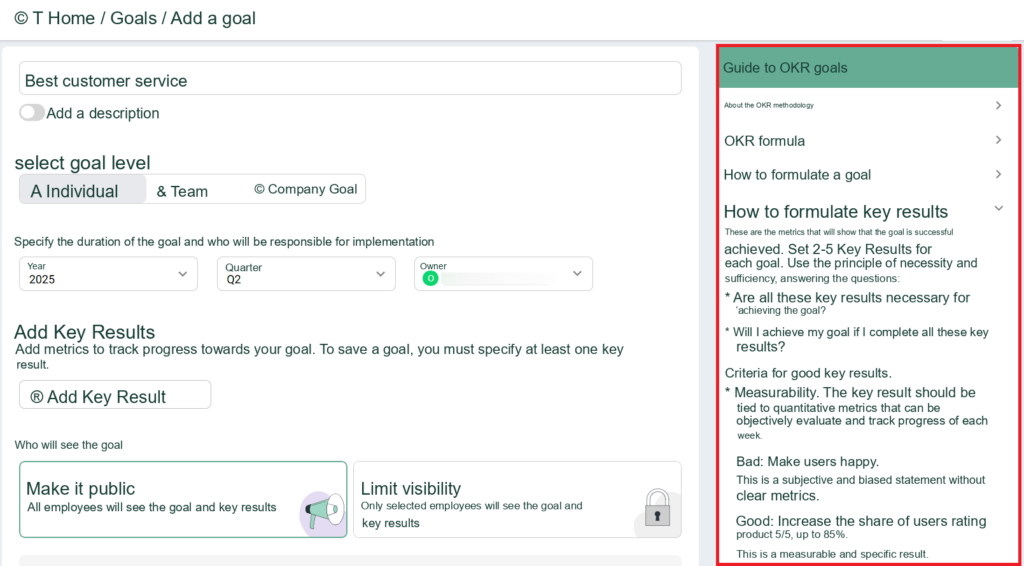
Built-in guidance makes it easy to understand the details and configure goals correctly
All created goals can be filtered by period, team, or individual.
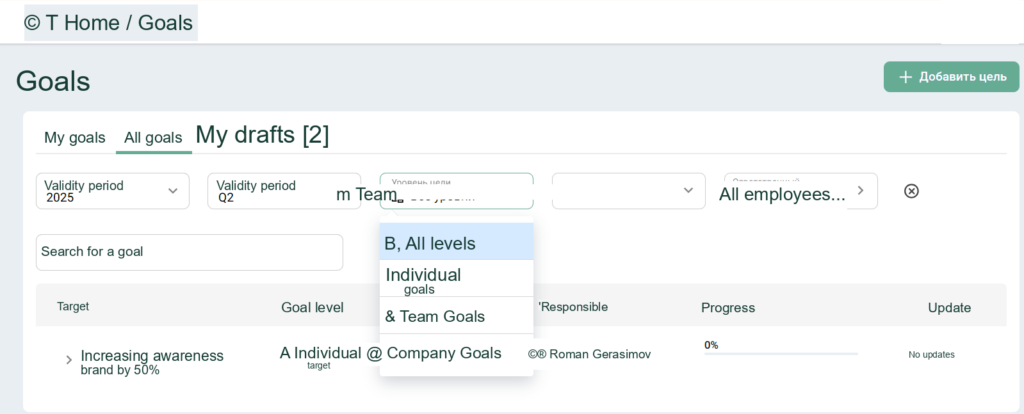
Filters make every goal in Appraise easy to find
Goal progress can also be tracked together with the date of its latest update. Only goal participants and their managers can access progress, eliminating the risk of accidental changes.
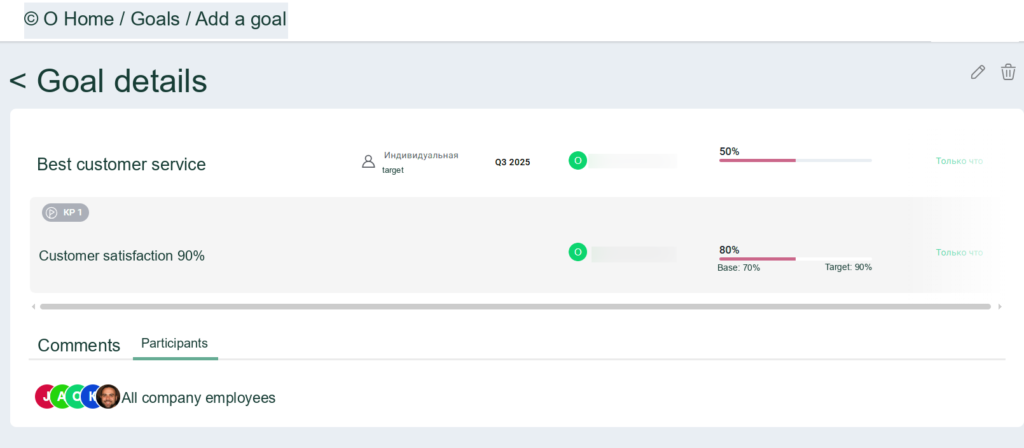
Track goal achievement in Appraise
Access rights can be configured when necessary.
Appraise also provides automatic reminders: if a goal has not been updated recently, the employee receives a notification.
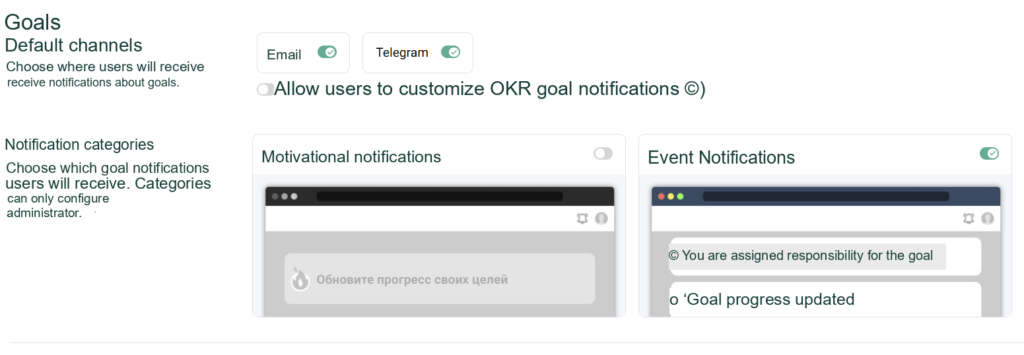
Configuring goal reminders
Why use the OKR module in Appraise
- Process transparency. All goals and results are always available in one place.
- Easy configuration. You can flexibly adapt OKRs to your company’s needs.
- Greater engagement. Assigning responsible employees and providing regular updates keeps every participant informed about progress.
Help your team achieve ambitious goals
Learn more about goal-setting features and applying the OKR methodology in Appraise