



Performance Review, or performance evaluation, helps identify employees’ strengths and areas for growth over a specific period and determine directions for their further development. For this tool to benefit the team and the business, it must be used thoughtfully rather than as a box-ticking exercise. To learn how to conduct a Performance Review without wasting time, read on.
Contents
The role of Performance Reviews in employee management
The Performance Review approach provides a comprehensive view of an employee’s work and contribution to the company. A performance evaluation analyzes whether the employee is a good fit for their role, how they are developing their professional and personal qualities, what results they have achieved, and whether they have the potential for career advancement.
A Performance Review is especially valuable when it reveals that an employee has significantly exceeded expectations, meaning their results are better than expected. In this case, the manager can initiate a salary increase, bonus review, paid training, or other forms of recognition.
However, if the review results in a low score, that is not a reason for harsh criticism or dismissal. A Performance Review is not a method of punishment, but a tool for growth. It highlights problems and weaknesses, among other things, and the manager’s task is to work with the employee to determine what is preventing them from achieving their goals, which skills need improvement, and where support is needed.
Benefits of Performance Reviews for companies and employees
Performance evaluation benefits everyone involved in the process.
For the company, it is an opportunity to:
- Analyze employee performance. Gain an accurate picture of how employees contribute to business objectives and take timely action to improve efficiency.
- Manage talent. Identify key employees and create a career development plan for them.
- Identify problem areas in teams or departments. Objective data makes it easier to plan the next steps needed to improve the situation. For example, one case may require specialized training, while another may require work on employee engagement.
- Improve corporate culture through open communication and greater trust within teams.
For employees, participating in a Performance Review is an opportunity to:
- Receive detailed feedback to see what they are doing well and where adjustments or additional effort are needed.
- Understand their career prospects. A review of strengths and growth areas provides a clear picture of what they need to develop to move into their desired role.
- Feel more motivated. Positive feedback inspires new achievements and increases job satisfaction.
Performance Reviews are designed to support development: the tool identifies high-performing employees and encourages them to achieve even better results, while those who are falling behind gain an incentive to improve and catch up with the leaders.
Nevertheless, performance evaluation is not yet a universal practice. Some believe that Performance Reviews have a largely negative effect on employees because the results can be demotivating. Others are convinced that evaluations take an enormous amount of time. All these arguments have some merit, but a well-organized process addresses most concerns. Let us look at how to conduct a review without fear or resistance.
How a Performance Review works: from objective to outcome
As a rule, the process is conducted twice a year (or, less frequently, once a year) or quarterly, depending on the business objectives. Consistency is essential: when employees clearly understand how and when their work is evaluated, it becomes part of their regular routine rather than a source of stress caused by uncertainty. The process can be divided into several stages; below, we highlight the key points at each stage.
Defining the objective
There is no point in blindly adopting another company’s approach, because every business has its own characteristics and priorities. It is important to understand exactly what your company will evaluate and which employee skills will be assessed. Most importantly, you need to understand why. For example, the objective may be to identify and reward high performers, meaning employees who are results-oriented and exceed their targets.
Defining the criteria
Once the objective has been defined, you need to establish the criteria used to determine whether an employee has achieved the desired result. The criteria should cover only what the employee can actually influence, such as the number of tenders won by an international sales manager or the number of campaign leads generated by a paid acquisition specialist.
A comprehensive evaluation should assess more than hard skills. In some cases, personal qualities have just as much impact on performance. For example, creative thinking helps people find unconventional solutions, communication skills help close multimillion-dollar deals, and strong time-management skills help employees complete necessary tasks faster.
Performance Review criteria may also include:
- KPIs, quantitative metrics used to evaluate an employee’s performance, such as the number of leads, calls, or sales.
- OKRs, an employee’s contribution to achieving company objectives, such as 95% customer satisfaction.
- A commitment to learning and professional development measured by completed courses, certifications, and advanced training.
- Activities beyond regular job responsibilities such as speaking at webinars and conferences, creating courses, or mentoring.
Preparation
Both the company and its employees need to be prepared for a Performance Review. Before launching the evaluation, explain why and how it will be conducted, which stages it includes, and how employees can prepare to complete the review successfully. This will reduce anxiety and help prevent employee resistance.
The next step is to prepare questionnaires with relevant questions.
A 180-degree review requires questionnaires for manager feedback and employee self-assessment. However, companies more often use 360-degree evaluations, in which colleagues also evaluate the employee and feedback from clients or contractors may be included in some cases.
Performance Review questions should help identify what an employee does well and where problems exist, document achievements, and clarify expectations about their work. Avoid overloading the questionnaire; 12-15 questions are sufficient.
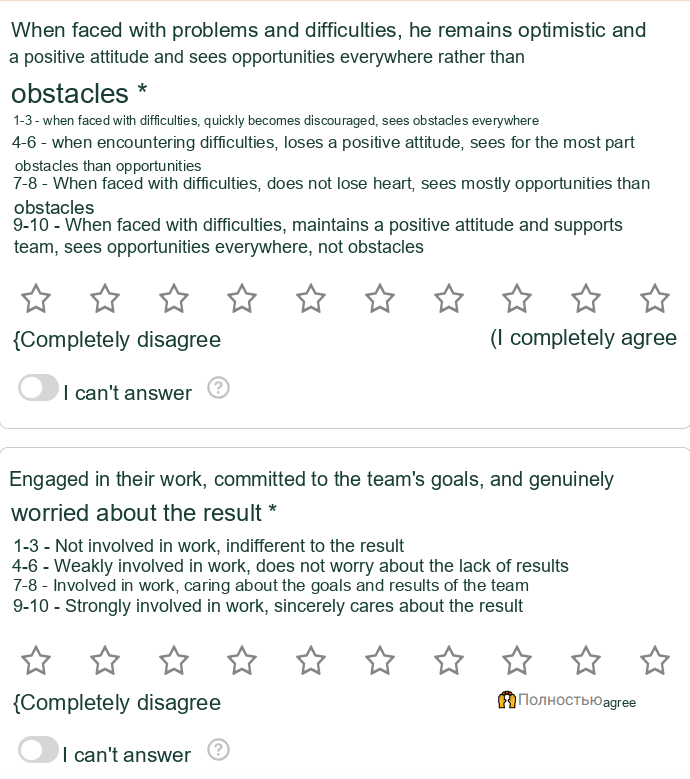
Sample Performance Review questions: an employee evaluation questionnaire in Appraise
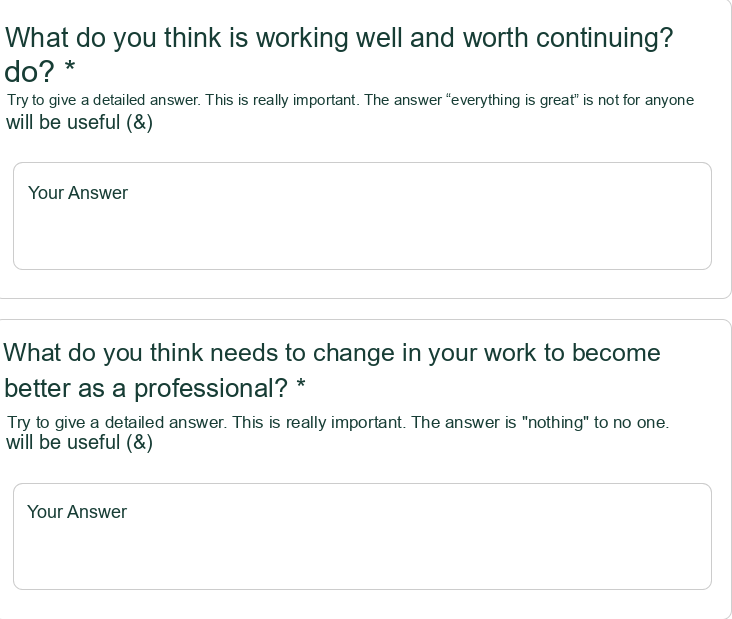
Sample open-ended questions: an Appraise questionnaire template
Read about how to create effective Performance Review questions in this article.
Conducting the evaluation and analyzing the results
At the scheduled time, HR professionals launch the review using a specialized platform or a manual process. The employee completes a self-assessment questionnaire, describing the projects they worked on, documenting achievements, noting their strengths and weaknesses, and setting goals.
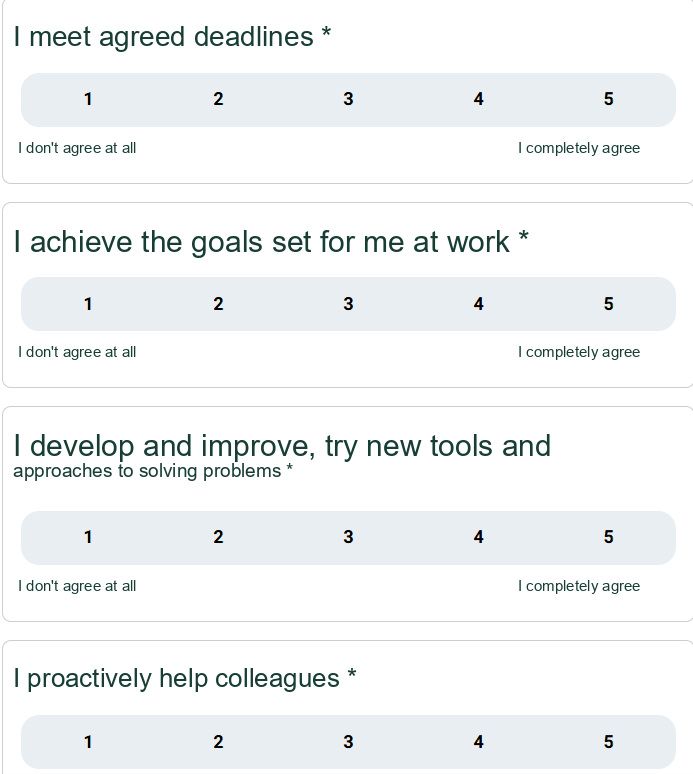
Self-assessment questionnaire in Appraise
Depending on the method selected, the manager also completes a questionnaire, while colleagues and other respondents participate in a 360-degree evaluation.
The most challenging stage is analyzing and consolidating all the information into clear conclusions. Performance Review automation greatly simplifies this process and saves HR professionals dozens of hours.
Discussing the results and creating an individual development plan
The final stage of a Performance Review is a meeting, where the manager discusses the results with the employee, identifies growth areas, and defines the next steps.
After the review, an individual development plan (IDP) is created for the employee. It specifies which skills need to be acquired or strengthened and which training is appropriate. The plan should include a deadline for completing these recommendations and milestones for tracking progress.

Survey and report templates
How to conduct a Performance Review
Common mistakes when conducting Performance Reviews
This list does not cover subjectivity or a box-ticking approach. Clearly, an evaluation should be impartial and based on facts. A review conducted merely for the sake of formality, with superficial questions and no discussion of the results or subsequent development plan, not only wastes people’s time but also undermines trust.
However, some mistakes are less obvious but no less dangerous: they can negatively affect evaluation results and demotivate employees.
Hidden criteria. For example, an employee may believe that their hard skills and the number of completed projects are being evaluated, only to learn during the results discussion that leadership and creativity were additional requirements for moving into a new role.
Unclear priorities. This issue is similar to the previous one: in both cases, the employee has little understanding of what to focus on to achieve the objective. Unclear priorities create additional stress. The employee may devote all their effort to what they believe matters, only to hear during the review meeting that other tasks were the real priorities, that they barely worked on them, and that they therefore received a low score. This can lead to complete disappointment and cause the company to lose the employee.
Prohibiting or ignoring feedback. A Performance Review results discussion is always a dialogue. Employees have the right not only to hear an evaluation of their work and their manager’s conclusions, but also to provide their own feedback. They should be able to discuss anything they consider contentious or unfair, present arguments in their favor, and influence a reassessment of the result.
Prohibiting or ignoring feedback. A Performance Review results discussion is always a dialogue. Employees have the right not only to hear an evaluation of their work and their manager’s conclusions, but also to provide their own feedback. They should be able to discuss anything they consider contentious or unfair, present arguments in their favor, and influence a reassessment of the result.
A clear understanding of the company’s objectives, open communication about them, and transparent evaluation criteria for managers and employees help prevent these mistakes. Appraise makes routine HR tasks easier.
How to conduct a stress-free Performance Review
Appraise lets you launch several evaluation streams at once: feedback from managers, colleagues, and direct reports, as well as self-assessment. Additional streams can be added as needed.
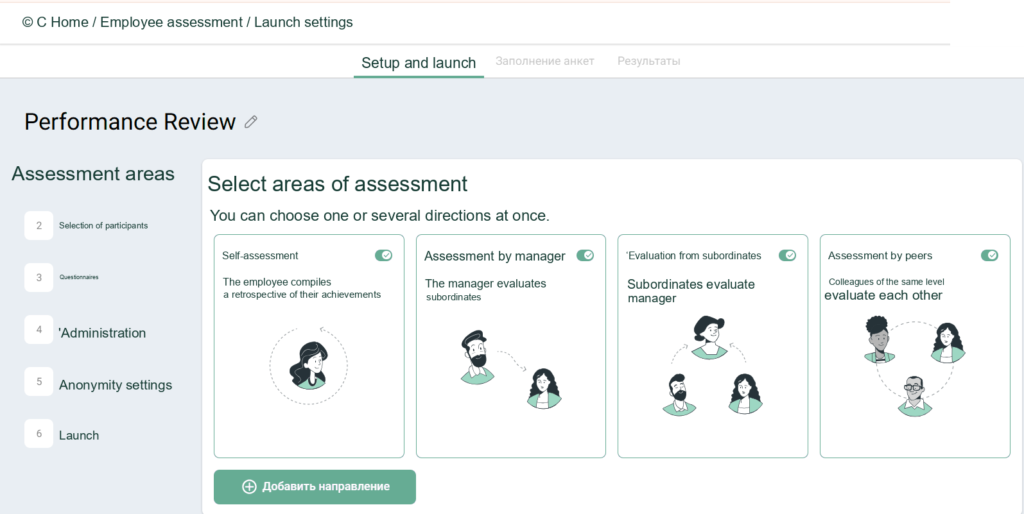
Launching a Performance Review in Appraise
Respondents are selected automatically based on the organizational structure. Participants can be added and edited to reflect cross-functional relationships.
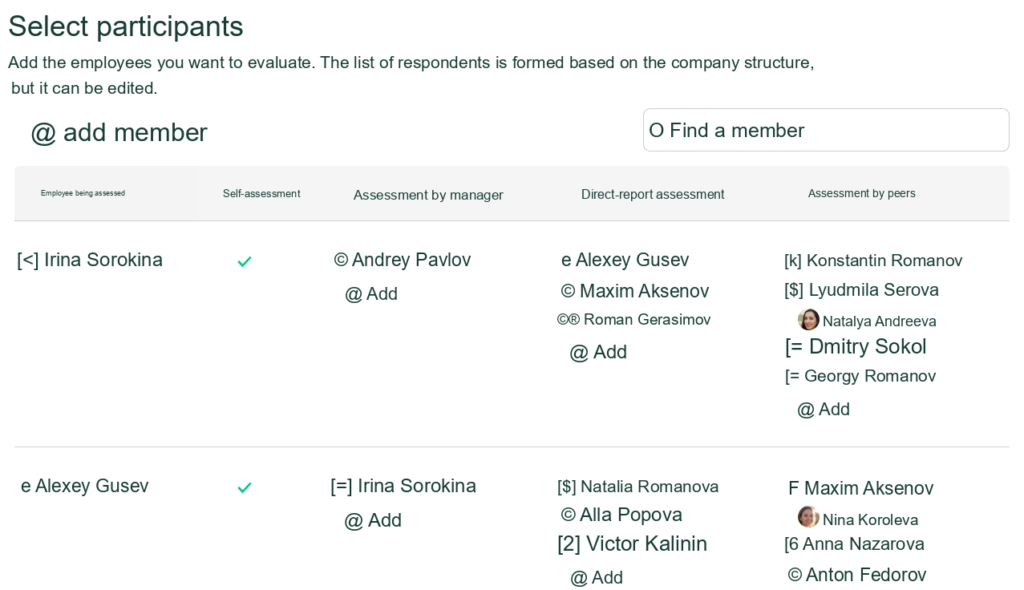
Selecting evaluation respondents in Appraise
Appraise provides questionnaire templates for launching evaluations, as well as a builder where you can create your own questions, select a scale from 0 to 10, and allow respondents to leave comments.
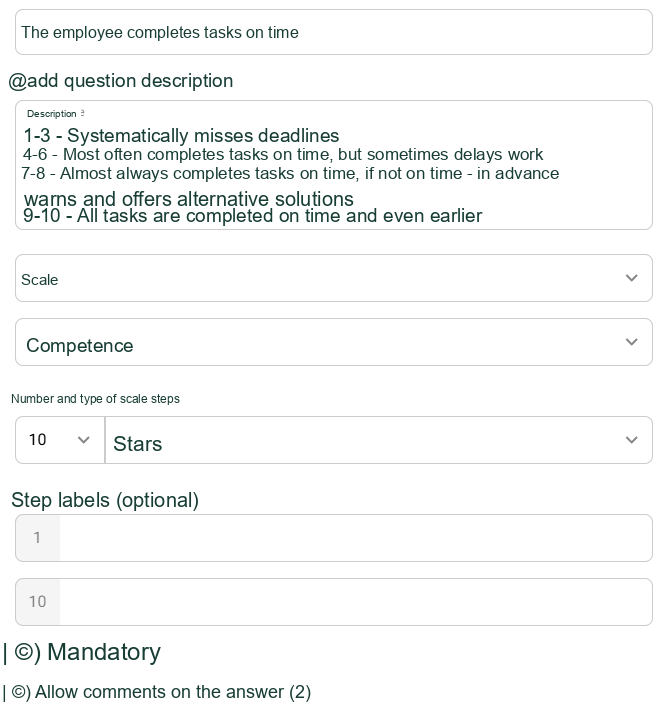
Appraise questionnaire builder
The tool helps track evaluation completion and sends reminders by email or messaging app to anyone who has not completed their questionnaire.
Once the evaluation is complete, Appraise automatically generates a presentation-format report with comments and recommendations for next steps.
Automate Performance Reviews
Launch evaluations your way and get ready-to-use results