



This article examines the metrics, case studies, and steps for reducing employee turnover through engagement management.
Contents
What is engagement, and why measure it in IT?
An engaged IT professional is not simply an executor, but a co-creator of projects. They suggest ways to optimize processes, take responsibility for results, and share the company’s values.
In an industry where the talent shortage has reached record levels, ignoring engagement means:
- Higher turnover. According to Gallup, engaged employees are 41% less likely to leave. Meanwhile, replacing an IT developer can cost twice their annual salary.
- Lower productivity. Engaged teams are 17% more effective. With tight deadlines and complex projects, a loss of focus can lead to failed projects and lost clients.
- Reputational risks. Dissatisfied IT employees readily share their experiences on specialist platforms such as GitHub, Habr, and Glassdoor, while a low eNPS discourages candidates.
Is ignoring engagement business suicide?
Let us examine the risks faced by a company that turns a blind eye to the state of its team.
Risk 1. Loss of expertise.
Employee departures result in:
- loss of knowledge about the codebase and business processes;
- lower code quality due to the constant transfer of tasks to new people;
- stagnating processes, as new employees spend months getting up to speed.
Fact: a team of 10 developers that replaces four people in one year loses up to 30% of its productivity because it must fight fires instead of developing features.
Risk 2. Missed market opportunities.
Response speed is critical in the IT sector. A disengaged team:
- adapts more slowly to new technologies;
- resists process changes;
- does not propose proactive solutions to capture market niches.
Impact: competitors with high engagement bring innovations to market 6-12 months faster.
Risk 3. Reduced investment appeal.
For venture capital funds and shareholders, engagement is a key indicator of business health:
- a high eNPS signals team stability;
- low turnover reduces the risk of disruption to product development plans;
- engaged employees directly influence customer NPS.
Consequence: companies with chronically low engagement receive 15-25% less investment.
How to measure engagement: metrics you cannot ignore
To obtain an objective picture, track a combination of metrics:
Metric 1. eNPS (Employee Net Promoter Score).
Formula:
eNPS = % of promoters (score 9-10) - % of detractors (score 0-6)
Question: How likely are you to recommend our company as a place to work?
Why it matters: it reflects overall loyalty and willingness to advocate for the company.
Metric 2. Employee turnover (Turnover Rate).
Formula:
Turnover = (Number of employees who left during the period / Average number of employees) × 100 %
Special consideration: track turnover separately in key IT teams and among top performers.
Why it matters: a sharp increase signals systemic problems.
Metric 3. Engagement Index.
How to calculate it: the average score across questions about pride in the company, willingness to make extra effort, and alignment between team and personal values.
Why it matters: it directly measures emotional and behavioral commitment.
Metric 4. Absenteeism (Absence Rate).
Formula:
Absence Rate = (Number of missed workdays / Total working time) × 100 %
Why it matters: high absence rates often correlate with burnout and disengagement.
Metric 5. Time to Productivity.
How to calculate it: the number of months a new employee needs to reach target performance.
Why it matters: a long onboarding period may indicate insufficient support and unclear processes.
Metric 6. Employee Satisfaction (ESAT).
How to calculate it: the average score on a scale from 1 to 5, where 1 means completely dissatisfied and 5 means completely satisfied.
Questions: How satisfied are you with your working conditions? and Do you feel that your achievements are recognized?
Why it matters: it identifies pain points in HR processes.
How often to measure:
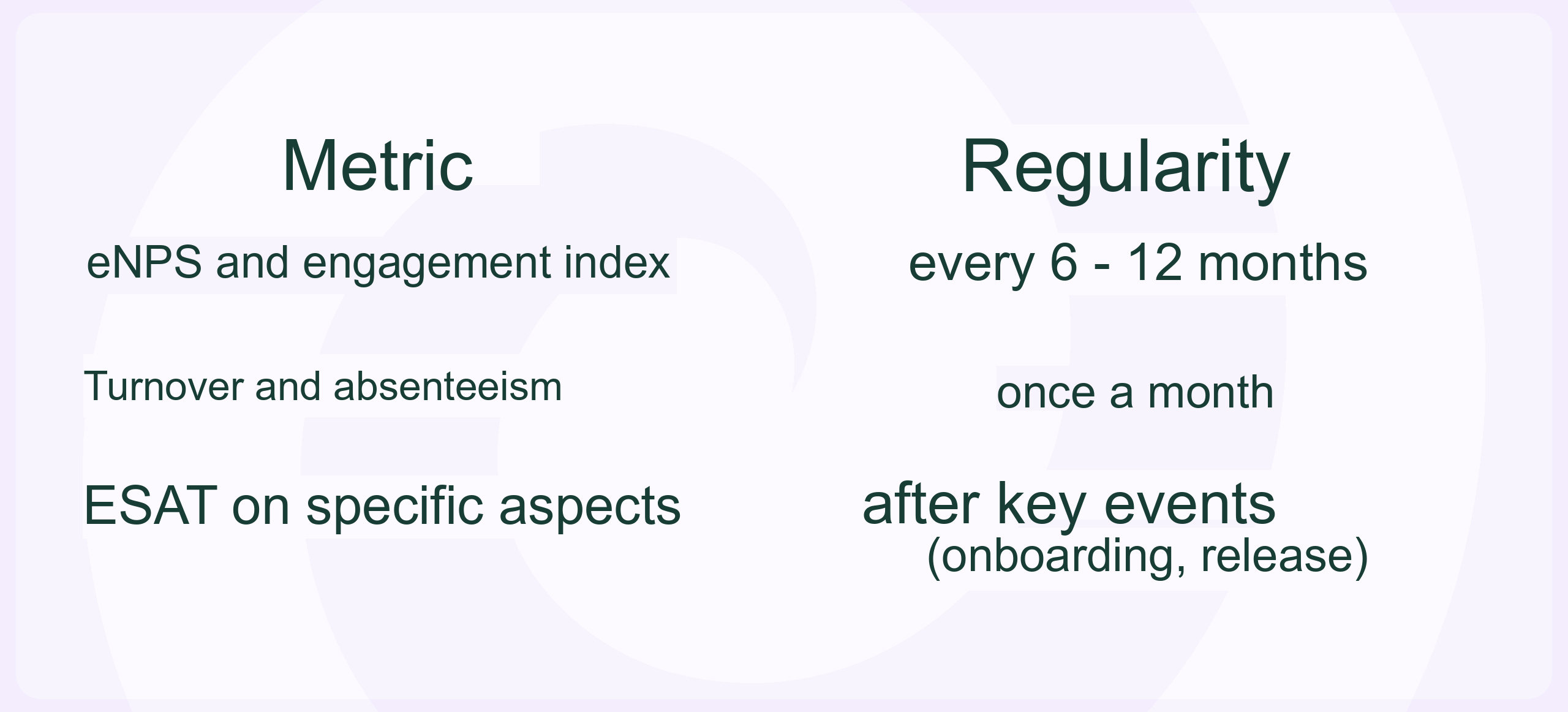
Important considerations:
Compare metrics across departments, levels, and tenure groups.
Remember: a one-time decline is not always critical, but consistent deterioration requires action.
Case study: how an IT company reduced turnover by 40% in one year through systematic engagement measurement
Context:
A Russian IT company developing SaaS solutions for retail had 280 employees. In 2023, it experienced a sharp increase in turnover:
- turnover rose from 8% to 18% in 6 months;
- five senior engineers left the development team;
- eNPS fell from +42 to +15 in one year.
Problem: management did not understand the reasons: salaries were competitive, and the benefits package included private medical insurance and stock options.
Solution:
Step 1. Diagnosis.
The company conducted an anonymous survey covering five areas:
- Satisfaction with working conditions.
- Recognition and feedback.
- Growth opportunities.
- Corporate culture.
- Work-life balance.
Key findings:
- 68% of developers reported a lack of a clear career path;
- 52% complained about unpredictable crunch periods before releases;
- 44% felt that their ideas did not reach management;
- only 29% were satisfied with the frequency of manager feedback.
Step 2. Prioritizing problems.
A workshop with senior managers identified three critical areas:
- Career development.
- Workload management.
- Feedback channel.
Step 3. Implementing solutions.
- Grade and personalized career path system. The company introduced a transparent competency matrix for every role, created an individual development plan for each employee, and launched a mentorship program (senior → middle).
- Process optimization. Managers introduced quarterly quiet weeks with no new feature launches, urgent tasks, or deadlines; divided the release cycle into stages with clear deadlines; and adopted a no-meeting Friday rule.
- Feedback culture. The company launched monthly open sessions with the CEO, created a Slack channel for suggestions with a guaranteed response within 48 hours, and introduced the three strengths and one growth area feedback format in reviews.
Step 4. Monitoring change.
A follow-up measurement was conducted after 6 months:
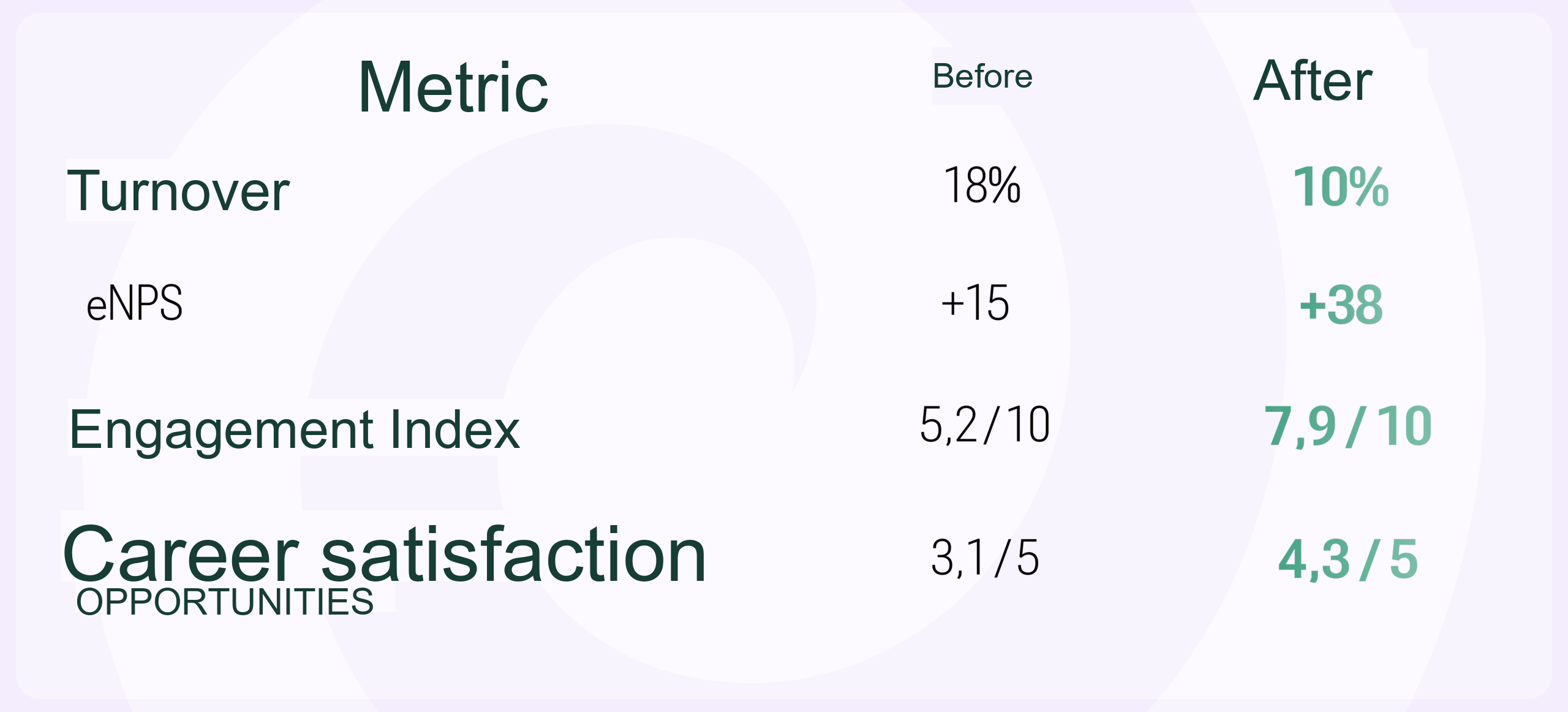
Additional outcomes:
- The number of employee initiatives increased by 70%.
- Time to fill vacancies fell from 60 to 35 days.
- Customer NPS rose from 62 to 74 due to improved code quality and product stability.
Key takeaways for HR:
- Surveys are not a goal, but a tool for action.
- Even in well-paid IT roles, people leave because of soft factors such as growth, recognition, and workload.
- Engagement should be measured regularly, every 6-12 months.
- It is important to close the feedback loop: survey → analysis → action → presentation of results.
Result: in 12 months, the company not only reduced turnover but also strengthened its employer brand, with incoming resumes increasing by 50%.
4 steps to high engagement: from theory to practice
Let us examine how to increase employee engagement systematically. Each stage includes practical tools for integration into day-to-day processes.
Corporate culture as the foundation
Engagement does not appear out of nowhere. It grows where:
- Employees understand the purpose of their work – not merely writing code, but transforming the retail market.
- The company creates a sense of ownership in the product by holding client demo days with developers and sharing user feedback with the team.
- There is psychological safety: people can propose ideas and make mistakes without fear of punishment. They also have room to experiment through time for personal projects, hackathons, and awards for ideas that did not work but generated insights.
- The company expresses appreciation through public recognition at team meetings, personalized bonuses, and peer-to-peer awards.
- The company’s values align with the professional’s personal principles.
When culture becomes fertile ground, engagement grows naturally and talent retention ceases to be a constant HR challenge.
Transparent communication: how to build open dialogue in an IT team
The Slack Future of Work study found that employees place a high value on transparency: 80% want to know more about how their organization’s leaders make decisions.
Key practices:
- Strategic meetings once a month with all employees to review results and discuss plans. This helps employees see the big picture and understand their role in it.
- Open project data: access to product metrics, a public task board with statuses, and discussion of the reasons behind decisions. This ensures people understand the purpose of their work.
- A culture of safe questions: encourage questions such as I do not understand why we are doing this or What if we tried another approach? and do not punish people for challenging ideas. Collective intelligence improves decision quality.
- Process documentation: internal guides for key scenarios such as how to deploy a release and how to request a budget, plus a knowledge base answering common questions. This helps new employees become productive faster and saves experienced employees from repeatedly explaining the same processes.
- Honesty in difficult situations. If a project is delayed, explain how it will affect the team. During layoffs or strategic changes, communicate directly rather than allowing rumors to spread. This preserves trust even during a crisis.
When the team understands the context, feels safe, and sees that its voice matters, engagement grows.
Professional development without a ladder: how to grow in IT
The traditional career ladder (junior → middle → senior → lead) does not meet the needs of professionals or the business. Many developers, analysts, and engineers want to develop without moving into management. How can a company create a growth system without vertical promotions?
Scenario 1. Horizontal specialization.
Features: a focus on mastery in a narrow field, such as database optimization, security, or ML.
KPIs: complexity of tasks solved, number of cases resolved, and expertise within the community.
Incentives: a higher grade without management responsibilities and involvement in key architectural decisions.
Scenario 2. Cross-functional development.
Features: mastering adjacent roles (developer → DevOps → technical writer).
KPIs: interdisciplinary projects, such as integrating AI into legacy systems.
Incentives: a broader range of tasks, rotation between teams, and bonuses for multiple skill sets.
Scenario 3. Mentorship and knowledge transfer.
Features: mentoring junior employees, creating internal training, and reviewing code.
KPIs: speed of new-hire onboarding, review quality, and number of sessions delivered.
Incentives: recognition, compensation for training others, and the opportunity to build a personal school of expertise.
Scenario 4. Innovation and R&D.
Features: working on experimental projects, such as testing new frameworks.
KPIs: participation in hackathons and publication of research.
Incentives: 20% of working time for personal projects and access to premium resources such as courses and conferences.
Scenario 5. Greater influence on the product.
Features: the authority to propose and implement architectural improvements and ownership of key modules with substantial responsibility.
KPIs: impact on product metrics such as speed, stability, and conversion.
Incentives: a sense of ownership and responsibility, professional challenges, and visible results.
Development without a ladder is not the rejection of growth, but an expansion of its forms. In this system, employees remain with the company even if they do not want to become managers, while the business retains key experts.
Regular feedback that works
For feedback to be useful, it needs a system rather than spontaneous conversations driven by mood.
Feedback formats in IT and beyond:
- One-to-one (1-1 meetings) every 1-2 weeks: these meetings should not become status reports; above all, they are a dialogue with the employee.
- Sprint retrospectives every 1-4 weeks: analyze processes, not personalities.
- Performance Review every 6-12 months: assess progress, adjust goals, and discuss compensation.
- Peer feedback (colleague → colleague) on request or after key project milestones: provides an outside perspective and improves collaboration.
- Anonymous surveys every 3-6 months: identify systemic issues such as burnout, conflict, and process gaps.
When every team member knows they will be heard, understood, and supported in their growth, engagement becomes sustainable and turnover declines.
Engagement as a strategy: from tactics to systematic work
For employee engagement to deliver long-term results, it requires a systematic approach: not box-ticking activities, but integration into business processes.
Key elements of an engagement strategy:
- Vision and goals : define why the company needs engagement, for example, to reduce turnover by 30% in one year or increase customer NPS to 70, and connect these goals to the business strategy, such as building stable teams to enter a new market.
- Measurement and analytics : conduct surveys every 6-12 months, focusing on eNPS, the engagement index, and satisfaction with career opportunities.
- Processes : assess alignment with company values during hiring, immerse new hires in the culture during onboarding, create a development system with transparent grades, individual development plans, and internal rotations, show appreciation, and collect and act on feedback.
- The role of leaders : train managers in coaching and feedback skills.
Instead of a conclusion: 3 actions you can take today
Improving engagement does not require large budgets or lengthy approvals. Start with these three steps:
Step 1. Take a quick snapshot of employee sentiment. Launch a short anonymous survey and collect data within 1-3 days.
Questions:
«What do you like most about your work right now?
What prevents you from working more effectively?
What do you need to work comfortably?
Is there an idea you would like to propose?
On a scale from 1 to 10, how supported do you feel by the team?
How to use the results:
- identify the three most common problems;
- discuss them with the team at the next meeting;
- select one simple initiative to address one of the problems.
Step 2. Schedule the first 1-1 meeting with every employee. This will help establish a personal connection and understand individual needs.
Conversation outline:
- What went well over the past week?
- What challenges did you encounter?
- What would you like to change / improve?
- Which skills would you like to develop over the next three months?
- Is there anything we did not have time to discuss in team meetings?
What to do afterward: schedule and fulfill the commitment made to the employee, for example, We will review this tool next week.
Step 3. Launch a mini recognition system. This will build the habit of noticing and valuing everyone’s contribution.
Ideas to consider:
- Introduce a weekly tradition: at Friday’s team meeting, everyone names one achievement by a colleague, for example, Ivan helped me understand the API this week. Thank you!
- Create a recognition chat where employees can post messages at any time.
- Personally send 1-2 individualized thank-you messages each week by email or chat.
What to do next:
- Analyze the feedback: what worked and what needs adjustment.
- Select the next 1-2 initiatives, such as developing an individual development plan or piloting task rotation.
- Embed successful practices into regular processes.
Most importantly: start small, but start today. Engagement grows where there is momentum, even when it is modest but consistent.